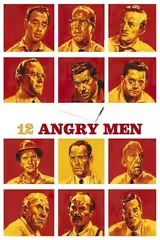
The reviews lean strongly positive, and the praise gathers around what Sidney Lumet does with a single room. Critics return to the staging, the close-ups and long takes that stop twelve men in one set from going static, and to the economy with which the script sketches jurors who mostly go unnamed. Henry Fonda’s quiet holdout and Lee J. Cobb’s belligerent opposite are the performances most often singled out, with the wider ensemble close behind.
The reservations concern the material more than its handling. Time Out finds the story contrived, and the Los Angeles Times treats the film as a relic, its all-white, all-male jury and tidy view of justice belonging to another age. The Telegraph goes furthest, arguing it leans too readily on liberal guilt and reduces its jurors to types, though it still admires the acting and construction. Variety notes some repetition in motives. The spread is narrow: one mixed verdict against thirteen approving ones.
R
Radio Times
★★★★★ · Tony Sloman
100
The critic calls it a marvellous movie and instant classic that has become part of life's currency, praising Fonda's integrity and Lumet's masterly direction for finding infinite visual variety within a single claustrophobic jury room set. Few films can genuinely be called brilliant, but this is certainly one of them.
Read the full review →T
The Times
12 May 2017 · ★★★★★ · Kate Muir
100
There is no more perfect chamber piece than this tense, smart and devastatingly revealing courtroom drama. The genius lies in establishing the mostly unnamed characters one by one with economical use of words and reactions.
Read the full review →E
Empire
1 January 2000 · William Thomas
90*
Sidney Lumet's debut is a masterclass in acting and direction, with Henry Fonda gradually swaying the other jurors through reasonable doubt. It stands out for its powerful dialogue, finely etched characters and beautifully worked plot despite the one-room setting.
Read the full review →R
RogerEbert.com
29 September 2002 · Roger Ebert
90*
The film is a masterful examination of reasonable doubt and the jury system, unfolding almost entirely in one claustrophobic room as twelve men debate a murder case. Ebert praises Lumet's direction, the ensemble cast, and the way tension builds through dialogue, personality clashes, and visual choices that heighten claustrophobia.
Read the full review →S
Slant Magazine
1 December 2011 · Glenn Heath Jr.
90*
The review celebrates Lumet’s debut as a dynamic, thematically rich courtroom drama that turns a confined jury room into a compelling arena for exploring prejudice and justice. It singles out the director’s fluid long takes and close-ups for revealing character motivations and shifting group dynamics.
Read the full review →A
The AV Club
26 March 2008 · A- · Noel Murray
90
The critic praises Lumet's dynamic staging and emphasis on faces and confined space in this single-room jury drama. It notes how the script and performances reveal how jurors' personal biases shape their view of the evidence, without the film declaring a definitive truth.
Read the full review →H
The Hollywood Reporter
13 April 2011 · Kirk Honeycutt
90*
The critic describes it as a truly great film, Lumet's first, about 12 male jurors battling in a claustrophobic jury room, with standout performances especially from Henry Fonda and Lee J. Cobb.
Read the full review →The critic notes the film's contrived story but praises the tense, lucid, and economical treatment, along with strong performances, especially from Fonda, Cobb, Marshall and Begley. The consistently taut, sweltering atmosphere created by the camerawork transforms it into a strangely realistic thriller.
Read the full review →L
Los Angeles Times
2 March 2008 · Dennis Lim
75*
The critic views the film as a relic due to its idealized justice system and all-white male jury but praises it as one of Hollywood's more entertaining civics lessons and a lucid demonstration of the deliberative process. He singles out Lumet's economical direction that exploits the pressure-cooker atmosphere of the jury room.
Read the full review →N
The New Yorker
20 April 1957 · John McCarten
75*
The film turns a jury deliberation into an engaging drama that reveals the characters' motivations and prejudices as they shift from near-unanimous conviction toward doubt. McCarten notes Lumet's skillful handling of the confined space and commends the strong performances, especially by Fonda, Cobb, and others.
Read the full review →V
Variety
31 December 1956 · Variety Staff
70*
The story emphasizes the responsibility of jurors and the concept of reasonable doubt as eleven men quickly vote guilty and one holdout forces reconsideration. The review highlights Lumet's effective direction in the single-room setting and states that the film leaves a tremendous impact despite some repetition in motivations.
Read the full review →T
The Telegraph
25 March 2023 · Simon Heffer
60*
The film is recognised as a masterpiece and a distinguished start to Lumet's career, stunningly well acted and cleverly constructed. It relies too easily on the liberal idea of white, middle-class, patriarchal guilt, with characters reduced to caricatures.
Read the full review →E
Eye for Film
29 May 2017 · Amber Wilkinson
90*
The review highlights the film's status as a jury room classic with strong performances and themes of prejudice. It praises the Criterion Blu-ray's restoration and extras, including the original teleplay, for enhancing appreciation of Lumet's debut.
Read the full review →The piece calls Lumet's debut a gripping, brilliant human drama that sets out his recurring themes of guilt, innocence, prejudice and the justice system. It praises the masterful performances, taut screenwriting and positive, earned conclusions about ideals and decency.
Read the full review →Ordered by the weight we give each publication, then by score. Scores are normalised to 100; * means inferred from an unrated review. Summaries are ours, not quotations; follow the links for the reviews themselves. How we rate