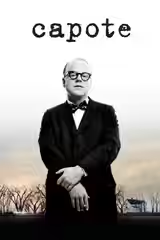
Almost every critic puts Philip Seymour Hoffman first. The reviews agree that his Capote, the voice, the gestures, the appetite for attention, carries the film, and several think it the reason the film works at all. Beyond the performance, the praise settles on subject rather than style: most critics read it as a study of a writer whose great book costs him his self-respect, and they credit Bennett Miller’s controlled direction and Dan Futterman’s script with keeping that moral question in view without lecturing.
Where they part is on how much the film understands its subject. Several reviews, the British ones especially, find Capote drawn as a literary vampire and admire the portrait while doubting it goes anywhere new. Slant Magazine goes further, calling the film a brisk character assassination that lists his ruthless acts without any insight into his talent as a writer. That is the only outright dissent; the rest of the spread is narrow, running from warm to very warm.
E
Empire
27 January 2006 · Kim Newman
90*
The critic calls the film outstanding and praises its focus on the creation of In Cold Blood as a work of art. Hoffman’s performance as Capote is highlighted as miraculously well-cast and central to the film’s success.
The film is a guilt-edged triumph driven by Philip Seymour Hoffman's precise and compelling performance as Truman Capote, which brings the eccentric writer vividly to life. The critic singles out Hoffman's skill in portraying the character's odd glory and ambition while noting the film's controlled direction and exploration of contrasting Americas.
The film is a powerful study of a writer whose great achievement requires the surrender of his self-respect. It focuses on the moral conflict at the heart of Capote's work on In Cold Blood and the precise, uncanny performance of Philip Seymour Hoffman.
Hoffman delivers a galvanising, awards-worthy embodiment of Capote at his peak; Miller achieves a tender, macabre view of the parasitic artist-subject connection in his debut feature.
Bennett Miller's thriller is a perfectly crafted study of a moral bankrupt, with Hoffman delivering a magical, uncanny performance as the repellent yet compelling Capote.
The mesmerizing performance of Philip Seymour Hoffman dominates every scene in this unsettlingly intimate account of Capote's obsessive research. Director Bennett Miller and screenwriter Dan Futterman's penetrating study enthralls in every aspect, tracing the double edge of literary achievement and its shattering personal cost.
The critic views the film as a classic American tragedy that captures the true story of Capote's obsession with In Cold Blood. It highlights the compelling performances and the ethical dilemmas at the heart of the narrative.
The film is the most intelligent and absorbing ever made about a writer’s working method and character. Hoffman’s performance as Capote is a standout, capturing the mix of strength, guile, malice, and mendacity.
The critic sees the film as a cautionary tale about narcissism poisoning relationships and ethics in journalism, highlighting Hoffman's haunting portrayal of Capote's self-infatuation and its human cost. It praises the strong performances and pathos in the story of exploitation and lost humanity.
The film casts Capote as a vampiric opportunist whose project undoes him rather than as its hero. Hoffman's performance, especially the voice, is praised as Oscar-worthy and deepening throughout.
The film portrays Capote as a ruthlessly ambitious literary vampire who exploits those around him for his book In Cold Blood. Hoffman's performance as the unsympathetic, self-obsessed writer is brilliantly accurate and magnetic.
Bennett Miller's film is a fascinating reconstruction of the period when Capote pursued literary glory while flirting with moral ruin. It is principally the story of a writer's vexed relationship with his work and himself, with Philip Seymour Hoffman's performance connecting with the audience despite the character's narcissism.
Hoffman gives one of the decade's best performances in a film that reads the story as Capote's self-damning exercise of ego. The early fish-out-of-water comedy gives way to a harrowing portrait of narcissism and horror.
The critic finds the film a brisk, well-made character assassination of Capote that lists his ruthless acts without sympathy or insight into his writing talent. It praises Philip Seymour Hoffman's intense performance as the manipulative writer but notes the film's narrow, one-sided focus.
The critic praises the biopic as well-paced and superbly acted, highlighting Philip Seymour Hoffman's excellent depiction of Capote's complexity, effeminacy, and manipulative side. The film is noted for showing the writer's self-centered use of the murderers' story for his career, though it remains moving in its recognition of his failings.
The critic finds the film a dark, absorbing study of Capote's narcissism and the moral costs of his journalistic methods. It singles out the performances, especially Hoffman's nuanced portrayal of a man who gains a voice at the expense of his soul.
The review praises the film as an unflinching character study of Truman Capote as a talented but selfish manipulator whose pursuit of his book destroys him. It singles out the bleak, desaturated visual style and Philip Seymour Hoffman's immersive, Oscar-winning performance for particular praise.
Ordered by the weight we give each publication, then by score. Scores are normalised to 100; * means inferred from an unrated review. Summaries are ours, not quotations; follow the links for the reviews themselves. How we rate