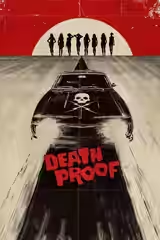
The reviews split almost down the middle, with slightly more negative than positive, and the praise lands in the same two places whatever the verdict. Nearly everyone singles out the climactic car chase, shot with real stunts and no digital help, and Kurt Russell’s turn as Stuntman Mike; Zoë Bell’s stunt work draws its own admirers. The warmest notices, from the Los Angeles Times and Empire, treat the two-part structure as a bold joke on slasher conventions rather than a flaw.
The reservations cluster on the talk. Around half the critics find the long dialogue stretches padded and the second half repetitive, and Eye for Film calls the standalone cut Tarantino’s weakest film. The spread is wide, and it moves with time: Little White Lies reverses its own Cannes pan on revisiting, and later pieces from Collider and /Film argue the film has grown into a cult favourite. The Guardian stays unpersuaded, finding the seventies styling tedious.
E
Empire
31 August 2007 · Damon Wise
90*
The review praises Death Proof as a smart, entertaining grindhouse homage that plays with slasher and car-chase conventions while delivering a subversive twist and a thrilling finale. It highlights Kurt Russell's performance and the standout car chase as key strengths in an authentic, old-school Tarantino effort.
Read the full review →L
Los Angeles Times
6 April 2007 · Dennis Lim
90*
The critic finds Tarantino’s “Death Proof” exhilarating and structurally bold, splitting the story into two segments with opposite outcomes for groups of women facing Stuntman Mike. It praises the film’s surprising turns, poetic trash talk, unerring soundtrack, and the visceral, CGI-free climactic car chase as one of Tarantino’s most original works since “Pulp Fiction.”
Read the full review →L
Little White Lies
25 August 2015 · David Jenkins
85*
The critic, who initially panned the film at its Cannes premiere, now regards it as Tarantino's most radical, poetic, and finest work of the century. They single out its poignant humanization of archetypal characters and its exploration of duality, repetition, and vulnerability beneath the grindhouse surface.
Read the full review →N
The New York Times
6 April 2007 · A.O. Scott
75*
The critic views Death Proof as a decidedly modest picture whose scaled-down ambition is part of its appeal, consisting of long stretches of talk interrupted by kinetic bouts of automotive mayhem. He praises its sincere tribute to Monte Hellman and the way it strips away quotation marks to find a route back to the basics of character, action and story.
Read the full review →H
The Hollywood Reporter
23 May 2007 · festival review · Kirk Honeycutt
70*
The critic views the standalone version positively as fitting Tarantino's oeuvre, noting its artistic chances, post-modern rethinking of pulp fiction, and how it sneaks philosophical depth into sex talk and car stunts despite rudimentary motives. The Cannes screening is seen as interesting though out of place in competition.
Read the full review →V
Variety
1 April 2007 · Todd McCarthy
70*
Tarantino’s “Death Proof” stands out for its great dialogue and electric performances rather than genre play, with vibrant bonding and camaraderie among two sets of young women. The critic highlights the mesmerizing girl talk, poetic trash talk, real stunts in the chase sequence, and strong turns from the cast including Kurt Russell and Zoë Bell.
Read the full review →R
RogerEbert.com
25 October 2007 · Roger Ebert
65*
Tarantino's half of the Grindhouse double bill is the stronger one, with skillful car-chase sequences and a satisfying finale despite overly long dialogue scenes. The critic singles out the highway duel and Kurt Russell's performance as highlights in an otherwise minor work.
Read the full review →N
The New Yorker
9 April 2007 · David Denby
65*
The critic notes that Death Proof isn’t as flagrantly imitative as its companion film and praises the intimate, detailed, funny talk among the characters as well as the exciting real-space car chase in the second half. He finds Tarantino caught in contradictions between humanism and nihilism in the service of schlock homage.
Read the full review →T
The Telegraph
26 April 2008
60*
Death Proof is enjoyable if a little patchy as a standalone film. The car chases and crashes are highlights, along with Kurt Russell's performance, but it does not stand up well against Tarantino's earlier work.
Read the full review →T
Time Out
17 September 2007 · ★★★ · Ben Walters
60
The review sees the film as a fan-boy indulgence with a double structure that stretches thin material, full of Tarantino-speak and quotation marks. It singles out the climactic car chase as a bona fide old-school tour de force and notes smart attention to tensions between old and new technologies.
Read the full review →I
The Independent
20 September 2007
50*
The review finds the film a solid but ultimately disappointing killer-on-the-road thriller that mimics 1970s exploitation style with Tarantino's dialogue and references. It singles out the energetic car chase finale for praise while noting the overall reproduction feels like a step down from the director's best work.
Read the full review →T
The Times
22 September 2007 · Kevin Maher
50*
The standalone release of Death Proof is uneven and will mainly please dedicated Tarantino fans. The first half builds effective tension as a homage to 1970s exploitation cinema, but the second half suffers from weak chemistry and an uninspired finale.
Read the full review →This stylistically authentic but overly talky tribute to 1970s exploitation cinema fuses slasher and chase genres with mixed success. The critic singles out the extensive stretches of dialogue that slow the pace and emphasize the second group of actresses.
Read the full review →G
The Guardian
21 September 2007 · Peter Bradshaw
40*
Tarantino's standalone cut of his Grindhouse segment is a bit of a failure, padded with long stretches of inconsequential dialogue that fail to match his earlier work. The extravagant head-on collision scene offers a lethal roar of entertainment, but the studied 70s stylings and offensive tone are ultimately tedious.
Read the full review →E
Evening Standard
10 April 2012
30*
The review dismisses the film as a depressing waste of talent, with clunky dialogue, lack of flair, and pointless grindhouse affectations that fail to capture the spirit of the originals. It grudgingly notes the car chases are competent but concludes the film has nothing new or worthwhile to say.
Read the full review →S
Screen Daily
22 May 2007 · festival review
30*
The extended Cannes cut is a pointless, overly referential genre exercise that fails to cohere as a slasher, chick-flick, or stunt film. The critic singles out the dull, talky passages and lack of narrative drive despite strong stunt work and Kurt Russell's performance.
Read the full review →S
Sight and Sound
· Tony Rayns
30*
The critic finds the solo release version bloated and conceptually confused, far from authentic grindhouse fare despite its retro trappings. He singles out the protracted car chase in the second half as intermittently exciting but notes the overall lack of dramatic traction and memorable dialogue.
Read the full review →S
Slant Magazine
31 March 2007 · Jeremiah Kipp
30*
The critic finds Tarantino's segment more homage than reinvention, with strong performances from Kurt Russell but paper-thin characters and dialogue that make the revenge plot feel disaffected and campy rather than engaging. The self-referential style is seen as more offensive than the original grindhouse films it emulates.
Read the full review →C
Collider
30 April 2022 · Lisa Laman
90*
The critic calls Death Proof one of Tarantino's finest features, praising its subversive slow-burn thriller structure in the first half, the audacious shift to a new cast, Kurt Russell's eerie performance, and the gender-role reversal in the finale with its gruesome yet satisfying payoff. They single out the lively leads (including Zoë Bell and Rosario Dawson) and the film's effective riff on slasher/exploitation tropes.
Read the full review →/
/Film
11 May 2022 · Mike Shutt
90*
The critic highlights how Death Proof has gained appreciation as a cult classic since its separate home video release, praising its stunt work, tension-building, and character focus as proof that even minor Tarantino surpasses most directors' best efforts. They single out Zoë Bell's fearless performance and the extended practical car chase for particular praise.
Read the full review →D
Digital Spy
18 September 2007 · Tony Delgado
40*
The film is a disappointing and uneven homage to 1970s exploitation cinema that elicits more boredom than thrills overall. The critic singles out Kurt Russell's performance and the thrilling final car chase for praise while criticizing the dull, irrelevant dialogue scenes.
Read the full review →S
The Skinny
16 August 2007 · ★★ · Iain Burnside
40
The film recycles Tarantino clichés with wilder whimsy but neither half satisfies, relying on viewer patience that often runs out before the climactic chase. Zoe Bell's stunt work provides the only real excitement amid sharp dialogue and choice songs, but the director has nothing new to say.
Read the full review →D
Den of Geek
21 September 2007 · 2 out of 5 · Sarah Dobbs
30*
The critic enjoyed the first half's setup, grainy grindhouse style, and snappy dialogue but found the second half lazy and repetitive, with pointless extended scenes that wasted all goodwill built earlier.
Read the full review →E
Eye for Film
5 September 2007 · festival review · Anton Bitel
30*
The critic finds the expanded UK release version of Death Proof overlong and padded with excessive dialogue that drags down the experience, calling it Tarantino's weakest film. The solid premise, visual style mimicking grindhouse aesthetics, and practical stunts are singled out as highlights amid the complaints about the writing.
Read the full review →Ordered by the weight we give each publication, then by score. Scores are normalised to 100; * means inferred from an unrated review. Summaries are ours, not quotations; follow the links for the reviews themselves. How we rate