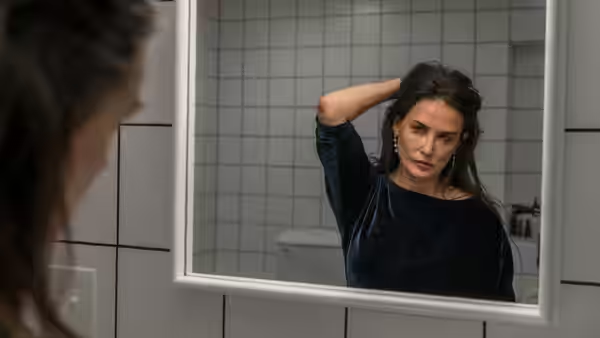
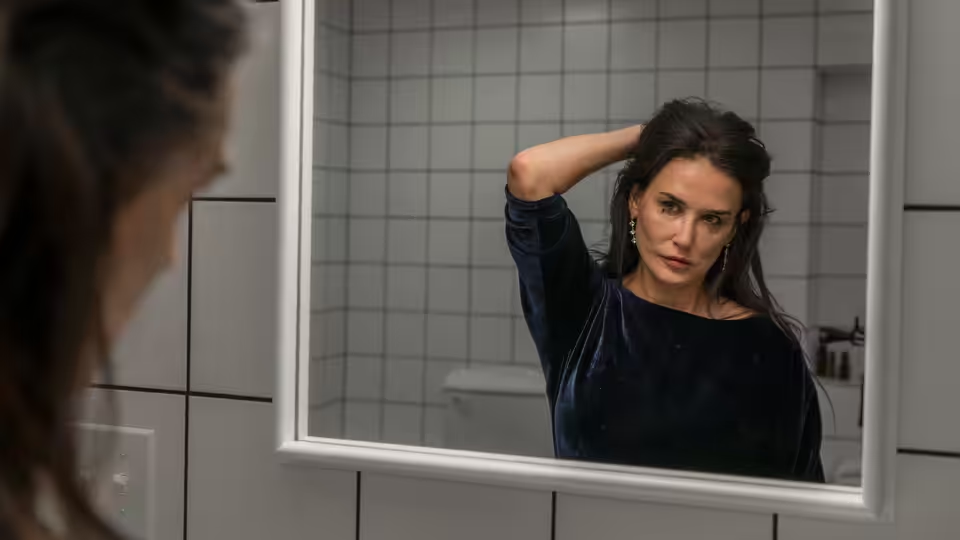
Elisabeth (Demi Moore) adjusting her hair while looking in a bathroom mirror
Film review

The Substance

2024 · Directed by Coralie Fargeat · 2h 21m · MPA R

In a sentenceDennis Quaid eating prawns is the most frightening thing in it, and the competition is stiff

Elisabeth (Demi Moore) has hosted a television aerobics show for years. On her fiftieth birthday the producer, Harvey (Dennis Quaid), decides to replace her, and she overhears him doing it. After a car accident, a nurse slips her a flash drive advertising the Substance, a black-market serum that promises a younger, better version of herself. The rules are strict: the two versions must alternate, one week each, and the balance must be respected. Elisabeth injects it, and Sue (Margaret Qualley) emerges. Coralie Fargeat writes and directs this body horror, released in UK cinemas on 20 September 2024 with an 18 certificate and running 141 minutes.

Plays from YouTube when you press play; nothing loads from them until then.

Fi1m review

Coralie Fargeat’s horror about a television star who splits herself into a younger model is loud, bright and superbly made, and Demi Moore is remarkable in it. It says one thing many times over 141 minutes. If you can stomach it, it is worth your evening.

Elisabeth (Demi Moore) has hosted a television aerobics show for years, and on her fiftieth birthday she loses it. She overhears Harvey (Dennis Quaid), the producer, saying so on the telephone in the gents, and the word “fifty” comes out of him like a diagnosis. There is a car accident, a hospital, and a nurse who slips a flash drive into her coat pocket. On it is an advertisement for the Substance, a serum that promises a younger, better version of you. The rules are simple: one week each, then switch, no exceptions. She injects it, and Sue (Margaret Qualley) climbs out of her back.

That is the film’s one idea, and Coralie Fargeat, who wrote and directed, spends 141 minutes saying it as loudly as she can. The result is a good horror film, superbly built, often funny and about twenty minutes too long. Moore is the reason to see it.

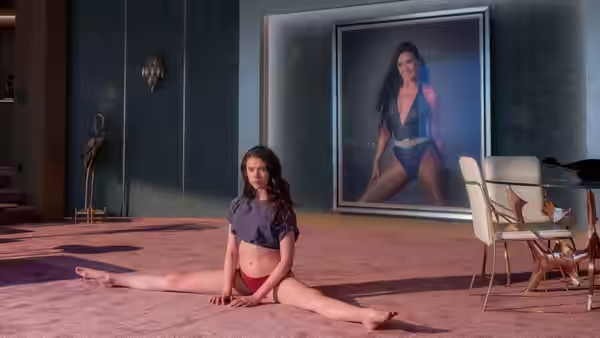
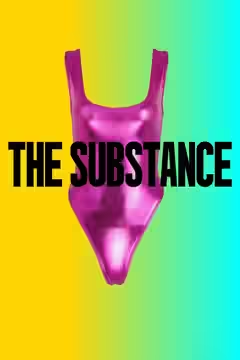
Fargeat’s previous film, Revenge (2017), used wide lenses and a great deal of blood, and The Substance uses more of both. Benjamin Kračun puts the camera so close to faces that pores become craters, and he lights Elisabeth’s flat in a hard afternoon white so that every line shows. Stanislas Reydellet gives that flat one enormous window facing a billboard, and the billboard has Elisabeth on it, and then it does not. Emmanuelle Youchnovski dresses Elisabeth in a yellow coat she wears like armour, and Sue in a pink leotard that fits like paint.

Quaid’s Harvey is the film’s cleanest target. There is a lunch scene early on where he eats prawns and talks about ratings, and Kračun shoots it from below with the lens a few inches from his mouth, so we can see the shells and hear them. We laughed, then felt slightly sick, then laughed at feeling sick. Harvey gets three or four more scenes and each is a variation on the lunch.

Moore’s best moment has no dialogue at all. Elisabeth is dressed for a date, and on her way out she catches sight of herself and goes back to the mirror. She adds lipstick, then wipes it away, then adds more, and keeps going until her face is smeared and the evening is gone. Raffertie’s score, which elsewhere pounds like a gym class, drops out, and Kračun holds still. It moved us more than we expected, because nothing pushed us: Moore does it with her hands and her breathing, and she is a star we have been looking at for forty years, in a film that knows we remember.

The trouble is repetition. The switch, with its needle, its stitching and its long split down the spine, is shown again and again, and the three editors, Jérôme Eltabet, Valentin Féron and Fargeat herself, cut each one to Raffertie’s electronics like an advertisement for the product. It is a joke the first twice. By the fifth time we were checking our watch. Qualley is asked to be a surface and is a persuasive one, but Sue has nothing to want except more of the same, and the leotard routines are filmed with the same lingering close-ups on thighs and lips that the film is supposed to be mocking.

The last half hour goes further than we thought a film with this certificate would go, and we will not describe it. We can say that the prosthetics are practical and extraordinary, that we were horrified in the way Fargeat meant us to be, and that the film stops arguing and starts throwing things. Set beside David Cronenberg’s The Fly (1986), the standard for this sort of thing, it has the same appetite for flesh and much less interest in the person inside it. Elisabeth has a flat, a show and a mirror, and no friends, books or history that we hear of, and so for two hours and twenty minutes we are watching a woman we are told about rather than one we know.

See it in a cinema if you can, with an audience, where the noise and the flinching are part of the evening. At home it becomes smaller and slightly silly. Do not eat first.

Critical consensus AI synthesised

77
Positive
11
Mixed
0
Negative
2

Most critics take to The Substance with relish, and the praise clusters in two places: Demi Moore, whose performance is called fearless in nearly every review, and the practical effects, which are found revolting in exactly the way intended. Margaret Qualley is regularly named alongside her. Many reviews also credit Fargeat’s editing and visual style, though several treat that style as both the film’s strength and its limit.

The reservations follow a pattern: a number of otherwise warm notices find the satire unsubtle, the plotting thin and the characters shallow, and a few wonder whether the camera’s extremes end up repeating the objectification the film attacks. The dissent is sharp rather than mild. Little White Lies calls it an ugly screed that blames women for the standards it critiques, Film Comment finds the metaphors tangled and the shocks reinforcing prejudice, and The Times dismisses it as sleaze dressed in feminist rhetoric. The spread is wide, but the weight sits firmly at the enthusiastic end.

Time Out
19 May 2024 · ★★★★★ · Phil de Semlyen
100

The critic hails it as a magnificent, wildly entertaining shocker and the birth of a new horror maestro, praising its extreme, disgusting, and thoughtful take on pressures on women along with strong performances.

Read the full review →
Evening Standard
19 September 2024 · Nick Howells
95*

The review hails the film as the best and maddest of the year so far, an instant classic that amps up Cronenberg-style gore into a delirious, entertaining blitzkrieg with brilliant, bold work from Moore.

Read the full review →
The Guardian
22 September 2024 · Wendy Ide
85*

The film offers a refreshing female perspective on the female body in horror, focusing on the emotional and physical turmoil of menopause rather than reproduction. Demi Moore delivers a fearless, exposed performance as the lead in this excessive, blood-soaked satire.

Read the full review →
Variety
19 May 2024 · Critics Pick · Owen Gleiberman
85*

The critic hails the film as a visionary, cathartically fun extreme feminist body-horror work with garish accessibility and primal vision, praising Fargeat's stylized aggro voice and fusion of influences into something original, along with Moore's fearless, rippled performance and Qualley's magnetic confidence. The grotesque climax and metaphors of cosmetic enhancement are singled out as resonant and ambitious.

Read the full review →
Empire
16 September 2024 · Laura Venning
80*

The critic finds Fargeat's follow-up a perversely enjoyable if unsubtle body horror that revels in grotesque excess and delivers gory mayhem to grimly funny effect. Moore's performance is highlighted as a gleeful middle finger to ageing gracefully.

Read the full review →
The i Paper
18 September 2024 · Christina Newland
80*

The critic praises this unsubtle, gross-out body horror as a glorious takedown of anti-ageing and beauty culture, with pleasurably disgusting effects that effectively satirise the pressures on women while escalating the horror to hysterical extremes.

Read the full review →

Straight answers AI written, from our review

Is The Substance worth watching?
The Substance is worth watching for anyone with a strong stomach and an interest in body horror, and we scored it 74. Demi Moore is the reason to see it, and the film is superbly built and often funny, but it says one thing many times over 141 minutes and repeats its central transformation until the joke wears thin. It plays best in a cinema with an audience.
How long is The Substance, and what is it rated?
The Substance runs 2h 21m and is rated R by the MPA in the US. It is a horror and science fiction film.
Where can I watch The Substance in the US?
The Substance is streaming on HBO Max, MUBI, Amazon Prime Video, Hulu, The Roku Channel and Apple TV in the US, and it is also available to rent from Amazon Prime Video and Apple TV from $5.99. It leaves HBO Max on 1 October. Availability is checked daily; the links above go straight to each service.
How violent or frightening is The Substance, and is it suitable for children?
The Substance is an 18 certificate body horror and is not suitable for children or younger teenagers. It contains needles, stitching, a long split down the spine shown repeatedly, a great deal of blood and prosthetic gore, and a last half hour that goes further than we expected a film with this certificate to go. The squeamish should not eat beforehand, or should give it a miss.
How does The Substance compare to Sunset Boulevard?
The Substance takes the faded star of Sunset Boulevard and makes her fear literal, with blood, needles and practical prosthetics where Billy Wilder used a mansion and a monologue. The older film is the sharper and more humane of the two, more interested in the person than the flesh. Fargeat's is louder and funnier in bursts, and the choice for anyone who wants their horror shown rather than implied.
What should I watch after The Substance?
After The Substance, try Sunset Boulevard (1950, Fi1m 91): The original faded star in a mansion, and still the sharpest about it. Then The Fly (1986, Fi1m 88): Body horror that remembers there is a person inside the body; and Death Becomes Her (1992, Fi1m 76): Two women, one youth potion, and the same joke played for laughs.

Cast

Awards

Academy Awards, 2025

Nominated
Best Makeup and Hairstyling
Nominated
Best Picture

Golden Globes, 2025

Won
Best Actor – Motion Picture Musical or Comedy

Best Screenplay Award, 2024

Won
Best Screenplay Award

European Film Award for Best Film, 2024

Nominated
European Film Award for Best Film

If you liked this, try…

  1. Sunset Boulevard (1950, Fi1m 91)The original faded star in a mansion, and still the sharpest about it.

  2. The Fly (1986, Fi1m 88)Body horror that remembers there is a person inside the body.

  3. Death Becomes Her (1992, Fi1m 76)Two women, one youth potion, and the same joke played for laughs.

  4. Titane (2021, Fi1m 74)French, metallic and merciless; Fargeat’s nearest neighbour in appetite.

  5. Revenge (2017) · not reviewed yetFargeat’s first film: wide lenses, a desert, and a great deal of blood.

Free account

Know what to watch tonight

Two lists that know where things are streaming, collections you can share, your own score beside ours, and Discover that remembers what you have seen.

  • Want to see, sorted by what is streaming now
  • Seen, with your score out of ten
  • No adverts, ever