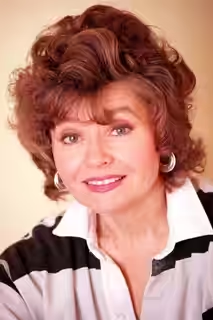
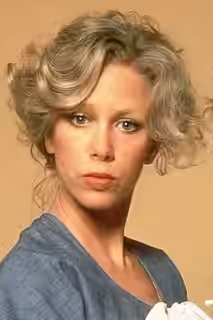
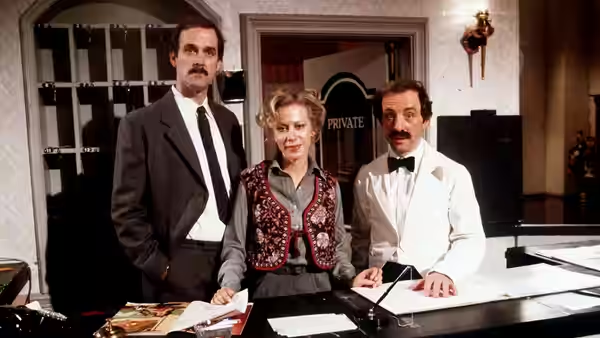
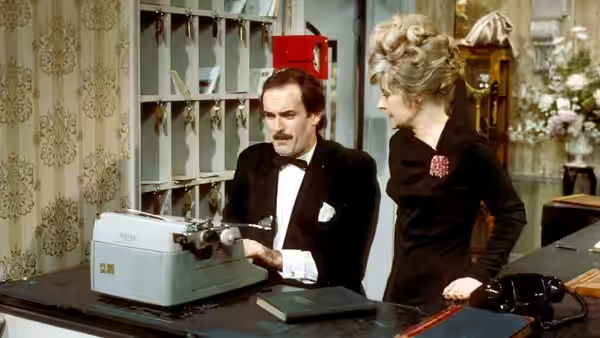
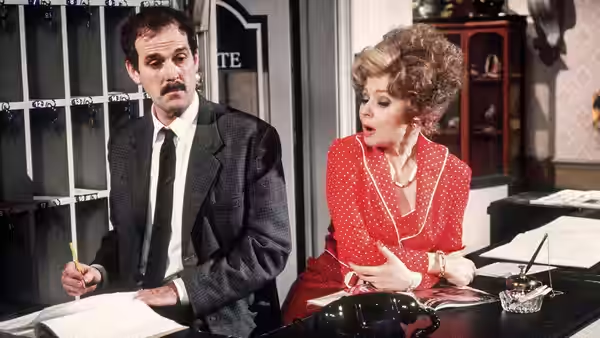
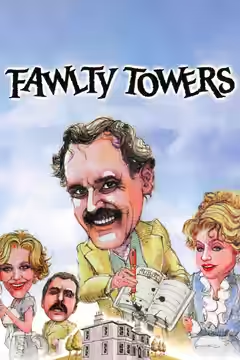
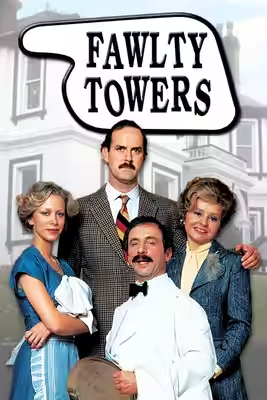
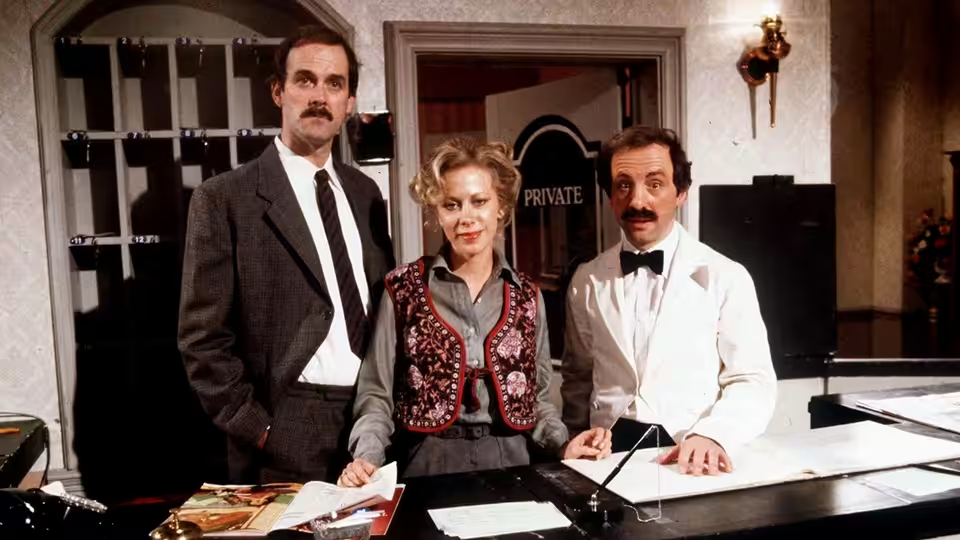
Basil Fawlty (John Cleese) and Sybil Fawlty (Prunella Scales) stand with a colleague at the reception desk
Series review

Fawlty Towers

1975 · Created by Connie Booth, John Cleese · Series · 30m · MPA TV-PG

In a sentenceA hotel where the proprietor needs more looking after than the guests

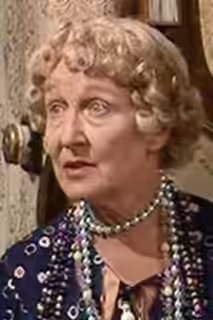
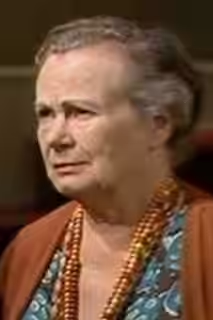
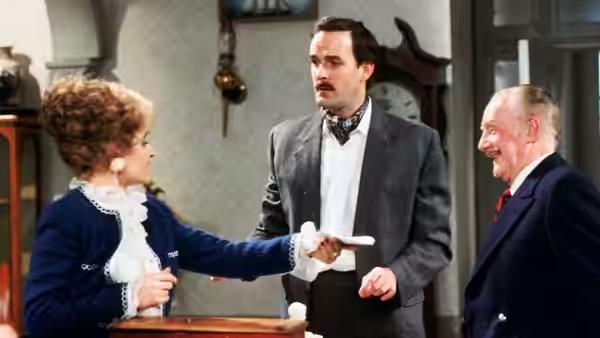
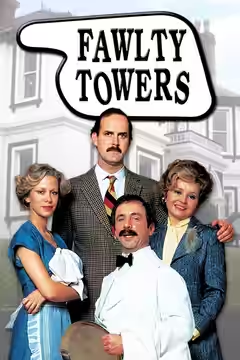
Basil Fawlty (John Cleese) runs a hotel, where dealing with other people is a daily source of frustration. Prunella Scales plays Sybil Fawlty, Connie Booth plays Polly Sherman and Andrew Sachs plays Manuel. Basil’s attempts to stay in charge bring him into conflict with the people around him. Ballard Berkeley appears as Major Gowen, with Gilly Flower as Miss Tibbs and Renee Roberts as Miss Gatsby. Written by Cleese and Booth, the comedy comprises two series of six half-hour episodes.

Fi1m review

Fawlty Towers remains an exceptionally funny comedy, written with care by John Cleese and Connie Booth. The supporting cast matches Cleese’s precision, though the treatment of Andrew Sachs’s Manuel sometimes makes us wish a joke had stopped earlier.

Fawlty Towers is a comedy about the difficulty of serving people when their mere presence annoys you. John Cleese and Connie Booth give Basil Fawlty a hotel to run and too little patience for anybody in it, then let him make each difficulty worse. We recommend it without needing to make allowances for its age: the writing is exact, the acting alert, and the laughs come from watching people struggle to keep up appearances. Its crueller jokes need rather more defending.

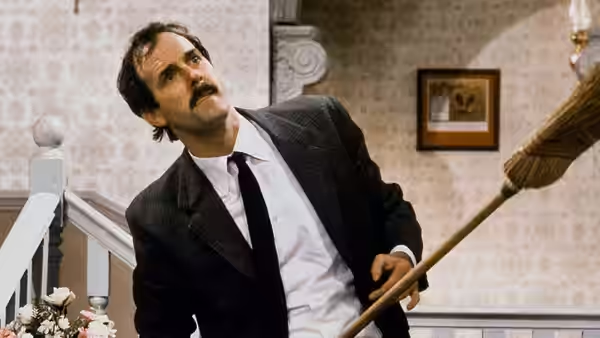
Cleese regulates how much anger Basil can show at any given moment. Watch how hard he works at holding himself upright, and how ridiculous that effort becomes when he loses his temper. We laughed at the stiffness before the outburst had even arrived. His attempt to retain a little dignity makes the waiting funny, and gives the eventual loss of control a force that shouting alone would not have.

Prunella Scales gives Sybil a steadiness that makes Cleese’s agitation funnier, without behaving as though she is waiting to deliver a rebuke. Her assurance can make Basil look beaten before he has finished speaking. Connie Booth’s Polly is alert to the practical problem beneath all the commotion, and Booth makes that attentiveness worth watching. Andrew Sachs is just as careful with Manuel’s physical timing. His eagerness gives us something more engaging than a succession of mistakes.

Directors John Howard Davies and Bob Spiers understand how much depends on keeping the other performers in play while Cleese commands attention. Their staging lets us follow a situation clearly enough to dread what Basil will do to it. Editors Susan Imrie, Bob Rymer and Bill Harris preserve the small waits that make a reaction funny. Nobody appears to be rushing towards a favourite punchline, and the supporting cast have time to let embarrassment or annoyance show.

Dennis Wilson’s music has a brisk politeness that suits the establishment Basil would like to think he runs. It is a useful introduction to a programme in which ordinary professional courtesy proves so difficult. By the standards of situation comedy, the writing asks for unusually little affection for its central character. Cleese and Booth trust that following Basil’s predicament will keep us watching even when we have stopped wishing him well.

The scripts are less sure when Manuel becomes an easy target. Sachs plays him with such care that the willingness to keep returning to Basil’s contempt can feel cheap, especially when we have already understood the joke. A few of these exchanges go on long enough for us to become irritated with the writers, who have left Sachs doing more work than the gag deserves.

There are twelve episodes across two series, each running about half an hour. Cleese can vary a hesitation, a movement or the force of a reply without our spending so long with Basil that we become tired of him. We would recommend the programme even to someone who thinks they have had enough of angry men on television. Leave time for a second episode.
Critical consensus AI synthesised

87
Positive
7
Mixed
0
Negative
0

The reviews are unanimous in their approval, and most of them say the same thing about why. John Cleese’s performance as the hotel proprietor is the centre of nearly every piece: the manic physical business, the timing, the way the scripts build a small grievance into total collapse. Several critics treat the twelve episodes as a benchmark for British sitcom writing, and the pieces written around the 50th anniversary argue that the cruelty and snobbery still play as sharply as they did on first broadcast.

Reservations are scarce and the spread is narrow. The one cooler notice, from The Times, comes from a critic who admits his enthusiasm lapsed for a while before a fresh viewing restored it, and even that piece ends on the show’s side. Two of the later reviews spend as much time on the reissued DVD commentaries as on the episodes. The Guardian was already calling it the comedy hit of the season in 1975, so the praise has held steady for half a century.

The AV Club
19 April 2002 · Tasha Robinson
90*

The critic praises the series as one of the high points of post-Python work and the British television industry's favorite sitcom, citing its sharp scripting, physical slapstick, and chaotic farcical energy built around John Cleese's performance.

Read the full review →
The Guardian
18 October 1975
90*

The critic calls Fawlty Towers the undoubted comedy hit of the season for its fresh mix of comic techniques. John Cleese's manic physical performance as the hotel proprietor stands out, supported by strong turns from the cast and precise direction.

Read the full review →
The i Paper
19 September 2025 · Alec Evans
90*

Marking the 50th anniversary, the writer ranks all 12 episodes from the two series, affirming the show’s status as a British institution and comedy benchmark while noting how even its lesser entries deliver memorable laughs and character work.

Read the full review →
The Telegraph
20 September 2025 · Sean Thomas
90*

The critic celebrates Fawlty Towers on its 50th anniversary as still the pinnacle of cruel British humour, highlighting its blend of snobbery, bullying and surreal chaos as essential national traits that make it enduringly funny and cathartic.

Read the full review →
Variety
12 October 2001 · Tim Gray
90*

The critic calls the series one of the funniest in TV history, averaging more laughs per minute than most sitcoms, and praises the DVD extras including interviews with Cleese and the directors' commentaries.

Read the full review →
The Times
19 October 2009 · Andrew Billen
70*

The TV critic re-examines the series decades later and finds it holds up despite initial 1975 critical dismissal, noting that a recent viewing restored his appreciation for Cleese’s performance and the show’s comic precision after a momentary lapse.

Read the full review →

Straight answers AI written, from our review

Is Fawlty Towers worth watching?
Fawlty Towers is worth watching for almost anyone who likes comedy, and we scored it 90. John Cleese and Connie Booth write with exactness, the supporting cast keeps pace, and the laughs come from watching people struggle to keep up appearances. Only the repeated jokes at Manuel's expense need defending, and they sometimes run on too long.
How long is Fawlty Towers, and what is it rated?
Fawlty Towers has episodes of about 30m and is rated TV-PG by the MPA in the US. It is a comedy series.
Where can I watch Fawlty Towers in the US?
Fawlty Towers is streaming on BritBox, Amazon Prime Video and The Roku Channel in the US. Availability is checked daily; the links above go straight to each service.
How violent or frightening is Fawlty Towers, and is it suitable for children?
Fawlty Towers carries a UK 12 certificate and contains no frightening material; its discomfort comes from Basil Fawlty's temper, not from violence. There is a good deal of shouting and some rough treatment of Manuel that older children may find funnier than adults do. Younger children are unlikely to be scared, but the certificate suggests the tone is pitched at teenagers and upwards.
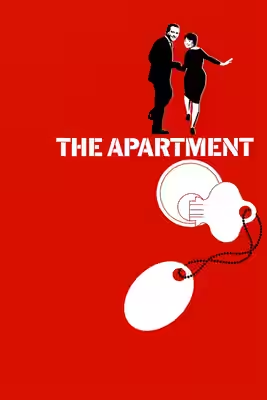
How does Fawlty Towers compare to The Apartment?
Fawlty Towers and The Apartment both find comedy in people forced to be polite to those they would rather not serve, but the resemblance ends there. Cleese's programme is a tightly built farce in half-hour bursts; Billy Wilder's film is a slower, sadder office romance with more sympathy for the people underneath. We think the sitcom the sharper of the two, and the film the more affecting.
What should I watch after Fawlty Towers?
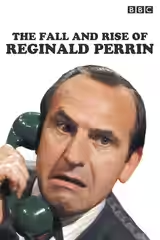
After Fawlty Towers, try The Fall and Rise of Reginald Perrin (1976, Fi1m 83): Another Englishman finds that maintaining respectable appearances becomes an exhausting occupation. Then Tampopo (1985, Fi1m 84): Restaurant work becomes a comedy of obsessive standards and unruly appetites; and The Apartment (1960, Fi1m 91): For more compromised hospitality, office grovelling and sympathy for the people underneath.

Cast

If you liked this, try…

  1. The Fall and Rise of Reginald Perrin (1976, Fi1m 83)Another Englishman finds that maintaining respectable appearances becomes an exhausting occupation.

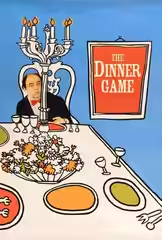
  2. The Dinner Game (1998) · not reviewed yetA smug host discovers how much damage one evening’s hospitality can cause.

  3. Tampopo (1985, Fi1m 84)Restaurant work becomes a comedy of obsessive standards and unruly appetites.

  4. The Apartment (1960, Fi1m 91)For more compromised hospitality, office grovelling and sympathy for the people underneath.

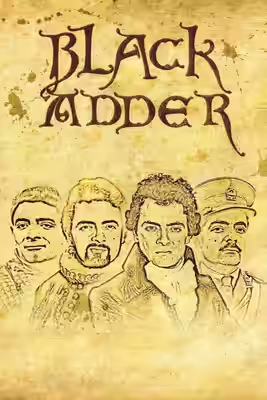
  5. Blackadder (1983, Fi1m 84)Another articulate bully keeps discovering the practical limits of his own cleverness.

Free account

Know what to watch tonight

Two lists that know where things are streaming, collections you can share, your own score beside ours, and Discover that remembers what you have seen.

  • Want to see, sorted by what is streaming now
  • Seen, with your score out of ten
  • No adverts, ever