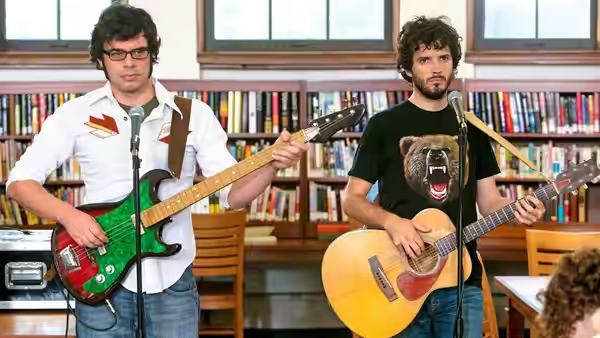
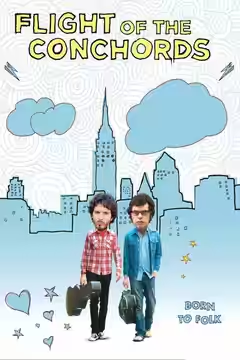
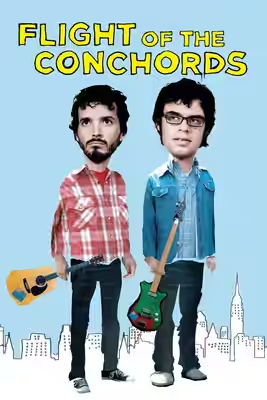
Bret McKenzie (Bret McKenzie) and Jemaine Clement (Jemaine Clement) playing guitars before bookshelves
Series review

Flight of the Conchords

2007 · Created by Jemaine Clement, Bret McKenzie, James Bobin · Series · 30m · MPA TV-MA

In a sentenceTwo New Zealand musicians take on New York, provided nobody expects them to hurry

Flight of the Conchords follows Bret McKenzie and Jemaine Clement as Bret and Jemaine, two New Zealand musicians trying to get somewhere in New York. The pair depend on each other as they struggle to establish themselves, with manager Murray Hewitt (Rhys Darby) alongside them. Everyday situations lead into songs, taking them through musical styles that have little in common with their circumstances. Their efforts as a band provide the continuing story between these musical departures. Kristen Schaal plays Mel, with Arj Barker as Dave, David Costabile as Doug and Frank Wood as Greg.

Fi1m review

Flight of the Conchords is a warmly funny musical comedy whose songs make its deadpan performers even funnier. Bret McKenzie and Jemaine Clement are worth the patience, though the ordinary plots sometimes leave rather too much waiting between numbers.

Flight of the Conchords is good company, especially when its two leads stop trying to get anywhere and start singing. Created by James Bobin, Bret McKenzie and Jemaine Clement, it follows struggling New Zealand musicians in New York whose dependence on each other is more convincing than their prospects. The comedy asks us to spend time with them at their own slow pace. For much of the series that is an easy invitation to accept, although the gaps between songs can test our patience.

McKenzie and Clement play Bret and Jemaine with an absence of strain that is harder to achieve than it looks. They leave us to notice the absurdity rather than announcing when it has arrived. Their co-dependence gives the quieter scenes something to work with, because neither looks likely to improve the other’s situation. Rhys Darby, as manager Murray Hewitt, offers welcome company without upsetting the low-key tone. We grew fond of the pair because their limitations are allowed to be funny without requiring us to despise them.

The music, credited to Clement, makes that restraint pay off. Everyday life gives way to songs drawn from widely different genres, and the change of scale is funny before the number has properly begun. We laughed when the everyday scenes tipped into song, because McKenzie and Clement’s unshowy performances make the musical fuss seem so unnecessary. The songs are accomplished enough to reward listening beyond the jokes, which matters when a programme asks us to stop following a story and hear one through.

Patrick Alexander Stewart’s cinematography keeps the non-musical comedy on the same quiet footing as the acting. Dan Butts and Christine Stocking’s production design also works best when it lets everyday life look unremarkable. That gives the songs something ordinary to interrupt. The visual restraint is welcome in a programme that could easily spend its entire half-hour signalling how peculiar it is.

Casey Brown’s editing is most persuasive when the comedy breaks into song; away from the music, the pace can become a problem. The plots are slight, and some stretches give the pair too little to do beyond being themselves. Bobin, McKenzie and Clement, who are also among the writers, sometimes seem too content to let a small comic idea occupy the available time. We enjoy their company, but that does not make every pause productive. This is where the half-hour format occasionally feels longer than it should.

Anyone who finds musical comedy exhausting may be surprised by how little these two demand that we join in. There is no sense of being bullied into cheerfulness, and the range of musical styles gives the programme room to keep changing. Its two series amount to 22 half-hour episodes, a manageable commitment for a comedy with such an unhurried manner. Give it one episode, and judge it after the singing starts.

Critical consensus AI synthesised

74
Positive
8
Mixed
0
Negative
1

Most critics like it a good deal, and the warmth is spread fairly evenly. The praise clusters on the tone: a low-key, deadpan style in which two New Zealand musicians drift through New York and songs break into ordinary conversation at odd moments. More than one review calls it the most charming or simply the best comedy on television at the time, and most single out the unshowy performances of the two leads and the manager, played by Rhys Darby, as its strongest assets. The musical parodies, ranging across a wide spread of genres, are admired almost everywhere.

The spread is narrow apart from one clear dissent. Variety finds the plots close to irrelevant and the episodes dragging whenever the music stops. Elsewhere the reservations are mild and concern the second series: Empire and Den of Geek both think some of the later songs are weaker than the first run, and The Independent notes that a slightly bigger budget costs it a little of its ramshackle feel, though all three still rate it well.

The AV Club
21 November 2007 · A · Nathan Rabin
95

The critic praises the show's redefinition of deadpan humor through the co-dependent New Zealand musicians and their manager, highlighting how music invades everyday life in surreal, incongruous ways.

Read the full review →
The Guardian
22 November 2007 · Peter Bradshaw
90*

The critic calls the HBO series the best comedy on TV, praising its low-key, quirky style and the natural, unshowy performances of its two leads as struggling New Zealand musicians in New York.

Read the full review →
The Telegraph
23 April 2009
90*

The piece highlights the cult HBO sitcom's rapid rise and calls it the most charming comedy on television, praising its sweet and whimsical mishaps over more cringeworthy modern sitcoms.

Read the full review →
Empire
29 July 2009 · William Thomas
70*

The reviewer expresses initial concern over the quality of new songs and episodes after the success of season 1, noting some forced moments early on. Later episodes improve markedly thanks to strong guest direction and inventive subplots, preserving the show's whimsical charm about two hapless musicians.

Read the full review →
The Independent
1 August 2009
70*

The DVD review describes the second series as a delightfully deadpan sitcom that is bolder and funnier than the first, despite a slightly bigger budget reducing some ramshackle charm, and singles out the manager character for praise.

Read the full review →
The Times
3 November 2007 · Ed Potton
70*

The review praises the sweet comedy series for its gauche chutzpah, inventive musical parodies and inviting world, noting influences from The Mighty Boosh, Peep Show and Curb Your Enthusiasm while highlighting its own distinctive appeal.

Read the full review →

Straight answers AI written, from our review

Is Flight of the Conchords worth watching?
Flight of the Conchords is worth watching for anyone who enjoys deadpan musical comedy and does not mind an unhurried pace, and we scored it 84. Bret McKenzie and Jemaine Clement are funny without strain, and the songs reward listening beyond the jokes. The slight plots leave some dull stretches between numbers, so give it one episode and judge it once the singing starts.
How long is Flight of the Conchords, and what is it rated?
Flight of the Conchords has episodes of about 30m and is rated TV-MA by the MPA in the US. It is a comedy series.
Where can I watch Flight of the Conchords in the US?
Flight of the Conchords is streaming on HBO Max, Amazon Prime Video, The Roku Channel and Hulu in the US, and it is also available to rent from Amazon Prime Video. Availability is checked daily; the links above go straight to each service.
How violent or frightening is Flight of the Conchords, and is it suitable for children?
Flight of the Conchords contains no violence or frightening material that we noted, but it carries a US TV-MA rating and has no UK certificate, so it is aimed at adults rather than children. The comedy is low-key and adult in tone rather than shocking. Older teenagers who like dry humour should be fine; younger children are unlikely to be interested.
How does Flight of the Conchords compare to This Is Spinal Tap?
Flight of the Conchords is a gentler, slower musical comedy than This Is Spinal Tap, and the earlier film is the tighter of the two. Both follow bands whose confidence outruns their circumstances, and both take real care over their songs. Spinal Tap suits almost anyone in a single sitting; the Conchords suit viewers happy to spend 22 half-hours with two men who are in no hurry.
What should I watch after Flight of the Conchords?
After Flight of the Conchords, try This Is Spinal Tap (1984, Fi1m 91): Another band whose confidence survives considerably more than its circumstances ought to allow. Then We Are Lady Parts (2021, Fi1m 80): For more musical comedy where the songs deserve attention beyond their jokes; and Detectorists (2014, Fi1m 87): Another patient comedy that lets apparently uneventful lives become worth caring about.

Cast

If you liked this, try…

  1. This Is Spinal Tap (1984, Fi1m 91)Another band whose confidence survives considerably more than its circumstances ought to allow.

  2. We Are Lady Parts (2021, Fi1m 80)For more musical comedy where the songs deserve attention beyond their jokes.

  3. Detectorists (2014, Fi1m 87)Another patient comedy that lets apparently uneventful lives become worth caring about.

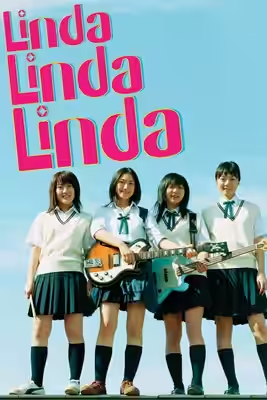
  4. Linda Linda Linda (2005) · not reviewed yetFor a different band’s hesitant progress, with room for friendship between rehearsals.

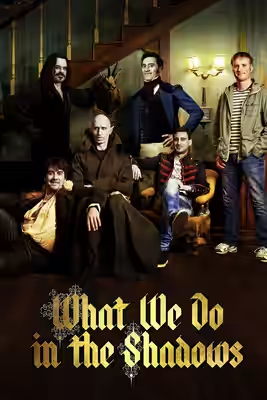
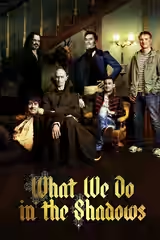
  5. What We Do in the Shadows (2014) · not reviewed yetDeadpan vampires make shared accommodation look almost as difficult as musical success.

Free account

Know what to watch tonight

Two lists that know where things are streaming, collections you can share, your own score beside ours, and Discover that remembers what you have seen.

  • Want to see, sorted by what is streaming now
  • Seen, with your score out of ten
  • No adverts, ever