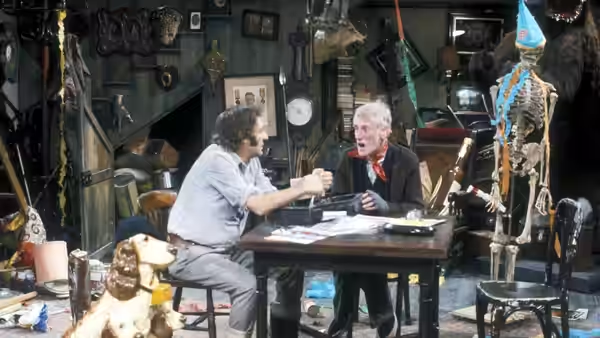
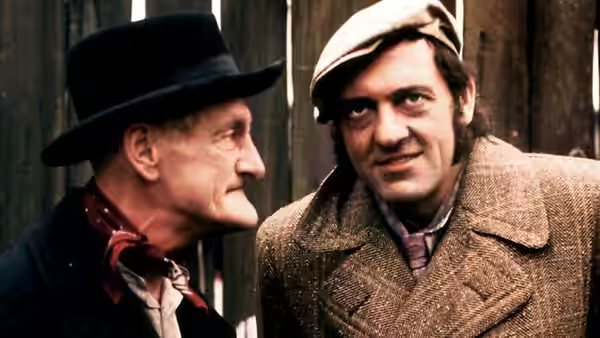
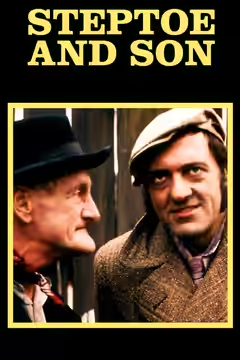
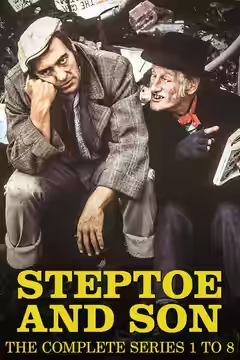
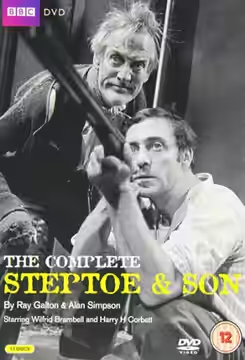
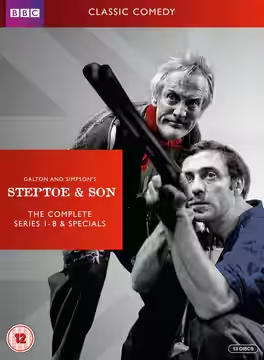
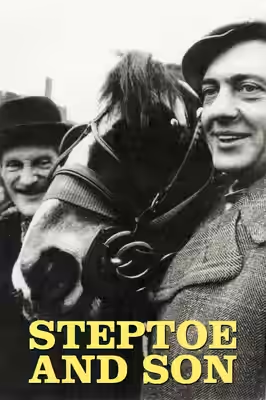
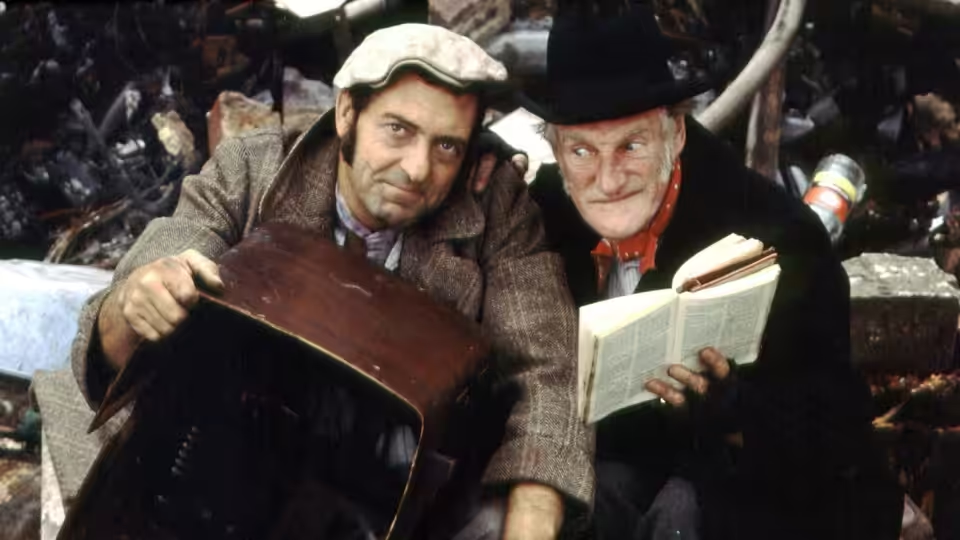
Harold (Harry H. Corbett) holds a case beside Albert (Wilfrid Brambell) with an open book
Series review

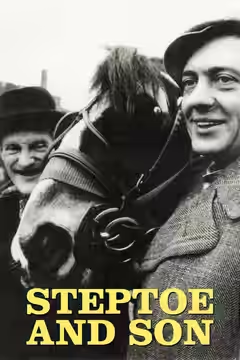
Steptoe and Son

1962 · Created by Ray Galton, Alan Simpson · Series · 30m · MPA NR

In a sentenceHarold Steptoe has ambitions; his father has objections and rather more practice

Harold Steptoe (Harry H. Corbett) wants his father, Albert Steptoe (Wilfrid Brambell), to take him seriously. Harold puts on airs; Albert gives him little encouragement. Each knows how to irritate the other, and neither is inclined to leave the other’s weaknesses alone. Their arguments turn on Harold’s pretensions and Albert’s readiness to undermine him, with each trying to get the better of the other. Frank Ferris (J.G. Devlin) is among those who appear alongside them, while father and son remain occupied with their quarrel.

Fi1m review

Harry H. Corbett and Wilfrid Brambell make this father-and-son comedy funny enough to hurt. We recommend it for their performances, with a warning that the repeated quarrelling can become wearing.

Steptoe and Son is a fine comedy about the unpleasant uses people find for knowing each other too well. Ray Galton and Alan Simpson give Harold and Albert enough reason to quarrel that neither needs to manufacture an offence. Their writing is funny, observant and sometimes difficult to sit through, although the repetition can wear us down. The important decision is to let a family disagreement remain ugly after it has supplied a laugh.

Harry H. Corbett makes Harold’s pretensions both irritating and understandable. Harold wants to be thought better than he is, and Corbett finds the embarrassment in having that wish noticed by the person least likely to indulge it. We can recognise the vanity without deciding that he deserves everything Albert gives him. A performance built only around wounded dignity would soon become exhausting; Corbett keeps Harold’s hunger for respect apparent even when he is being tiresome.

Wilfrid Brambell’s Albert is harder to feel sorry for, which contributes considerably to the discomfort. His pleasure in undermining Harold makes the father’s company increasingly oppressive. We laughed at Harold’s self-importance, then felt ashamed of how easily Albert had enlisted us against him. Brambell gives Albert enough relish to make us question why we were enjoying the exchange.

The directing credits include Duncan Wood and John Howard Davies, and the programme’s strength is its attention to the changing advantage between the performers. A quarrel needs enough time for an insult to register and for the person receiving it to recover. The editing, credited to Peter Pierce, Bob Rymer, Geoffrey Botterill and Howard Waters, feels responsive to that rhythm. The timing is good because the next joke does not always provide immediate relief.

The music credits include Dennis Wilson and Ron Grainer, though the accompaniment is less memorable than the friction in the voices. That is a reasonable priority for a comedy so dependent on the way these men address each other. At 30 minutes, an episode can make their company feel oppressive without requiring an entire evening of it. We would resist watching too many together.

The weakness is the repeated pressure on the same sore spots. Harold’s need to impress and Albert’s determination to spoil the attempt can make an exchange feel settled before it has properly begun. The writing sometimes asks us to stay with the hostility longer than its comic invention warrants. The performances keep it watchable, but the nastiness is less interesting when we can anticipate both the insult and the response.

Much domestic comedy reassures us that people who quarrel this often must love each other underneath. This series is unusually willing to let the unpleasantness stand, without asking us to find it endearing straight away. That makes it troubling, and it also means the programme can be poor company when we want uncomplicated warmth. We recommend it for the precision of the two performances, with a little space between episodes.

Critical consensus AI synthesised

1 of 6
Positive
1
Mixed
0
Negative
0
The Guardian
13 December 2011
80*

The critic praises the series as a diamond-hard comedy of manipulation and mutual disgust that deserves the same adoration as its peers like Dad's Army. They single out the central father-son war of attrition between the pretentious Harold and scraggly Albert, which builds into something powerful and disturbing.

Read the full review →

Straight answers AI written, from our review

Is Steptoe and Son worth watching?
Steptoe and Son is worth watching for anyone who likes their comedy uncomfortable, and we scored it 83. Harry H. Corbett and Wilfrid Brambell make the father-and-son quarrelling funny enough to hurt, and the writing by Ray Galton and Alan Simpson never lets a family argument turn cosy. The repetition can wear, so we would leave a little space between episodes.

How long is Steptoe and Son, and what is it rated?
Steptoe and Son has episodes of about 30m and is rated NR by the MPA in the US. It is a comedy series.
Where can I watch Steptoe and Son in the US?
Steptoe and Son is not on any streaming or rental service in the US at the moment. It is available in 1 other country; change your country at the top of the page to see where. Availability is checked daily.
How violent or frightening is Steptoe and Son, and is it suitable for children?
Steptoe and Son contains no violence or frightening material to speak of; it carries a UK 12 certificate for the sustained nastiness of its two leads towards each other. Nothing in the review suggests anything more adult than that. It suits teenagers and adults, though younger children are unlikely to enjoy half an hour of two men picking at each other's weaknesses.
How does Steptoe and Son compare to The Royle Family?
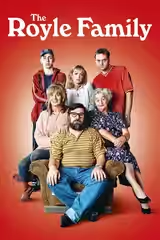
Steptoe and Son is the harsher of the two, a family comedy that lets its quarrels stay ugly after the laugh has landed, where The Royle Family is patient, exact and kinder than it first looks. The later programme is the better place to go for warmth beneath the complaints. Choose the earlier one when you can take the discomfort, and the two performances that make it worth enduring.
What should I watch after Steptoe and Son?
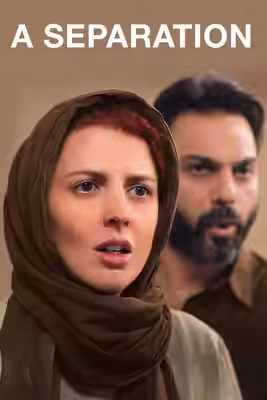
After Steptoe and Son, try The Royle Family (1998, Fi1m 85): Stay with family comedy, with more affection beneath the complaints and interruptions. Then Tokyo Story (1953, Fi1m 92): For a quieter, sadder account of the distance between parents and children; and A Separation (2011, Fi1m 93): For family arguments where understanding everyone’s reasons makes the situation more painful.

Cast

If you liked this, try…

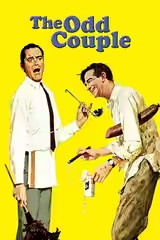
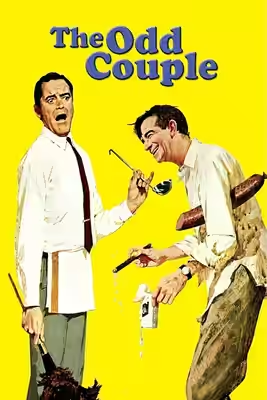
  1. The Odd Couple (1968) · not reviewed yetAnother painfully funny household where familiarity supplies an inexhaustible list of grievances.

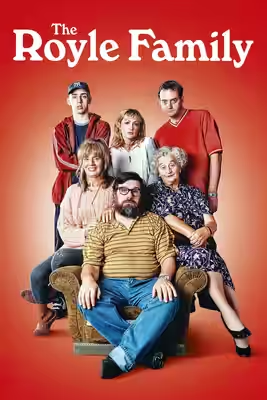
  2. The Royle Family (1998, Fi1m 85)Stay with family comedy, with more affection beneath the complaints and interruptions.

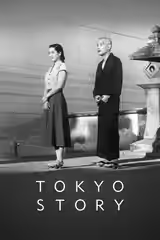
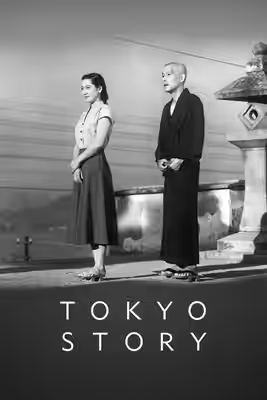
  3. Tokyo Story (1953, Fi1m 92)For a quieter, sadder account of the distance between parents and children.

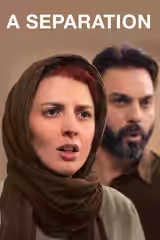
  4. A Separation (2011, Fi1m 93)For family arguments where understanding everyone’s reasons makes the situation more painful.

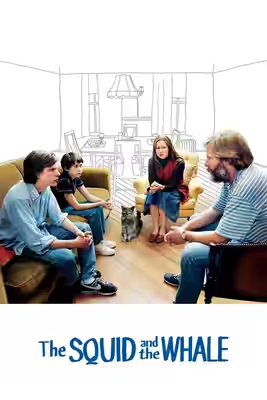
  5. The Squid and the Whale (2005, Fi1m 83)More parental vanity, with children learning habits they would be better without.

Free account

Know what to watch tonight

Two lists that know where things are streaming, collections you can share, your own score beside ours, and Discover that remembers what you have seen.

  • Want to see, sorted by what is streaming now
  • Seen, with your score out of ten
  • No adverts, ever