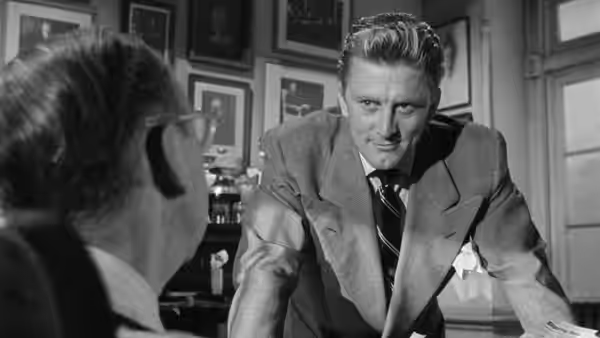
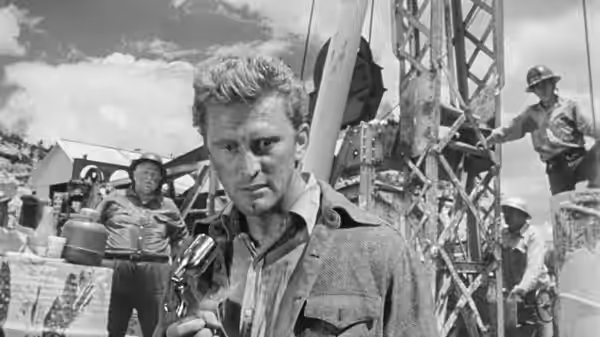
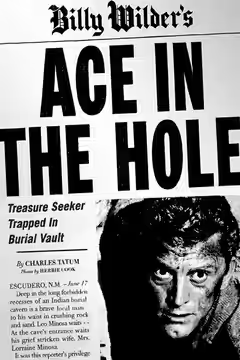
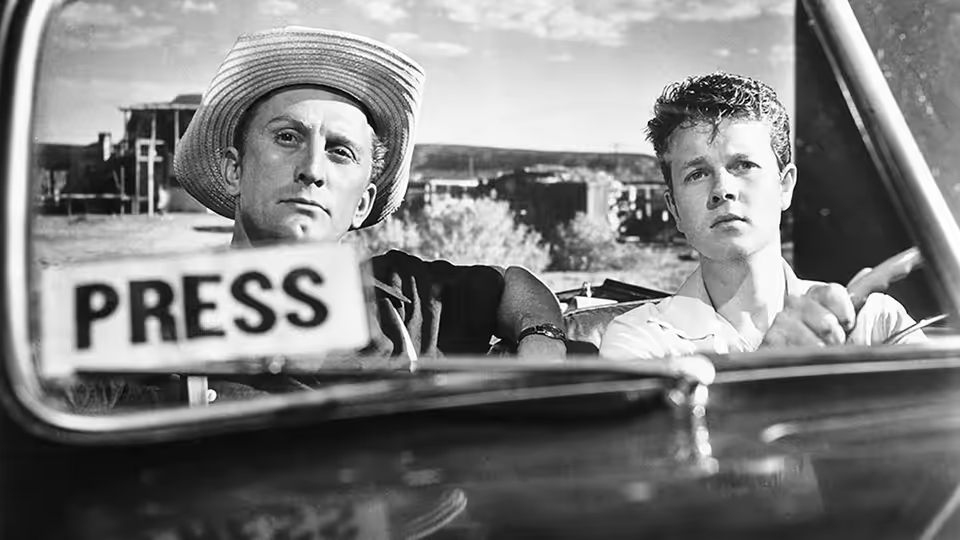
Charles Tatum (Kirk Douglas) and Herbie Cook (Robert Arthur) seated in a car with a press sign
Film review

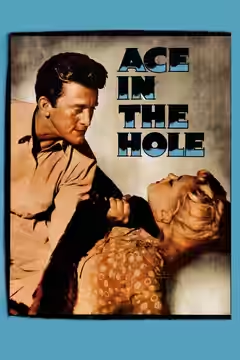
Ace in the Hole

1951 · Directed by Billy Wilder · 1h 52m · MPA NR

In a sentenceKirk Douglas could make a request for a comment sound like extortion

Charles Tatum (Kirk Douglas), a journalist looking for a way back up, sees his chance when Leo Minosa (Richard Benedict) becomes trapped in a cave. Reporting on the man’s predicament brings him into contact with Lorraine (Jan Sterling), the trapped man’s bitter wife. He wants a story that will restore his standing, and this disaster offers the prospect of attention. The urgent business of helping someone in danger now has to compete with a reporter’s ambitions. As Charles Tatum takes an interest in the cave, Lorraine has grievances of her own.

Plays from YouTube when you press play; nothing loads from them until then.

Fi1m review

Billy Wilder’s Ace in the Hole is a furious, funny account of a reporter treating another man’s suffering as a career opportunity. Kirk Douglas makes its cruelty frighteningly persuasive, even when the script makes greed explain too much.

Ace in the Hole is a harsh, gripping newspaper drama, and we recommend it warmly, though Billy Wilder sometimes makes greed explain people too completely. Its reporter, Charles Tatum (Kirk Douglas), sees a trapped man as a chance to repair his own prospects. The film takes that ugly calculation seriously enough to let us understand its appeal. There is a good story here, and a capable journalist who knows how to sell it; the horror is how readily those professional virtues become excuses for what he does.

Kirk Douglas gives Charles Tatum a force that makes the film’s cynicism difficult to dismiss as mere scolding. We found him frightening because he treats another man’s helplessness as something he is entitled to use. The performance is aggressive, but not merely loud. Kirk Douglas makes his certainty sound enough like competence to explain why anyone would listen. Billy Wilder allows that energy to carry us along for longer than feels comfortable, even though the film gives us no reason to mistake the reporter’s purpose.

Jan Sterling’s Lorraine is essential to keeping this from becoming a display by its leading man. Her bitterness has an impatience that resists the sentimental treatment a wife in such a story might receive. We are not asked to pretend that suffering automatically improves a marriage, or makes the people near it generous. There is pleasure in the dryness of her delivery, and she gives Lorraine enough force to hold our attention even when the reporter is trying to commandeer it.

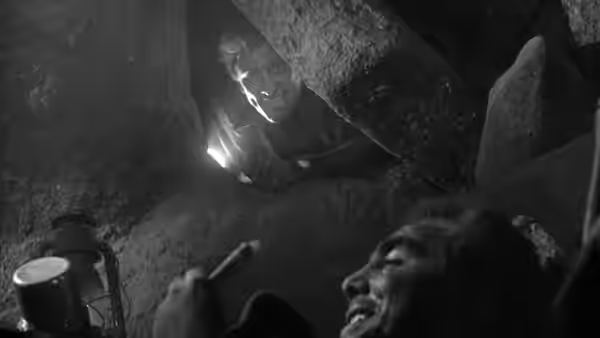
Charles Lang’s cinematography gives the cave a physical unpleasantness that the reporter’s excitement cannot make us forget. Leo Minosa (Richard Benedict) is trapped there, and the confinement keeps the story’s human cost plain. That matters in a film with so much relish for verbal cruelty: the place itself resists the pleasure of a well-turned insult. Arthur P. Schmidt’s editing keeps the exchanges brisk without making the suffering seem incidental, and the film remains engrossing across its 112 minutes.

The script by Billy Wilder, Walter Newman and Lesser Samuels is strongest when Charles Tatum can make a selfish demand sound like ordinary business. He does not need to announce that he is wicked; his determination to get a story makes familiar professional language sound ugly. The humour grows out of people trying to get something from each other, and the dialogue makes those exchanges entertaining without disguising their cruelty. Hugo Friedhofer’s score is suitably stern, although we would sometimes prefer less insistence when the dialogue has already made the point clear.

The weakness is the ease with which the wider world confirms the reporter’s view of it. Billy Wilder’s attack on the public appetite for other people’s trouble is convincing, but some characters seem to have been recruited simply to prove him right. Their greed can become predictable before we have learnt much else about them. Jan Sterling does much to complicate that pattern, though the writing sometimes limits how far she can get.

Watch it with someone who enjoys a newspaper drama for the pleasure of seeing a professional at work. Kirk Douglas supplies that pleasure in abundance, which is precisely why the film is so uncomfortable. Allow time afterwards for an argument about how much of the blame belongs to the people buying the story.

Critical consensus AI synthesised

77
Positive
12
Mixed
0
Negative
2

Most critics praise Ace in the Hole as a caustic media satire whose account of sensationalism and public appetite for suffering remains relevant. Praise centres on Kirk Douglas’s ruthless reporter, with Wilder’s economical direction and sharp writing also drawing approval. The reviews repeatedly stress that the blame extends beyond corrupt journalism to the crowds consuming it. Several find bitter humour in that bleak view of human behaviour.

The spread is wide despite twelve of the fourteen reviews being positive, and the two dissenters both write in 1951. The New York Times acknowledges the performances and the force of the crowd scenes but finds the plot’s assumptions implausible. The New Yorker goes further, rejecting the reporter’s characterisation, the dialogue and the mixture of satire and melodrama. The central disagreement is over credibility: most critics value the film’s severity, while its detractors find that its exaggerations weaken the drama.

Time Out
25 July 2007 · ★★★★★ · David Fear
100

Wilder’s acidic media satire was ahead of its time and remains a blistering indictment of tabloid infotainment and human cynicism. The review highlights the film’s flaying of the fourth estate and its enduring relevance.

Read the full review →
The AV Club
18 July 2007 · A · Nathan Rabin
95

The critic calls the film a lost masterpiece whose unflinching darkness about media exploitation was ahead of its time. Douglas's ruthless journalist and Sterling's bitter wife are singled out as key to its guilty laughs and prescient bite.

Read the full review →
RogerEbert.com
12 August 2007 · Roger Ebert
90*

The film offers an unflinching portrait of rotten journalism and the public’s appetite for sensational stories, with no one escaping blame. It singles out the lean, economical direction and Kirk Douglas’s ferocious lead performance for particular praise.

Read the full review →
Slant Magazine
19 January 2004 · Ed Gonzalez
90*

The review presents the film as an unsung masterpiece about greed and moral irresponsibility in the media and public. It singles out the way the escalating carnival outside the cave mirrors the trapped man's suffering and the story's lasting relevance to tabloid culture.

Read the full review →
The Guardian
16 October 2024
85*

The critic calls the film a strikingly relevant and cyclonically witty media satire that still stands the test of time, praising its sharp dialogue, cynical take on sensationalism, and how it shows stories spiralling out of control with public complicity.

Read the full review →
Empire
23 March 2006 · David Parkinson
80*

The review presents Ace in the Hole as a neglected classic whose exposure of the underside of celebrity culture has only grown more relevant over time. It singles out Kirk Douglas's chillingly superb performance as the manipulative reporter.

Read the full review →

Straight answers AI written, from our review

Is Ace in the Hole worth watching?
Ace in the Hole is worth watching for anyone who enjoys a harsh newspaper drama with a professional at work, and we scored it 87. Kirk Douglas makes the reporter's cruelty frightening rather than merely loud, and Jan Sterling's bitter wife keeps it from becoming a one-man show. Our reservation is that Billy Wilder sometimes lets greed explain people too completely.
How long is Ace in the Hole, and what is it rated?
Ace in the Hole runs 1h 52m and is rated NR by the MPA in the US. It is a drama film.
Where can I watch Ace in the Hole in the US?
Ace in the Hole is streaming on Amazon Prime Video in the US, and it is also available to rent from Amazon Prime Video from $3.99. Availability is checked daily; the links above go straight to each service.
How does Ace in the Hole compare to Network?
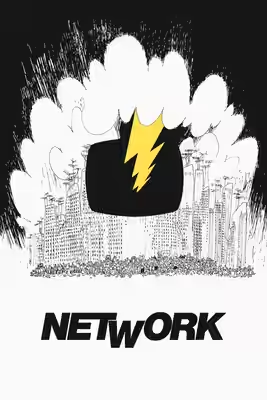
Ace in the Hole and Network are both furious accounts of suffering repackaged as profitable entertainment, but the earlier film is the tighter of the two. Wilder keeps his attack fixed on one reporter and one trapped man, and Charles Lang's cave never lets us forget the cost. Network is broader and funnier, though its speeches can crowd out the people; choose it if you want satire, Ace in the Hole if you want a character study.
What should I watch after Ace in the Hole?
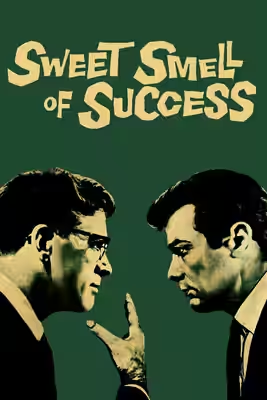
After Ace in the Hole, try Sweet Smell of Success (1957, Fi1m 88): More newspaper cruelty, with reputations traded by men who call it work. Then Network (1976, Fi1m 86): For another furious account of suffering repackaged as profitable public entertainment; and Nightcrawler (2014, Fi1m 85): A colder look at the cameraman who needs the disaster to continue.

Cast

Awards

National Film Registry, 2017

Won
National Film Registry

Academy Awards, 1952

Nominated
Best Writing, Original Screenplay

Venice Film Festival, 1951

Nominated
Golden Lion

If you liked this, try…

  1. Sweet Smell of Success (1957, Fi1m 88)More newspaper cruelty, with reputations traded by men who call it work.

  2. The Lost Honour of Katharina Blum (1975) · not reviewed yetFor a woman’s experience of being made useful to a predatory press.

  3. Network (1976, Fi1m 86)For another furious account of suffering repackaged as profitable public entertainment.

  4. Peepli Live (2010) · not reviewed yetA rural media circus whose comedy also makes room for the exploited.

  5. Nightcrawler (2014, Fi1m 85)A colder look at the cameraman who needs the disaster to continue.

Free account

Know what to watch tonight

Two lists that know where things are streaming, collections you can share, your own score beside ours, and Discover that remembers what you have seen.

  • Want to see, sorted by what is streaming now
  • Seen, with your score out of ten
  • No adverts, ever