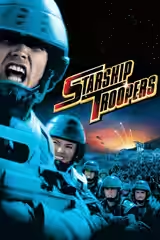
Most critics now call Starship Troopers a satire of fascism and militarism, and most of them say it was missed the first time round. The praise clusters on the Federal Network newsreel interruptions, which several reviews single out as the point where the joke lands, and on Verhoeven’s borrowed Nazi imagery. The bug battles and the effects behind them are admired almost as widely, by the film’s admirers and its doubters alike.
The reservations are of two kinds. Two of the 1997 reviews are the coolest: Roger Ebert finds it joyless and short of human spark, and Janet Maslin in The New York Times sees lurid spectacle pandering to exploitation fans. Later critics accept the satire but knock the wooden leads and the teenage romance, and Little White Lies argues the film plays its jingoism straight, with no irony to hide behind. The spread is wide but lopsided: thirteen of fifteen reviews come down in favour.
E
Empire
1 January 2000 · Adam Smith
90*
Verhoeven turns Heinlein's militaristic novel into a gleefully excessive sci-fi satire full of gooey CG bug battles, faux-propaganda newsreels and vapid Aryan teens, delivering both visceral mayhem and a pointed joke about fascism and jingoism.
Read the full review →A
The AV Club
10 June 2010 · Scott Tobias
90*
The critic calls it one of the most subversive major studio films, a brilliant dissection of how all wars work through propaganda, dehumanization of the enemy, and eager sacrifice by the young. He singles out the Federal Network newsreel-style clips and Verhoeven's Nazi allusions for making the satire effective.
Read the full review →G
The Guardian
12 November 2022
90*
The critic argues that Starship Troopers is a brilliant satire of fascism that was misunderstood on release. They single out the film's ironic use of Nazi-style propaganda imagery and Verhoeven's intent to make audiences question the characters' militarism.
Read the full review →T
The Telegraph
7 November 2017
90*
The critic calls Starship Troopers a misunderstood masterpiece and the most expensive troll film ever made. They single out its seductive portrayal of a fascist society that draws viewers into cheering for it while exposing its horrors.
Read the full review →N
The New Yorker
6 July 2020 · David Roth
85*
Verhoeven’s film is a mordant anti-fascist satire that deliberately replicates fascist aesthetics and war-movie conventions to expose a society built on violence, citizenship-through-service, and endless conflict, with its themes resonating strongly in the present.
Read the full review →L
Little White Lies
5 November 2017 · Ned Carter Miles
80*
The film is a reappraisal-worthy example of ambiguous satire that faithfully and artlessly depicts jingoistic militarism and fascist propaganda aesthetics without providing critical distance or irony, making its worldview disturbingly seductive and compelling on its own terms.
Read the full review →R
Radio Times
★★★★ · Alan Jones
80
This violent adaptation is popcorn exploitation at its best, with outstanding special effects in the bug swarms and intergalactic warfare. The teenage romance subplot weakens it, but never enough to spoil the absurdly apocalyptic satire.
Read the full review →i
The i Paper
5 October 2017 · Joel Draba-Mann
80*
Twenty years on, the film is reappraised as an overt satire of fascism and American militarism that was initially missed by critics. It singles out the propaganda news segments and parallels to Gulf War-era politics and later events for praise as prescient.
Read the full review →V
Variety
27 October 1997 · Todd McCarthy
80*
The critic hails the spectacular effects, gung-ho sci-fi epic fun, and visual exhilaration, praising the action, special effects, and momentum while noting its strong appeal to younger sci-fi audiences.
Read the full review →T
Time Out
21 July 2014 · TCh
70*
The film replays World War II as sci-fi with the audience rooting for the fascists in a totalitarian utopia that looks like a daytime soap. It only truly comes alive during the gruesome, large-scale bug battles, ending with a perverse touch that impresses despite the grotesque surface.
Read the full review →R
RogerEbert.com
7 November 1997 · Roger Ebert
50*
The critic calls it a violent but joyless kiddie sci-fi movie faithful to its juvenile source material, praising the sly satire on militarism and fascism while complaining it lacks exhilaration, warmth, and human spark.
Read the full review →N
The New York Times
7 November 1997 · Janet Maslin
40*
The review describes the film as lurid spectacle with contrasts between squeaky-clean characters and gruesome bug battles, questioning its broad appeal and noting it panders to fans of raw exploitation.
Read the full review →P
Polygon
6 May 2026 · Brian VanHooker
90*
The critic hails the film as a misunderstood anti-war masterpiece whose satire of militarism and fascism remains sharp decades later, recommending it for its themes and entertainment value now streaming on Netflix. The unique alien bug designs and intense battle scenes are singled out for praise.
Read the full review →R
The Ringer
7 November 2022 · Miles Surrey
90*
The critic celebrates the film as a sharp, reevaluated satire on militarism, fascism, and propaganda that has become a cult classic, noting how its themes feel more relevant today amid real-world events. The piece singles out the depiction of characters unaware of their own fascism and the misleading newsreel sequences for praise.
Read the full review →C
Collider
5 August 2022 · Lloyd Farley
70*
The film is a satirical masterpiece that criticizes militarism and propaganda through over-the-top military ads and Nazi-like symbolism. Its real strength is the social commentary and relevance to contemporary society, despite wooden acting from leads.
Read the full review →Ordered by the weight we give each publication, then by score. Scores are normalised to 100; * means inferred from an unrated review. Summaries are ours, not quotations; follow the links for the reviews themselves. How we rate