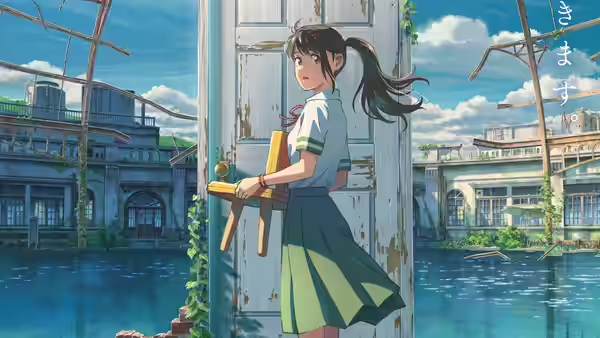
a white door standing alone in shallow water amid ruined buildings
Film review

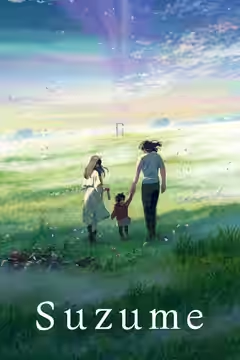
Suzume

2022 · Directed by Makoto Shinkai · 2h 02m · MPA PG

In a sentenceGirl meets boy, boy becomes a chair, and the chair gives the best performance in the film

Suzume Iwato is a schoolgirl living with her aunt Tamaki in a port town in southern Japan. On her way to school she meets Souta Munakata, a young man looking for ruins, and follows him to an abandoned spa resort. In its flooded courtyard stands a single door. She opens it, sees a starlit meadow, and pulls a stone cat from the ground. The cat runs off, something vast begins to push through the door, and Souta, whose job is closing such doors, is turned into a three-legged child’s chair. They set off across Japan after the cat, shutting doors before earthquakes come through them. Makoto Shinkai writes and directs; Nanoka Hara, Hokuto Matsumura and Eri Fukatsu lead the voice cast.

Plays from YouTube when you press play; nothing loads from them until then.

Fi1m review

Makoto Shinkai sends a schoolgirl and an enchanted chair across Japan to shut the doors that let earthquakes in. The chair is funny, the skies are as good as ever, and the film is sincere about a real disaster; the romance underneath is thin.

Suzume Iwato (Nanoka Hara) is a schoolgirl who lives with her aunt Tamaki (Eri Fukatsu) in a port town in southern Japan. On her way to school she passes a young man, Souta Munakata (Hokuto Matsumura), who asks the way to some ruins. She follows him to a spa resort that closed years ago and finds, standing in a courtyard of rainwater, a door with nothing behind it. She opens it. Makoto Shinkai, who wrote, directed and edited the film, spends the next two hours on what comes through, and on the small stone cat Suzume pulls from the mud, which comes to life and turns Souta into a three-legged child’s chair. It is a handsome, sincere and crowded film, and we recommend it, with one reservation about what it asks its heroine to feel.

The doors stand in places people have abandoned: the spa, a school, a hillside fairground. Through them comes what the film calls a worm, a red mass that rises above a town, and if it falls there is an earthquake. Only Suzume and Souta can see it. Everyone else’s phone goes off. Shinkai uses the shrill alarm that Japanese phones sound before a quake, and we flinched every time, as no monster has made us flinch in years, because it is a real noise attached to real memories. The film does not hide which. The earthquake and tsunami of 11 March 2011 sit under the whole picture, and when the worm hangs over a city at dusk the sky turns the colour of a bruise.

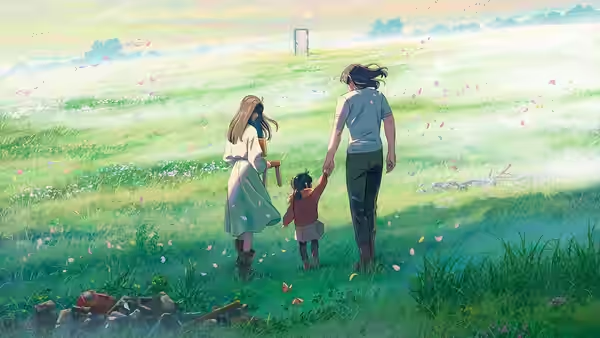
Ryosuke Tsuda’s photography is the chief pleasure. Sunlight comes through leaves in hard white flares, rain shines on tarmac, a night ferry crosses black water under a sky with too many stars. The meadow beyond the door, lit by every sunrise at once, is among the best images Shinkai has made. He cuts his own films, and he cuts fast; the journey covers half of Japan in what feels like a long weekend, and a scene has barely settled before he is on to the next. Yojiro Noda, who scored Your Name, and Kazuma Jinnouchi supply piano, strings and a choir that swells whenever a door is about to close, which is often.

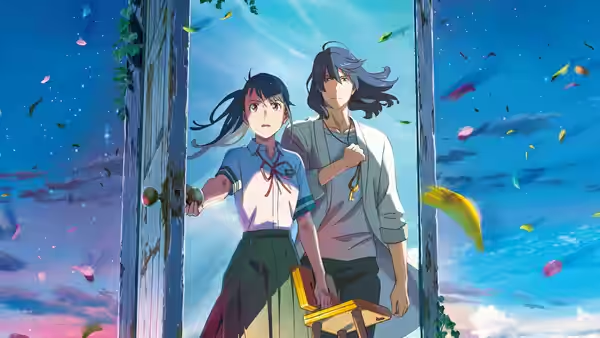
The chair is a triumph we did not expect. Souta, now a wooden seat missing a leg, clatters down staircases, sprints along a quayside, throws himself from a moving car and is picked up by a toddler, while Matsumura’s grave voice comes from somewhere inside the varnish. We laughed a great deal and were not ashamed of it. The cat, Daijin (Ann Yamane), is nearly as good: a smiling white creature with a small child’s voice that tells Suzume it likes her and then does something terrible. Shinkai never tells us what it wants, and the film is better for that.

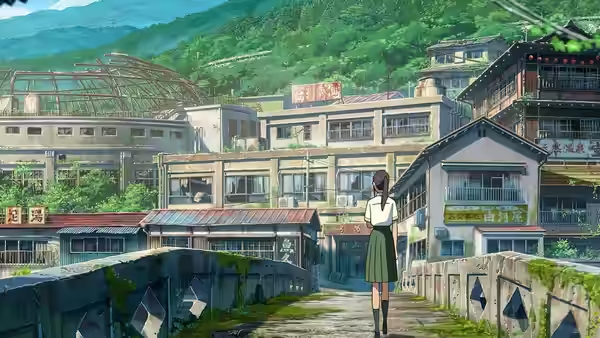
The middle is a chase after the cat, and the warmest scenes are the stops. Chika (Kotone Hanase), a schoolgirl whose family grows oranges, takes Suzume home for the night. Rumi (Sairi Ito), who runs a bar and has twins, puts her to work behind the counter. Tomoya Serizawa (Ryunosuke Kamiki), a friend of Souta’s with an open-top car, drives the last leg. These people are kind to a stranger without making a speech about it, and the emptying towns they live near, weeds in the playgrounds and rust on the Ferris wheels, are the film’s most honest subject. Fukatsu’s Tamaki gets a scene late on, in a lay-by, that we will not describe; it is the truest acting in the film.

The reservation is the romance. Suzume decides she loves Souta after a few days in his company, most of them with him as furniture, and the last movement asks us to take that love as a matter of life and death. We did not believe it. Shinkai did this better in Your Name, where the lovers had a whole film to earn it. The mechanics do not help either: keystones, closers, a place called the Ever-After, all explained at least twice, and a climax that ties them off more tidily than the film’s own grief would allow. At 122 minutes it could lose ten from the middle.

Against Shinkai’s own work it is bigger and funnier than Weathering With You and less intimate than Your Name. Most critics have been a little warmer than us, chiefly for the pictures, which deserve it. See it on the largest screen you can, where the skies do their work. The alarm will follow you home regardless.


Critical consensus AI synthesised

78
Positive
10
Mixed
2
Negative
0

Most critics like Suzume, and the spread is narrow: nobody dismisses it, and the reservations are all of degree. Praise clusters on the animation, on Shinkai’s eye for the detail of contemporary Japan, and on the three-legged chair, which several reviews single out for its physical comedy and treat as the film’s warmest presence. Nearly every review takes the 2011 Tōhoku earthquake as the film’s real subject and credits Shinkai with handling grief and disaster in a way that stays accessible.

The doubts gather in one place. Several critics find it less affecting than his earlier films, with The AV Club, Collider and The i Paper saying so directly; Sight and Sound adds that the plot lacks momentum. The Times finds it a little too worthy, and The Skinny, the lowest score here, thinks the road-trip scale costs the film the intimacy of his previous work. Time Out is alone in objecting to the product placement.

Vulture
14 April 2023 · Alison Willmore
85*

The review calls it the best animated movie of the year so far, praising its openhearted romantic adventure about inheriting a broken world and its grounding in contemporary Japanese life and loss.

Read the full review →
Radio Times
★★★★ · James Mottram
80

Another charming animated offering that weaves real-world themes into a fantastical story, with vibrant images confirming Shinkai's status.

Read the full review →
Time Out
12 April 2023 · ★★★★ · Emma Steen
80

It's a visually stunning crowdpleaser with the usual Shinkai formula of romance and disaster, though some plot elements and product placement are distracting.

Read the full review →
The AV Club
14 April 2023 · B · Sam Barsanti
77

The critic notes it lacks the full emotional punch of prior films but singles out the genius animation and humor of the talking chair character and its Ghibli-esque qualities.

Read the full review →
Slant Magazine
9 April 2023 · ★★★
75

The critic affirms Shinkai’s auteur status with shimmering visuals and a sweet, strange story of a girl making peace with her past, though the narrative feels slightly crowded.

Read the full review →
The Guardian
16 April 2023
65*

The critic finds the apocalypse visually appealing in this painterly coming-of-age anime shadowed by the 2011 tsunami. Shinkai excels at vivid details of modern Japan but the fairytale script feels less nuanced and grounded than his earlier work.

Read the full review →

Straight answers AI written, from our review

Is Suzume worth watching?
Suzume is worth watching, and we scored it 74. Makoto Shinkai's animated journey across Japan has skies as good as any he has drawn, a chair that gives the funniest performance in the film, and real seriousness about earthquakes; the romance underneath is thin, and the middle could lose ten minutes. Best seen on the largest screen you can find.
How long is Suzume, and what is it rated?
Suzume runs 2h 02m and is rated PG by the MPA in the US. It is an animation and drama film.
Where can I watch Suzume in the US?
Suzume is streaming on Netflix, Crunchyroll, The Roku Channel and Amazon Prime Video in the US, and it is also available to rent from Amazon Prime Video from $3.99. Availability is checked daily; the links above go straight to each service.
How does Suzume compare to Your Name.?
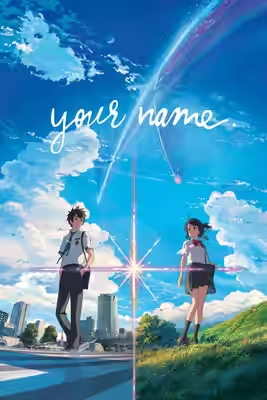
Suzume is bigger and funnier than Your Name., and less intimate. Both are Makoto Shinkai films about a girl and a boy separated by something strange, but the earlier film gives its lovers a whole story to earn their feelings, while Suzume asks us to take the romance on trust after a few days. Come to Suzume for the pictures and the chair; Your Name. is the one for the heart.
What should I watch after Suzume?
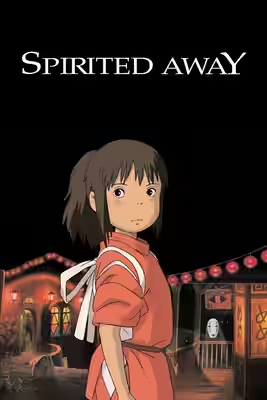
After Suzume, try Your Name (2016, Fi1m 84): Shinkai’s earlier body-swap romance, where the lovers get a whole film to earn it. Then Spirited Away (2001, Fi1m 92): Miyazaki’s girl in a haunted bathhouse; the closer cousin of Shinkai’s abandoned spa; and Wolf Children (2012, Fi1m 81): Mamoru Hosoda’s mother raising two half-wolf children; rural Japan, grief, and no worm.

Cast

Awards

Annie Award for Best Animated Feature, 2023

Nominated
Annie Award for Best Animated Feature

Berlin International Film Festival, 2023

Nominated
Golden Bear
Nominated
Silver Bear Grand Jury Prize
Nominated
Silver Bear Jury Prize

If you liked this, try…

  1. Your Name (2016, Fi1m 84)Shinkai’s earlier body-swap romance, where the lovers get a whole film to earn it.

  2. Spirited Away (2001, Fi1m 92)Miyazaki’s girl in a haunted bathhouse; the closer cousin of Shinkai’s abandoned spa.

  3. Wolf Children (2012, Fi1m 81)Mamoru Hosoda’s mother raising two half-wolf children; rural Japan, grief, and no worm.

  4. Shin Godzilla (2016, Fi1m 74)The other great Japanese film about 2011, with a monster and a lot of committee meetings.

  5. Drive My Car (2021, Fi1m 88)Grief, a long car journey and a stranger at the wheel, without the animation.

Free account

Know what to watch tonight

Two lists that know where things are streaming, collections you can share, your own score beside ours, and Discover that remembers what you have seen.

  • Want to see, sorted by what is streaming now
  • Seen, with your score out of ten
  • No adverts, ever