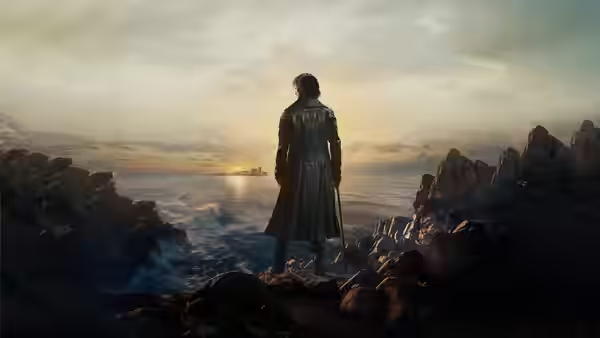
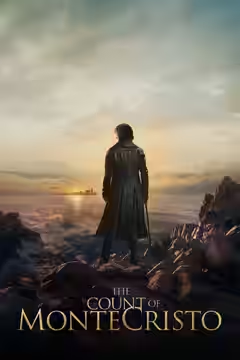
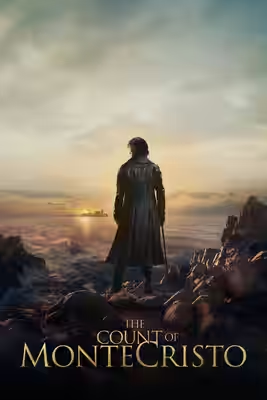
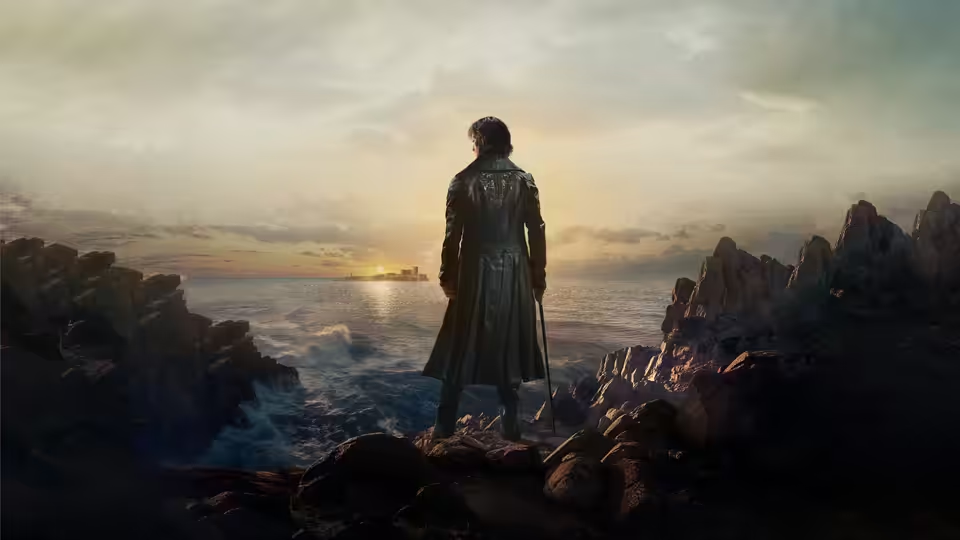
A man in a long coat stands on cliffs overlooking the sea at sunset
Film review

The Count of Monte Cristo

2024 · Directed by Alexandre de La Patellière, Matthieu Delaporte · 2h 58m · MPA NR

In a sentenceA man goes into a hole for years and comes out with better tailoring and worse manners than everyone who put him there

Edmond Dantès (Pierre Niney), a young sailor in Marseille, is made captain and is days from marrying Mercédès (Anaïs Demoustier). Three men want what he has: Fernand (Bastien Bouillon), who loves Mercédès; Danglars (Patrick Mille), who wanted the ship; and the prosecutor Villefort (Laurent Lafitte). A letter and a false accusation send Edmond to an island prison, where his only company is a fellow inmate, the Abbé Faria (Pierfrancesco Favino). Years later a man calling himself the Count of Monte Cristo arrives in Paris, rich, with two young companions (Anamaria Vartolomei and Julien de Saint Jean) and a plan. Adapted from Alexandre Dumas’s novel by Matthieu Delaporte and Alexandre de La Patellière, who also direct.

Plays from YouTube when you press play; nothing loads from them until then.

Fi1m review

Delaporte and de La Patellière’s Dumas is handsome, brisk for its length, and held together by Pierre Niney, who plays revenge as a long illness. The second half is all schemes and the villains are thin, but go.

Alexandre Dumas’s novel is long, and so is this. Matthieu Delaporte and Alexandre de La Patellière, who wrote and directed the recent pair of Three Musketeers films, have taken 178 minutes over Edmond Dantès and they play it straight: no winking, no modern irony, a sailor betrayed, buried and returned. The film is handsome, it moves faster than its length suggests, and Pierre Niney holds it together. In its second half it cares more about schemes than about people, and there we part a little from most of the reviews so far.

The first hour is the best of it. Nicolas Bolduc opens on a storm at sea, black water and a ship breaking up, and Edmond going over the side after a woman (Adèle Simphal) nobody else will go in for. Ashore in Marseille the light turns warm and low, and Niney plays the young Edmond as a man who has not yet been given a reason to be careful. Bastien Bouillon’s Fernand watches Mercédès (Anaïs Demoustier) with the wrong kind of attention, and Laurent Lafitte’s Villefort signs the paper that puts Edmond away without once raising his voice.

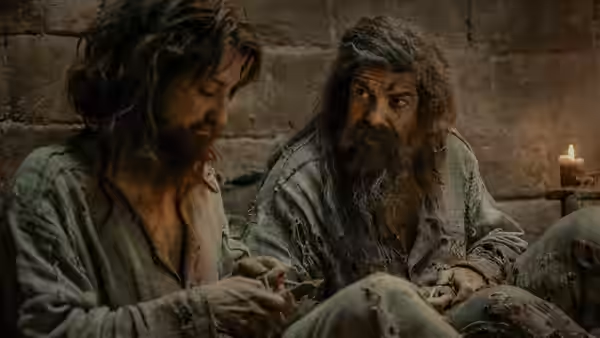
Then the cell. Stéphane Taillasson’s prison is stone, damp and one high slit of window, and Bolduc shoots it so dark that Niney’s face is often the only thing on screen. Time passes in beards and in the light moving across the wall. When another voice finally comes through the stone, that of Pierfrancesco Favino’s Abbé Faria, we were moved more than we expected to be, and it was Niney who did it: a man who has forgotten how to be spoken to, trying to remember. Favino plays the priest as a teacher first and a conspirator second. The film is quieter and kinder here than anywhere else in it.

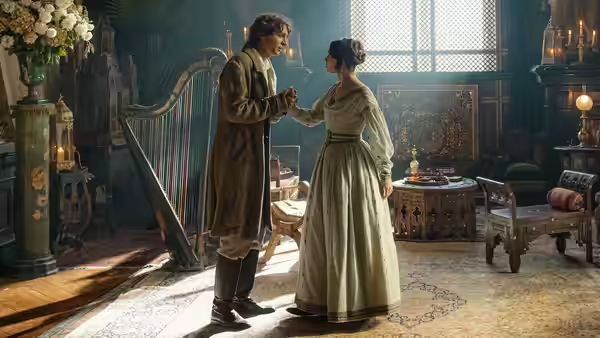
The Count, when he arrives, is a different performance. Thierry Delettre dresses him in black, high collars and gloves, and Niney drops his voice and his shoulders and more or less stops blinking. He is not fun, and he is not meant to be. Jérôme Rebotier’s score gives him brass and low strings every time he enters a room, and by the fourth entrance we wished it would let him walk in on his own. Anamaria Vartolomei’s Haydée and Julien de Saint Jean’s Andrea are the young companions he brings to Paris, and Vartolomei makes her few scenes count. She has her own reasons to be in that house.

The trouble is the machinery. Once the Count is in Paris the film becomes a set of plans being carried out, and Célia Lafitedupont cuts between them briskly enough that we never lost the thread. But the men on the receiving end have been given almost nothing to be. Patrick Mille’s Danglars is a banker who is greedy, Bouillon’s Fernand is a general who is proud, Lafitte’s Villefort is a prosecutor who is cold, and that is the whole of them. Each gets what is coming, and each time we felt less than we had in the cell. Vassili Schneider’s Albert, Fernand’s son, is the exception, a decent boy who has no idea what his father did, and the Count’s scenes with him are the ones in the second half with a pulse.

The film knows this is a problem, or at least a question. Its tagline insists that this is justice, not vengeance, and its last hour asks whether Edmond still believes that. Demoustier’s Mercédès, older now, gets the scenes that put it to him, and she plays them without pleading. We will not say where it comes out, except that the film is braver about the cost than its poster.

Set against the directors’ own Musketeers films it is grander and less playful, and most critics have said so. Set against the earlier screen versions of the book it is the fullest we have seen, and it treats the prison as years rather than as a montage. It is a 12A and a long one. It was built for a large screen and a full room; on a sofa the second half turns into a handsome serial about a rich man who is always right, and you may find yourself checking how much is left. In the cinema we did not.

Critical consensus AI synthesised

81
Positive
12
Mixed
1
Negative
0

Most critics like this a great deal. Twelve of thirteen reviews are positive, and the praise gathers in the same places: a nearly three-hour runtime that moves quickly, a screenplay that trims Dumas’s novel without losing its shape, and sets and photography on a scale several reviewers compare to a Hollywood blockbuster. Pierre Niney’s Edmond Dantès is singled out again and again, described as intense, haunted and more psychologically interesting than the part usually allows. Several critics add that the film takes the moral cost of revenge seriously rather than treating it as a lark.

The reservations are mild and few. The Guardian and Screen Daily both find it less mischievous than the same team’s recent Three Musketeers films, a costume spectacle played straighter than it might have been. The one mixed notice, from The Hollywood Reporter, calls it watchable but unremarkable, all intrigue and handsome backdrops with not much underneath. Nobody else agrees, and the spread is narrow.

Los Angeles Times
20 December 2024 · Robert Abele
90*

This grand, enjoyable epic condensation of the Dumas novel is a model of streamlining that zips through its three-hour runtime like a binge. Superb casting, especially Pierre Niney’s intense lead performance, and lush period detail make it a sumptuous, crowd-pleasing French import.

Read the full review →
Sight and Sound
30 August 2024 · Guy Lodge
90*

The critic describes the film as a grand, robustly entertaining spectacle and rollicking French blockbuster that stays true to the source novel's swashbuckling spirit through lavish production design and a barrelling narrative drive. Pierre Niney's haunted, fey performance as Edmond Dantès is singled out as a modern, sympathetic touch in otherwise familiar territory.

Read the full review →
The New York Times
19 December 2024 · Critic’s Pick · Jeannette Catsoulis
90*

This stirring, gorgeously filmed swashbuckler leaves previous versions of the Dumas revenge saga in the dust. The directors give the story nearly three hours to breathe while maintaining frisky pacing and elegant editing, delivering a big, cinematic adventure with heart and style.

Read the full review →
The Times
29 August 2024 · ★★★★☆
90*

The adaptation is called an indecently spectacular romp that is compelling, coherent, and visually stunning, turning Dumas’s tale into a thrilling modern spectacle that looks like a Hollywood blockbuster despite its French origins and modest budget. It succeeds as entertaining popular cinema without needing to be a deep class-system dissection.

Read the full review →
Screen Daily
24 May 2024 · festival review
80*

The critic calls the film a robust and very enjoyable retelling that is epic in scale, from its lavish sets and orchestral score to its bold performances and hefty running time. It is praised as a devilishly handsome old-school adventure and top-tier entertainment that zips through its nearly three hours effectively, though it lacks some of the mischief of the recent Musketeers films.

Read the full review →
The Guardian
1 September 2024 · Peter Bradshaw
80*

The critic praises this big-budget French adaptation of Dumas as a boisterous and very enjoyable epic directed with verve and acted with gusto by the team behind the recent Three Musketeers films. It delivers an old-fashioned costume spectacle of revenge and retribution, though it lacks the comic flair of those earlier swashbucklers.

Read the full review →

Straight answers AI written, from our review

Is The Count of Monte Cristo worth watching?
The Count of Monte Cristo is worth watching for anyone with the patience for a 178-minute revenge story played entirely straight, and we scored it 80. Pierre Niney holds it together, and the prison hour is quietly moving. The second half is more interested in schemes than in people, so see it in a cinema if you can; on a sofa it sags.
How long is The Count of Monte Cristo, and what is it rated?
The Count of Monte Cristo runs 2h 58m and is rated NR by the MPA in the US. It is an adventure and action film.
Where can I watch The Count of Monte Cristo in the US?
The Count of Monte Cristo is streaming on The Roku Channel, Apple TV and Amazon Prime Video in the US, and it is also available to rent from Amazon Prime Video and Apple TV from $4.99. Availability is checked daily; the links above go straight to each service.
How violent or frightening is The Count of Monte Cristo, and is it suitable for children?
The Count of Monte Cristo is a UK 12A, and the certificate is a fair guide: a storm at sea, a false imprisonment, years in a dark cell and a long campaign of revenge, but nothing graphic that the review found worth warning about. The prison scenes are grim rather than frightening. The real obstacle for younger children is the length, not the content.
How does The Count of Monte Cristo compare to Oldboy?
The Count of Monte Cristo and Oldboy both lock a man away for years and then let him loose, but they are different animals. Park Chan-wook's film is shorter, far crueller and much harder about what revenge costs the man taking it; Delaporte and de La Patellière's is grander, gentler and a 12A. Oldboy is the sharper film; Monte Cristo is the one to watch with company.
Is The Count of Monte Cristo based on a true story or a book?
The Count of Monte Cristo is based on Alexandre Dumas's novel, not on a true story. Matthieu Delaporte and Alexandre de La Patellière adapt it without modern irony, and it is the fullest screen version we have seen, treating the prison years as years rather than a montage. You do not need to have read the book; the film explains itself.
What should I watch after The Count of Monte Cristo?
After The Count of Monte Cristo, try Oldboy (2003, Fi1m 85): Fifteen years in a room, then vengeance; Park Chan-wook counts the cost harder. Then The Princess Bride (1987, Fi1m 86): For when you want the swordfights and the true love without the prison years.

Cast

Awards

Lumière Award for Best Cinematography, 2025

Won
Lumière Award for Best Cinematography

If you liked this, try…

  1. Le Bossu (1997) · not reviewed yetDe Broca’s swashbuckler takes its revenge slowly and its swordplay lightly, which this one does not.

  2. Oldboy (2003, Fi1m 85)Fifteen years in a room, then vengeance; Park Chan-wook counts the cost harder.

  3. The Three Musketeers: D'Artagnan (2023) · not reviewed yetThe same directors, more mud and more jokes, and half the running time.

  4. The Duellists (1977) · not reviewed yetRidley Scott’s first film: two Napoleonic officers who cannot stop fighting, shot like paintings.

  5. The Princess Bride (1987, Fi1m 86)For when you want the swordfights and the true love without the prison years.

Free account

Know what to watch tonight

Two lists that know where things are streaming, collections you can share, your own score beside ours, and Discover that remembers what you have seen.

  • Want to see, sorted by what is streaming now
  • Seen, with your score out of ten
  • No adverts, ever