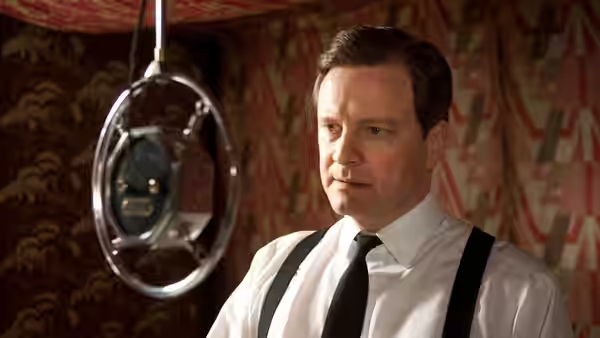
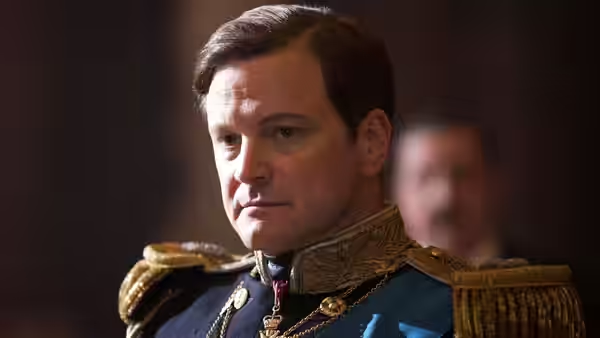
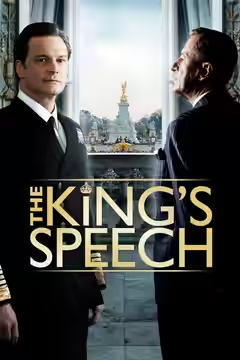
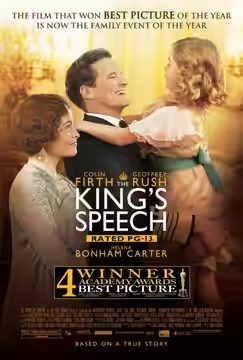
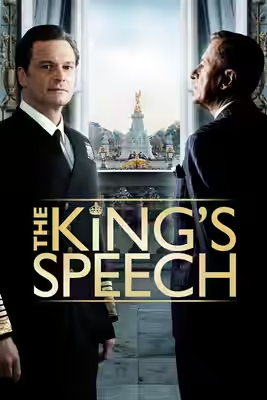
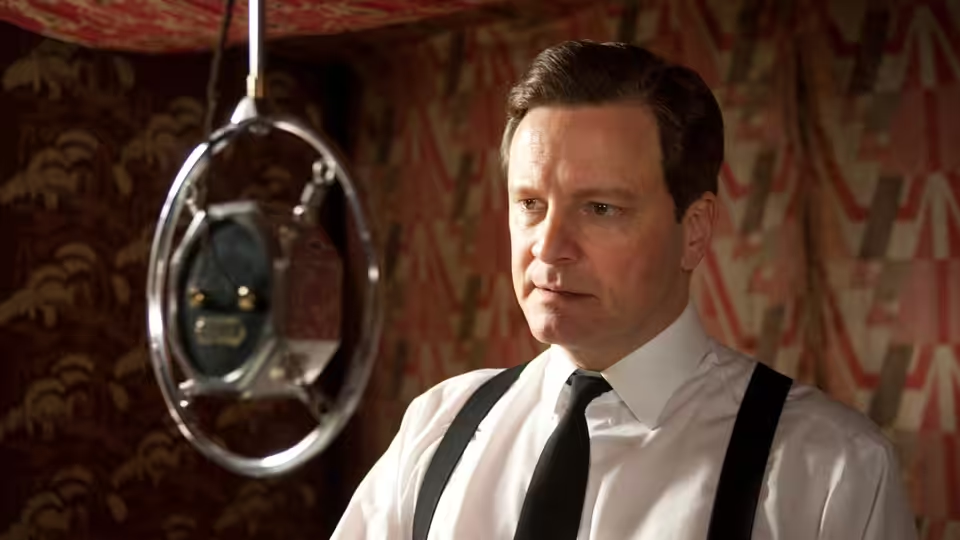
King George VI (Colin Firth) standing before a vintage studio microphone
Film review

The King's Speech

2010 · Directed by Tom Hooper · 1h 58m · MPA R

In a sentenceRoyal dignity improves considerably once the swearing starts

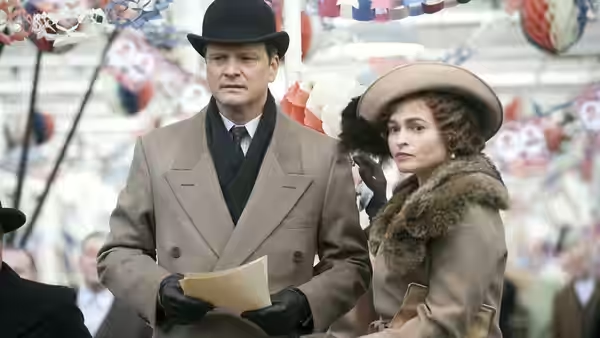
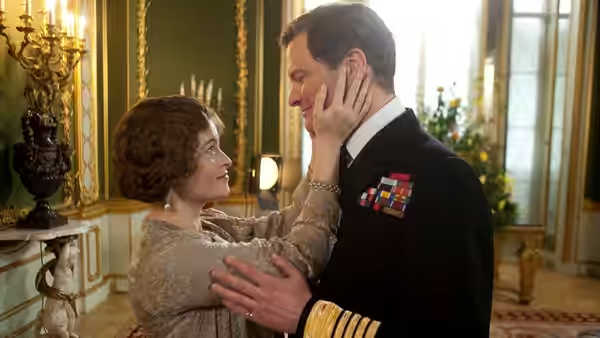
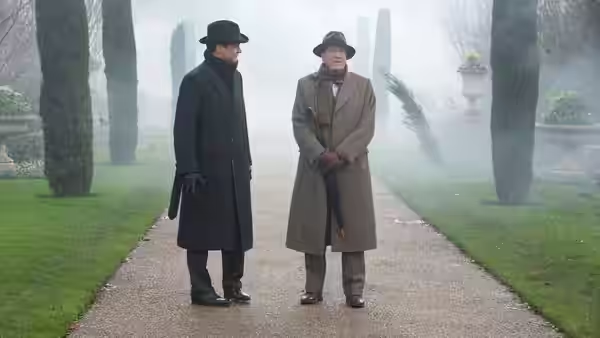
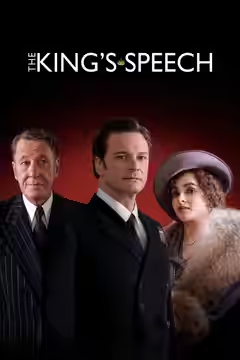
Colin Firth plays the future King George VI, whose stammer makes public speaking an ordeal. Radio places new demands on a royal voice, and his work with Lionel Logue, an Australian speech therapist played by Geoffrey Rush, brings together two men with different ideas about authority. Logue’s unconventional approach makes their sessions a difficult exercise in trust as well as speech. Their developing friendship sits at the centre of the royal family drama. Helena Bonham Carter plays Elizabeth, with Guy Pearce as Edward VIII and Michael Gambon as George V.

Plays from YouTube when you press play; nothing loads from them until then.

Fi1m review

Colin Firth and Geoffrey Rush make The King’s Speech a warm, funny and affecting drama. Its view of royalty is too comfortable, but the difficult business of speaking gives it real emotional weight.

The King’s Speech is a warmly recommended drama with a rather cosy view of royalty. Tom Hooper keeps the difficult relationship between a man who struggles to speak and the therapist trying to help him at its centre. David Seidler’s screenplay makes radio matter: public duty now requires a voice that can reach beyond the people standing nearby. The film is most convincing when it considers what that demand costs the speaker.

Colin Firth gives George VI enough pride and irritation to keep the suffering from becoming a request for sympathy. His stammer affects the whole performance, making speech feel like physical work whose difficulty cannot be wished away by good manners. We were more upset than we expected by his struggles to get the words out. Firth makes the effort convincing without letting it become everything we know about the man, and his comic timing remains alert to the absurdity of royal dignity.

Geoffrey Rush’s Lionel Logue gives him someone worth arguing with. Rush has the more expansive performance, but the pleasure lies in how carefully he responds to Firth; their exchanges feel testing even when Seidler is plainly preparing a laugh. The friendship becomes persuasive through discomfort, impatience and humour, and the script gives both actors room to be funny. Helena Bonham Carter’s Elizabeth adds warmth without competing with the central pair, and the film benefits from her lighter touch.

Eve Stewart’s production design supplies the handsome surroundings expected of a royal period drama, while Jenny Beavan’s costumes reinforce its formality. That polish works because the people inside it can still look uncomfortable. Danny Cohen’s fisheye photography is less helpful, making the camera conspicuous when Firth is already communicating the unease clearly enough. We understand the wish to disturb the respectable surfaces, but the distortion can feel like an instruction to notice the directing.

Tariq Anwar’s editing serves the comedy well, giving the conversations pace without treating difficult speech as dead time. That distinction matters in a film asking us to take the effort of speaking seriously. Alexandre Desplat’s music contributes to the warmth, though its encouragement can feel unnecessary when the actors have already made the feeling clear. The film is confident about entertaining us and occasionally too anxious to make certain we are moved.

The larger weakness is how little trouble it has with the institution surrounding George. Seidler finds comedy in royal absurdity, yet the sympathy for an unhappy man broadens too easily into reassurance about monarchy. The explanations for his difficulties are also tidier than the performance suggests they ought to be. Hooper favours a clear, encouraging story, and some of the complication disappears in making it so agreeable.

As a drama about an unlikely friendship, it earns its familiar shape through the quality of the company. We would have welcomed more friction in its treatment of royalty, but there is enough between Firth and Rush to keep the film from becoming merely polite. Their humour makes the solemnity easier to accept. Watch it for the two men doing the awkward work of learning how to talk to each other.
Critical consensus AI synthesised

74
Positive
9
Mixed
0
Negative
2

Most critics find The King’s Speech an affecting, witty historical drama, with praise centred on Colin Firth and Geoffrey Rush’s uneasy friendship. Firth’s portrayal of the king’s speech difficulties earns particular admiration for its physical demands and emotional restraint, while Helena Bonham Carter’s support also draws approval. The reviews credit David Seidler’s script with keeping the period material lively and Tom Hooper with giving the personal relationship enough space to hold attention.

The disagreement concerns how much reassurance the story can bear. Supporters acknowledge familiar plotting and calculated crowd-pleasing touches without finding them fatal. The dissent is sharper: Slant Magazine finds the psychology simplistic and the uplift contrived, while Eye for Film sees too little darkness or dramatic tension. The New York Times also objects to the sweetness and benign treatment of monarchy. Performances command broad agreement; the film’s politeness produces a much wider spread of opinion.

Film Comment
· Scott Foundas
85*

The critic calls Hooper’s period drama splendid and praises its focus on how radio transformed politics and public life. Firth and Rush deliver ideal performances balancing flourish and restraint.

Read the full review →
Time Out
4 January 2011
85*

Thanks to Seidler, Hooper and especially the leads, the film is an enlightening, entertaining, heartfelt and surprisingly funny crowd-pleaser focused on intimate character relationships.

Read the full review →
The AV Club
26 November 2010 · B+ · Tasha Robinson
83

The critic finds the film a respectably solemn yet crowd-pleasing historical drama that hits the right awards-bait marks with handsome detail and a riveting central performance from Colin Firth. It crackles with discomfort and relief in the central friendship while remaining a pleasure to watch despite its calculated trappings.

Read the full review →
Little White Lies
3/4/4 · Matt Bochenski
80

It is not just one of the most entertaining British films in years, but one of the most intriguing too.

Read the full review →
Radio Times
★★★★ · Stella Papamichael
80

This marvellously moving tale features an impressive Colin Firth as the stammering king, with deft direction capturing his limbo amid abdication and war, and strong support from Bonham Carter and Rush.

Read the full review →
The Guardian
6 January 2011 · Peter Bradshaw
80*

The critic praises the film as a richly enjoyable true-life drama about King George VI's stammer and his relationship with his speech therapist. Firth, Rush and Bonham Carter deliver strong performances in this witty, absorbing anti-Pygmalion story.

Read the full review →

Straight answers AI written, from our review

Is The King's Speech worth watching?
The King's Speech is worth watching for anyone who enjoys a warm, funny drama about an unlikely friendship, and we scored it 82. Colin Firth and Geoffrey Rush carry it; their sessions together are testing, comic and affecting. Its view of monarchy is too comfortable, and Alexandre Desplat's music occasionally pushes for feeling the actors have already supplied.
How long is The King's Speech, and what is it rated?
The King's Speech runs 1h 58m and is rated R by the MPA in the US. It is a drama and history film.
Where can I watch The King's Speech in the US?
The King's Speech is streaming on Amazon Prime Video, Hulu, Paramount+ and Apple TV in the US, and it is also available to rent from Amazon Prime Video and Apple TV from $3.99. Availability is checked daily; the links above go straight to each service.
How violent or frightening is The King's Speech, and is it suitable for children?
The King's Speech is a 12A in the UK and contains no violence to speak of; its US R certificate reflects the swearing that arrives once Lionel Logue's therapy loosens the king's tongue. Older children and teenagers will be fine, though the pleasures are conversational and the pace is unhurried, so younger viewers may lose patience.
How does The King's Speech compare to My Left Foot: The Story of Christy Brown?
The King's Speech is the gentler and more polished of the two, while My Left Foot is rougher, funnier and less pious about its difficult central man. Both rest on physically precise performances, but Daniel Day-Lewis is given more room to be prickly than Colin Firth. Choose the earlier film if you want less reassurance and more friction.
What should I watch after The King's Speech?
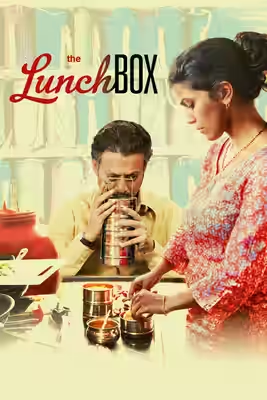
After The King's Speech, try Pygmalion (1938, Fi1m 84): Another sharp, funny tussle over speech, status and who gets to set the rules. Then My Left Foot (1989, Fi1m 85): A physically precise central performance gives a prickly man room to be difficult; and The Lunchbox (2013, Fi1m 75): An unlikely friendship develops through small exchanges, with warmth and room for doubt.

Cast

Awards

Academy Awards, 2011

Nominated
Best Cinematography
Nominated
Best Costume Design
Nominated
Best Film Editing
Nominated
Best Original Score
Nominated
Best Production Design
Nominated
Best Sound
Nominated
Best Supporting Actor
Nominated
Best Supporting Actress
Won
Best Actor
Won
Best Director
Won
Best Picture
Won
Best Writing, Original Screenplay

European Film Award for Best Actor, 2011

Won
European Film Award for Best Actor

European Film Award for Best Composer, 2011

Nominated
European Film Award for Best Composer

European Film Award for Best Editor, 2011

Won
European Film Award for Best Editor

European Film Award for Best Film, 2011

Nominated
European Film Award for Best Film

European Film Award – People's Choice Award for Best European Film, 2011

Won
European Film Award – People's Choice Award for Best European Film

BAFTA Film Awards, 2010

Won
Best Film

If you liked this, try…

  1. Pygmalion (1938, Fi1m 84)Another sharp, funny tussle over speech, status and who gets to set the rules.

  2. My Left Foot (1989, Fi1m 85)A physically precise central performance gives a prickly man room to be difficult.

  3. The Band's Visit (2007) · not reviewed yetFormal strangers gradually relax in a comedy that knows when to stop talking.

  4. The Lunchbox (2013, Fi1m 75)An unlikely friendship develops through small exchanges, with warmth and room for doubt.

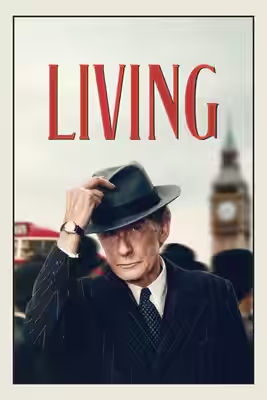
  5. Living (2022, Fi1m 81)A restrained lead performance makes duty and buried feeling matter without much fuss.

Free account

Know what to watch tonight

Two lists that know where things are streaming, collections you can share, your own score beside ours, and Discover that remembers what you have seen.

  • Want to see, sorted by what is streaming now
  • Seen, with your score out of ten
  • No adverts, ever