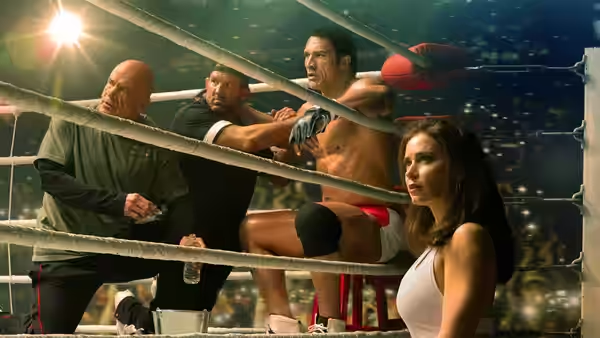
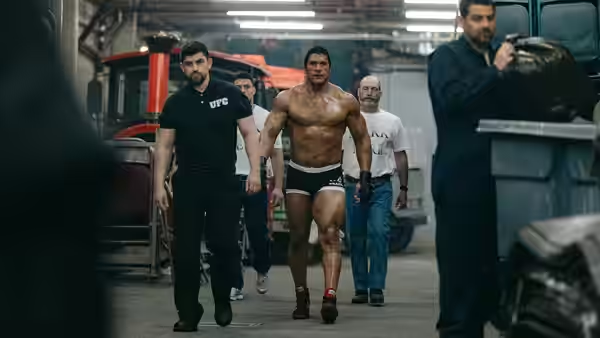
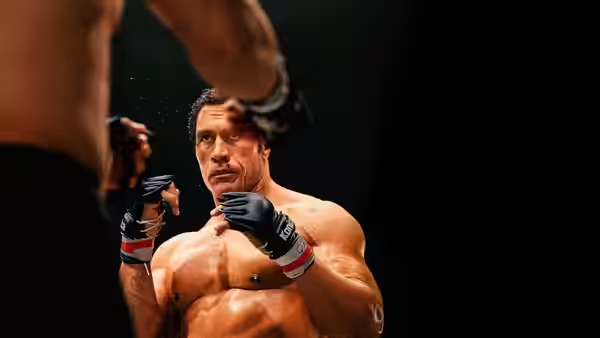
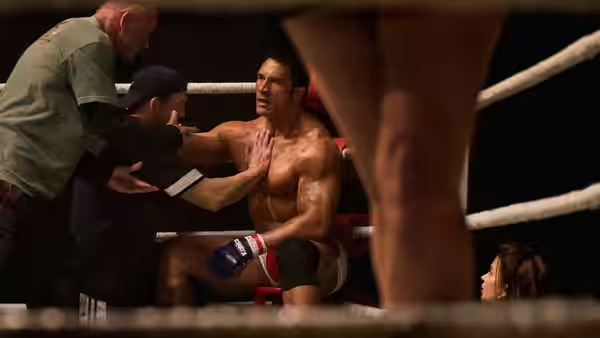
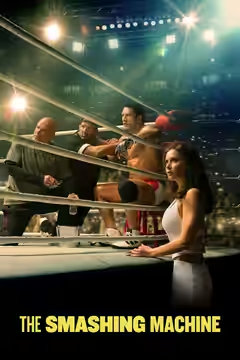
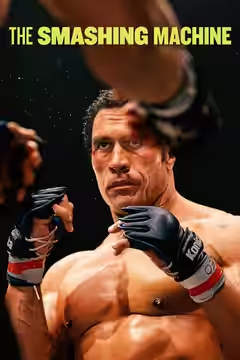
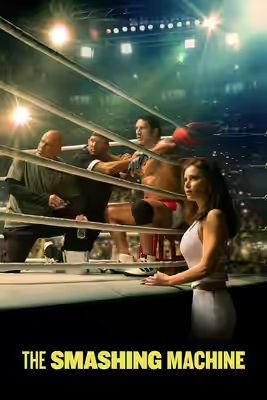
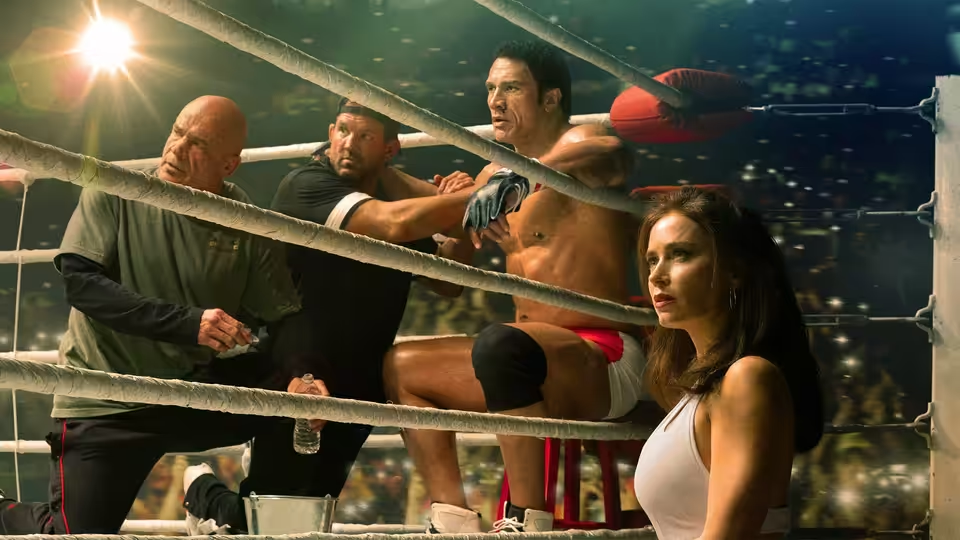
Mark Kerr (Dwayne Johnson) climbs the ropes in a boxing ring while Dawn Staples (Emily Blunt) watches
Film review

The Smashing Machine

2025 · Directed by Benny Safdie · 2h 03m · MPA R

In a sentenceA fight film in which the fights are the calmest hours of the man’s life

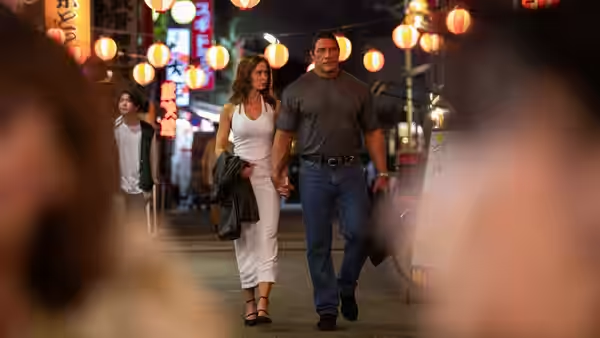
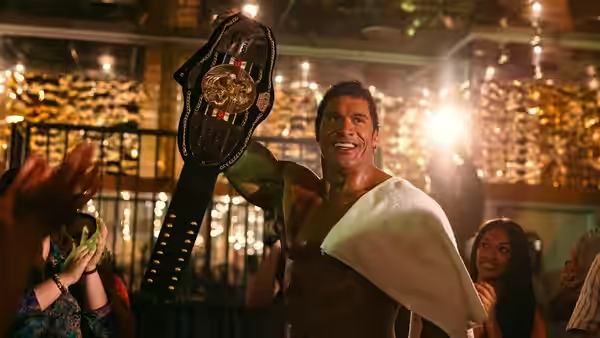
Mark Kerr (Dwayne Johnson) is a heavyweight in the early years of mixed martial arts, a college wrestler turned professional fighter who has not yet lost. The film follows him from a bout in Japan through a run of fights abroad, a friendship with fellow fighter Mark Coleman (Ryan Bader), and a life at home with his girlfriend Dawn Staples (Emily Blunt) that is louder than anything in the ring. The painkillers he takes for his body start to become something else. Bas Rutten appears as himself, and the boxer Oleksandr Usyk plays the opponent Igor Vovchanchyn. Written, directed and edited by Benny Safdie, in his first film without his brother.

Plays from YouTube when you press play; nothing loads from them until then.

Fi1m review

Benny Safdie’s portrait of the fighter Mark Kerr is quiet, careful and better acted than we had any right to expect, with Dwayne Johnson unrecognisable and good. It is also slower than it needs to be, and more ordinary than its manner lets on.

Benny Safdie, directing alone for the first time, has made a film about a fighter that hardly cares who wins. Mark Kerr (Dwayne Johnson) is a heavyweight in the first years of mixed martial arts, a wrestler who has never lost, and the film follows him through fights in Japan, a painkiller habit he does not think of as a habit, and a relationship with Dawn Staples (Emily Blunt) that is louder than anything in the ring. It is a good film with a fine performance, and it is slower than it needs to be. Worth your evening if you can take a sports film that keeps walking away from the sport.

Johnson is the reason to go. Under prosthetics, with his voice pitched soft and high, he plays Kerr as a large, polite boy who is puzzled that anyone should mind being hit by him. He thanks referees. He tells an interviewer he does not want to hurt anybody and only wants to win, and he seems to think those are the same sentence. Johnson has coasted through a decade of films in which he plays himself; here he stands still, listens, and we kept forgetting who we were looking at.

Blunt is the film’s noise. Dawn has decided to be furious before she knows what about, and the rows in the couple’s kitchen have a pitch the fights never reach. It is a big performance in a small film and it does not always fit; twice Safdie lets her go on past the point where we believed her. Ryan Bader, a fighter rather than an actor, plays Coleman with an ease trained actors would envy, and the two men talking nonsense in hotel corridors give the film its warmest minutes. Usyk, as Vovchanchyn, gets the same courtesy the film gives Kerr.

Maceo Bishop shoots the bouts from where a cameraman at the event would stand: outside the ropes, handheld, a half-second late, so that we hear the crowd before we see the knee land. There is no slow motion and nothing under the punches but the punches. James Chinlund’s arenas are lit flat and white like a trade fair and the hotel rooms are hotel-room beige. Heidi Bivens puts the men in tracksuits and singlets that look slept in. Safdie cuts his film so that scenes begin late and end early, and yet nothing hurries; the film drifts.

The oddest choice is the music. Nala Sinephro’s score is soft and warm and close to drowsy, laid over training and grief alike, and one training sequence is set to an Elvis ballad. This is the film saying what it thinks of Kerr: that he is a gentle man in a violent trade and the violence is the least of him. We liked it, and we can see why some have found it sends them to sleep.

Here is what got us. Early on, Kerr describes to a camera what it feels like to have another man give up beneath him, and his face is the face of a child describing a birthday. We were unsettled, then sad, because the film has already shown us his bathroom drawer, and we knew what that pleasure would cost. Johnson does it without raising his voice. It is the best scene he has ever played.

The trouble is the middle. Once the film has established that Kerr is quiet and Dawn is not and the pills are a problem, there are forty minutes in which it says so again. The domestic scenes take the same shape: he goes still, she escalates, somebody leaves a room. The film refuses the usual biopic furniture, the big speech, the montage with drums, and ends up where a biopic goes anyway. Uncut Gems (2019), which Safdie made with his brother, never let us sit still. This one asks us to sit still and does not always give us a reason.

See it for Johnson, whom we did not know could do this, and for the fights, which are the calmest scenes in the man’s life. Do not expect to be gripped; expect to be kept company. It runs 123 minutes and carries a 15.

Critical consensus AI synthesised

73
Positive
14
Mixed
3
Negative
1

The praise clusters on Dwayne Johnson. Nearly every critic singles out his performance as Mark Kerr, describing a star who has set his persona aside for something quieter, sadder and smaller than life, and several call it the best work he has done. Emily Blunt draws warm notices too, with more than one review finding the domestic scenes the strongest in the film. Benny Safdie’s direction gets a more mixed reception. Most admire its gentle, documentary-like approach and its interest in losing rather than winning; the Telegraph also credits the score with giving the story a sweet, spiritual edge.

The reservations are about what surrounds Johnson: a run of critics, from The Ringer to Collider and Den of Geek, find the storytelling conventional and slow, and The New Yorker goes further, calling the film distanced and passionless. Film Stories is the outright dissenter, finding it stiff and without guts. The spread is narrow, with most reviews landing at four stars or its equivalent.

Variety
1 September 2025 · festival review · Owen Gleiberman
90*

Dwayne Johnson gives a revelatory performance as Mark Kerr in Benny Safdie's clear-eyed and humane sports biopic. The film is praised for its intimate, documentary-like approach that avoids conventional biopic tropes while exploring the fighter's inner life.

Read the full review →
Empire
30 September 2025 · John Nugent
85*

The critic praises Dwayne Johnson's transformative performance as Mark Kerr, calling it the best of his career and a response to recent professional setbacks. Benny Safdie's direction is highlighted for creating a thoughtful, moving, and authentic portrait of loss, complexity, and failure in this unconventional sports biopic, drawing comparisons to Raging Bull and Rocky.

Read the full review →
The Observer
3 October 2025 · Wendy Ide
80*

In Benny Safdie’s first solo film, Dwayne Johnson delivers an unexpectedly bruised and naked performance as real-life MMA fighter Mark Kerr, balancing savage competitiveness with childlike earnestness. The story explores his rise and opioid-addled fall, with a terrific turn from Emily Blunt as his demanding girlfriend.

Read the full review →
The Telegraph
3 October 2025 · ★★★★ · Robbie Collin
80

The Smashing Machine is a crunchily satisfying fight movie that innovates subtly, with Dwayne Johnson shedding his daft image for a warm, sincere and ego-less performance as Mark Kerr. Safdie summons thrilling energy, and the score gives the tough story an unexpectedly sweet and spiritual edge.

Read the full review →
Time Out
1 September 2025 · ★★★★ · Phil de Semlyen
80

An unexpectedly gentle and soulful character study that puts heart before glory in the world of MMA. Johnson undercuts his persona with vulnerability in what amounts to his The Wrestler moment.

Read the full review →
Financial Times
2 October 2025 · Danny Leigh
75*

Benny Safdie’s curious drama about the fighting life is built around Dwayne Johnson, who is very good as Mark Kerr, conjuring an elusive character with fleeting glances and remarks. It is a big man in miniature, with souls grappled with in a hard-hitting film tied to Johnson’s wrestling roots.

Read the full review →

Straight answers AI written, from our review

Is The Smashing Machine worth watching?
The Smashing Machine is worth watching for anyone who can take a sports film that keeps walking away from the sport, and we scored it 70. Dwayne Johnson, under prosthetics and speaking soft, is the reason to go, and the fights are shot plainly and well. The middle forty minutes repeat themselves, so expect to be kept company rather than gripped.
How long is The Smashing Machine, and what is it rated?
The Smashing Machine runs 2h 03m and is rated R by the MPA in the US. It is a drama and history film.
Where can I watch The Smashing Machine in the US?
The Smashing Machine is streaming on HBO Max, Hulu, The Roku Channel and Amazon Prime Video in the US, and it is also available to rent from Amazon Prime Video from $4.99. Availability is checked daily; the links above go straight to each service.
How violent or frightening is The Smashing Machine, and is it suitable for children?
The Smashing Machine carries a UK 15 and a US R, and it is not for children. The fights are filmed without slow motion or softening, so the knees and punches land as they would in a real bout, and the kitchen rows between Kerr and Dawn are louder than anything in the ring. The film also follows a painkiller habit turning into addiction, which is the heavier material.
How does The Smashing Machine compare to The Wrestler?
The Smashing Machine and The Wrestler are both about a big man taken apart gently, with a body that will not stop paying, and the earlier film is the tighter of the two. Aronofsky presses harder on a familiar second-chance story; Safdie drifts, refuses the big speech and the montage, and is slower for it. Rourke's tenderness gives The Wrestler more reason to endure the punishment, while Johnson's stillness is the quieter surprise.
What should I watch after The Smashing Machine?
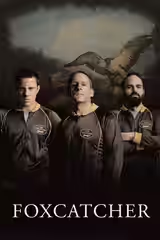
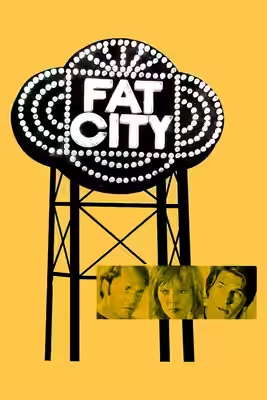
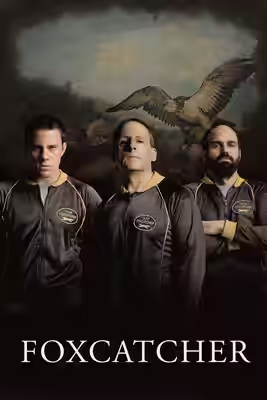
After The Smashing Machine, try The Wrestler (2008, Fi1m 85): Another big man taken apart gently, with a body that will not stop paying. Then Fat City (1972, Fi1m 73): Huston’s boxers lose slowly in daylight; the least glamorous fight film ever made; and Foxcatcher (2014, Fi1m 82): Wrestlers, money and a quiet man who cannot say what he wants.

Cast

If you liked this, try…

  1. The Wrestler (2008, Fi1m 85)Another big man taken apart gently, with a body that will not stop paying.

  2. Fat City (1972, Fi1m 73)Huston’s boxers lose slowly in daylight; the least glamorous fight film ever made.

  3. Tokyo Fist (1995) · not reviewed yetTsukamoto’s Japanese answer: fighting as sickness, shot as if the camera were bleeding.

  4. Foxcatcher (2014, Fi1m 82)Wrestlers, money and a quiet man who cannot say what he wants.

  5. The Iron Claw (2023, Fi1m 71)Brothers in the ring, grief outside it, and Efron unrecognisable in the same way.

Free account

Know what to watch tonight

Two lists that know where things are streaming, collections you can share, your own score beside ours, and Discover that remembers what you have seen.

  • Want to see, sorted by what is streaming now
  • Seen, with your score out of ten
  • No adverts, ever