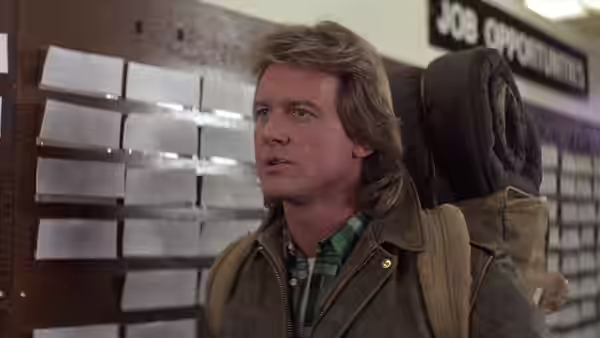
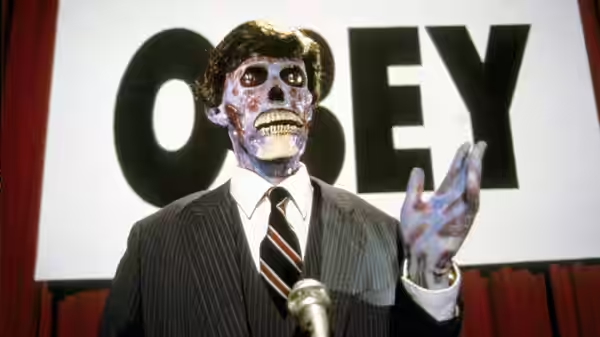
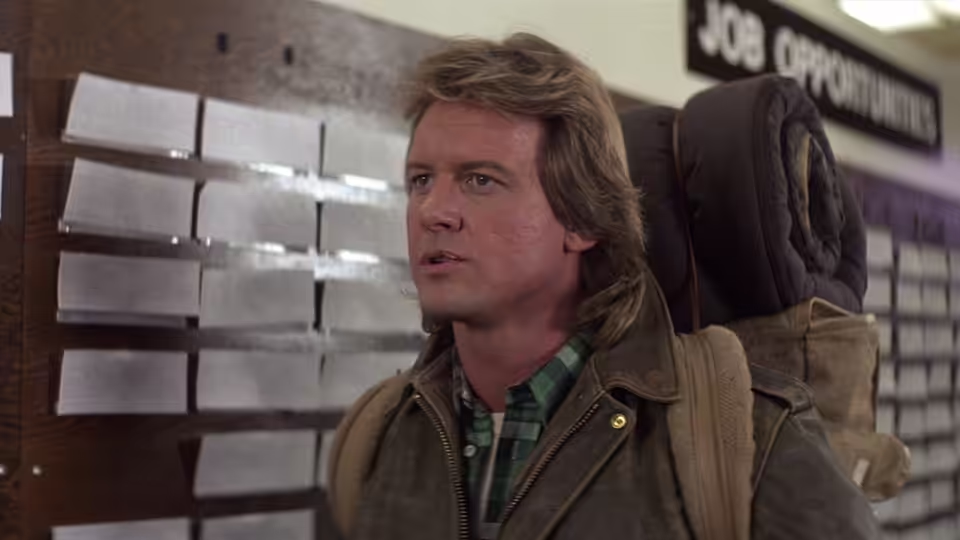
John Nada (Roddy Piper) standing before a job opportunities board
Film review

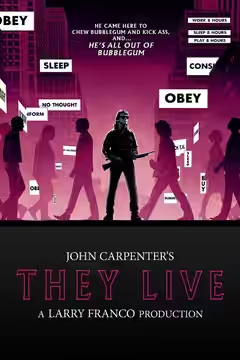
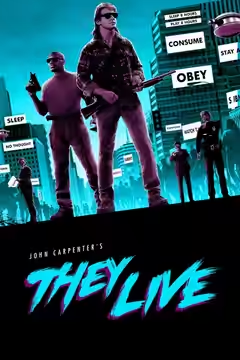
They Live

1988 · Directed by John Carpenter · 1h 33m · MPA R

In a sentenceA pair of sunglasses makes the economy look even worse

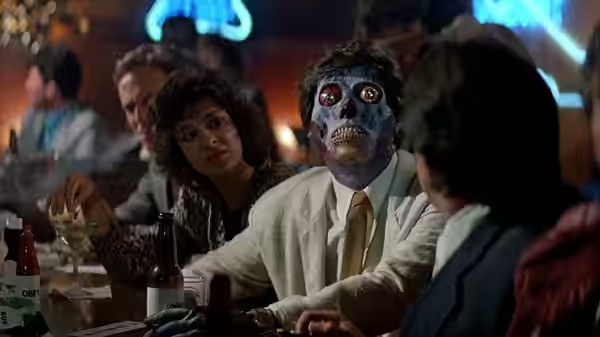
John Nada (Roddy Piper) discovers a pair of sunglasses that allows him to see what ordinary eyesight misses. Advertising conceals commands, and the people controlling the economy are not all human. Aliens use subliminal messages to keep the population obedient, hiding their power behind the habits of consumer life. Nada’s discovery puts him up against a system built to prevent people noticing who runs it, in a story that brings science fiction, political satire and physical confrontation together. Keith David plays Frank Armitage, with Meg Foster as Holly Thompsen.

Plays from YouTube when you press play; nothing loads from them until then.

Fi1m review

John Carpenter’s alien-invasion satire makes consumer culture look properly sinister, even when the storytelling wanders. Roddy Piper’s awkward charm and a sharp visual premise carry it through some clumsy dialogue and rather too much gunfire.

John Carpenter’s They Live is a funny, angry science-fiction film with a simple complaint: people are being told what to want by those who profit from their obedience. Its aliens control the economy through subliminal messages, which gives a familiar invasion story something specific to be cross about. Carpenter enjoys the fighting enough to let it crowd out the satire, and the story has some awkward joins. Even so, the discovery that special sunglasses can expose the whole arrangement is enough to make the film worth an evening.

Roddy Piper plays John Nada, the man who gets to see what everyone else is missing. Piper is better at being physically indignant than at delivering dialogue, and some lines sound as though he is still deciding where to put the emphasis. Yet his lack of polish helps: this is an appealing lead who seems equipped to hit a problem before he can explain it. Keith David, as Frank Armitage, brings a welcome firmness to the performances. Together they make the move towards action feel natural, even when it is not particularly helpful.

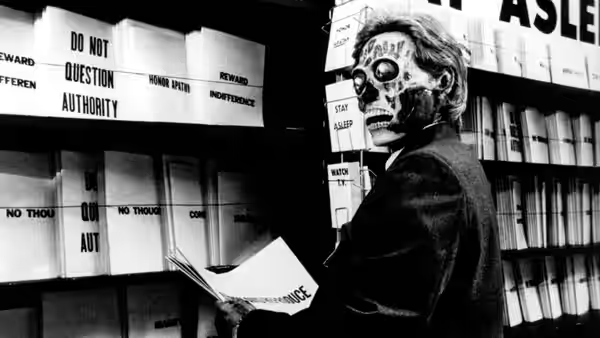
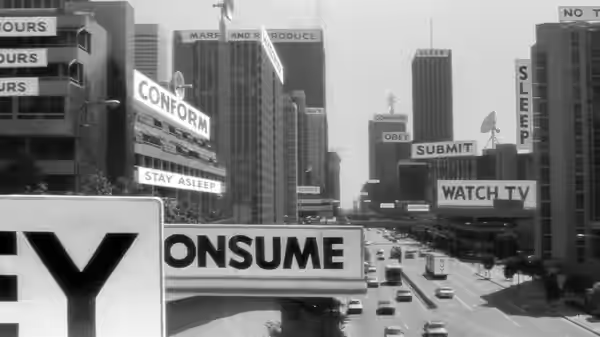
The sunglasses are the film’s strongest piece of storytelling. Advertising gives away its concealed instructions, and people in positions of power reveal what they are. We were unsettled by the advertising’s concealed instructions, because they scarcely exaggerate what advertising already asks us to do. Gary B. Kibbe’s cinematography keeps that discovery legible, so we can take in the joke without waiting for an explanation. The advertising also gives the production design a clear job, making the everyday business of buying things sufficient to suggest a threat.

Carpenter and the editors, Gib Jaffe and Frank E. Jimenez, take their time over the prolonged back-alley fight. They let it continue well past the point at which the need to establish anybody’s toughness has been met. We laughed at the sheer amount of effort involved, as the fighting continued after any reasonable opponent might have asked for a chair. It is a good joke about the exhausting business of winning a fight, and the editing gives it room to become ridiculous.

The trouble comes when gunfire starts to seem like the film’s answer to every question. Carpenter’s screenplay has given us an enemy worth thinking about, but the loose plotting and increasingly routine action leave less room to think about it. John Carpenter and Alan Howarth’s music keeps the action moving without making the shift feel much less abrupt. We start waiting for another discovery, rather than another opportunity for Nada to demonstrate that he can take care of himself.

As an alien-invasion film, it is pleasingly interested in who already has power before the invaders are exposed. The satire aims at consumerism and class, and Carpenter makes no attempt to hide whom he dislikes. That bluntness can wear thin: once we understand the connection between buying things and doing as we are told, the film has limited ways of developing it. But its willingness to take ordinary people’s discontent seriously gives the fighting a reason beyond the usual business of defeating an unpleasant visitor.

At 93 minutes, They Live does not demand much patience, although it sometimes spends that patience carelessly. The clumsy stretches are easier to forgive because Carpenter finds things to be angry about that we recognise without explanation. If polished dialogue is a condition of the evening, choose something else.

Critical consensus AI synthesised

75
Positive
7
Mixed
2
Negative
0

Most critics respond warmly to They Live, with praise centred on its attack on consumerism, class divisions and conformity through an accessible science-fiction action story. The sunglasses discovery and prolonged alleyway fight recur as highlights, giving the political satire a directness and physical force that the more enthusiastic reviews relish. Carpenter’s handling of paranoid suspense and anti-establishment humour also earns approval, particularly where the film makes its points without stopping the entertainment for a lecture.

The reservations concern how well that premise sustains a whole film, with several reviews noting uneven storytelling, tonal shifts or a disappointing payoff. Piper’s physical presence wins admirers, though his dialogue delivery and acting divide opinion. Time Out finds that fistfights and gunfire soon displace the intriguing idea, while The New York Times faults the blunt direction and weak performances. The spread is chiefly between enthusiasm for the satire’s bluntness and frustration with its execution.

Slant Magazine
1 December 2013 · Calum Marsh
85*

The critic praises the film's effective smuggling of an anti-consumerist message inside an entertaining B-movie sci-fi action package that indulges in spectacle while delivering pointed satire. He singles out the way it forces confrontation with commercial culture's control without sounding preachy.

Read the full review →
The AV Club
27 March 2008 · Scott Tobias
80*

The critic calls it one of Carpenter's last great films and a relevant satiric portrait of Reagan-era America that delivers genre goods while sneaking in social commentary on consumerism and class. He singles out the notorious six-minute alleyway fight scene as a highlight of its cult appeal.

Read the full review →
Empire
1 January 2013 · William Thomas
75*

The film re-uses sci-fi clichés and leaps around without a fully coherent storyline but keeps moving with a bizarre, intriguing mix of political allegory and old-fashioned paranoid horror. A highlight is the prolonged back-alley fight scene that parodies professional wrestling, though the payoff is disappointing; overall the film leaves viewers on a genuine high.

Read the full review →
Radio Times
★★★ · John Ferguson
60

The film is a cheerful B-movie salute to 1950s alien invasion sci-fi that returns Carpenter to his roots, with a relaxed directorial style that keeps the action moving while delivering satirical jabs at yuppie culture. Piper excels in action but is less effective with dialogue, supported well by the cast.

Read the full review →
Time Out
21 July 2014 · CM
60*

The critic describes the premise of aliens controlling humans via subliminal messages as initially intriguing but notes that the film quickly shifts focus to fistfights and gunfire. The comic-strip action is presented without demanding serious attention.

Read the full review →
Los Angeles Times
4 November 1988 · Michael Wilmington

Wilmington praises the film's wicked central concept of space invaders controlling society through subliminal messages and calls it one of Carpenter's best, with paranoid buildup and anti-establishment humor, despite some tonal shifts and silly moments.

Read the full review →

Straight answers AI written, from our review

Is They Live worth watching?
They Live is worth watching for anyone who wants an angry, funny alien-invasion film with a sharp premise, and we scored it 79. John Carpenter lets the gunfire crowd out the satire and the plotting is loose, so those who need polished dialogue should choose something else. The sunglasses that expose the whole arrangement carry the evening.
How long is They Live, and what is it rated?
They Live runs 1h 33m and is rated R by the MPA in the US. It is a science fiction and action film.
Where can I watch They Live in the US?
They Live is available to rent from Amazon Prime Video from $3.99. Availability is checked daily; the links above go straight to each service.
How violent or frightening is They Live, and is it suitable for children?
They Live carries an 18 certificate in the UK and an R in the US, and it is not suitable for children. The violence is a prolonged back-alley fight and a good deal of routine gunfire rather than anything designed to terrify. The unsettling part is the satire, in which advertising conceals orders that scarcely exaggerate what it already asks of us.
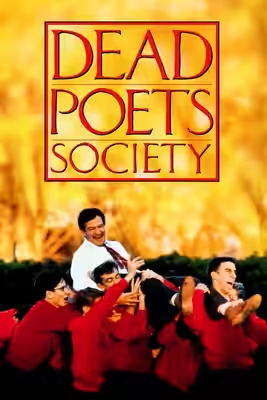
How does They Live compare to Dead Poets Society?
They Live and Dead Poets Society are both about people told what to want by those with power over them, but they are otherwise films of very different kinds. Carpenter's is a blunt science-fiction satire with fists and gunfire; Peter Weir's is a school drama that earns its sentiment through its performances. Weir's is the more polished; Carpenter's is angrier and cares less about behaving politely.
Is They Live based on a true story or a book?
They Live is not based on a true story; it is adapted from a novel by Ray Nelson. Carpenter's screenplay turns the source into a satire of consumerism and class, and our review does not measure how closely it follows the book. Knowing the source is unnecessary, since the film explains its premise the moment the sunglasses go on.
What should I watch after They Live?
After They Live, try Seconds (1966, Fi1m 84): A purchased fresh start turns sinister in another science-fiction attack on consumer promises. Then Society (1989, Fi1m 80): Class resentment becomes bodily horror with even less interest in behaving politely; and Sorry to Bother You (2018, Fi1m 81): Workplace obedience gets stranger and nastier in a satire that refuses good manners.

Cast

If you liked this, try…

  1. Seconds (1966, Fi1m 84)A purchased fresh start turns sinister in another science-fiction attack on consumer promises.

  2. Society (1989, Fi1m 80)Class resentment becomes bodily horror with even less interest in behaving politely.

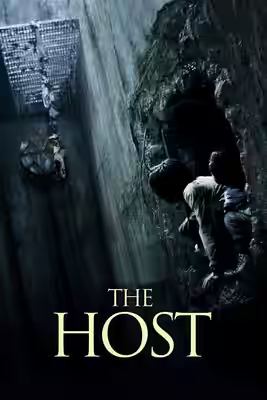
  3. The Host (2006) · not reviewed yetA monster film with political anger and a family worth worrying about.

  4. Sorry to Bother You (2018, Fi1m 81)Workplace obedience gets stranger and nastier in a satire that refuses good manners.

  5. Bacurau (2019) · not reviewed yetA community under threat gives its political anger something practical to do.

Free account

Know what to watch tonight

Two lists that know where things are streaming, collections you can share, your own score beside ours, and Discover that remembers what you have seen.

  • Want to see, sorted by what is streaming now
  • Seen, with your score out of ten
  • No adverts, ever