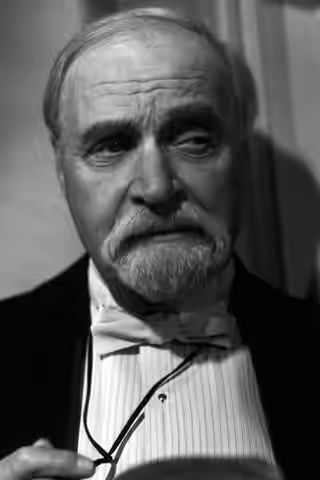
A pillar of the German stage who reached Hollywood in his seventies with almost no English, Albert Bassermann played grave, gentle old Europeans, and made the care of a man speaking a learned language look like wisdom. Hitchcock used it better than anyone.
Fi1m perspective
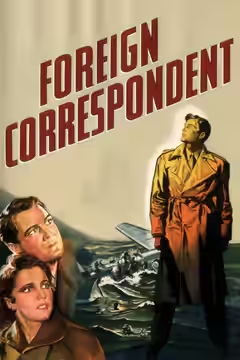
Watch him early in Foreign Correspondent (1940). Van Meer, the Dutch diplomat everyone in the film wants to get hold of, meets Joel McCrea's reporter and answers his plain questions with a courtesy so mild it barely registers as a performance. Bassermann gives him no grandeur at all: an old man who is used to being talked past and has decided not to mind. We found his later scenes hard to sit through, and it is entirely because of how harmless he has been in the first ones; what is done to him we will not describe, but the film's cruelty lands on the softest thing in it. Hitchcock knew exactly what he had.
He had been acting for more than fifty years by then. He began on the Mannheim stage in 1887, having studied chemistry, worked under Otto Brahm in Berlin from 1899 and Max Reinhardt from 1909 to 1915, and was known above all as an Ibsen actor whose characterisations were detailed, individual and often against the grain of how a part was supposed to be done. He was one of the first German stage actors of his standing to go before a camera, in Der Andere (1913), when that was still thought beneath a serious player. He left Germany in 1933 for Switzerland, reached America at the end of the decade, and learned his lines phonetically with his wife Elsa's help.
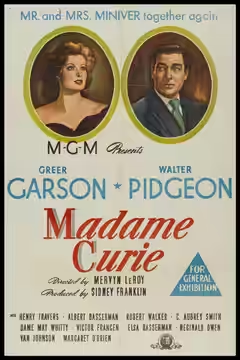
Hollywood knew what to do with a face like that and did it repeatedly. Consul Magnus Barring in A Woman's Face (1941), Professor Jean Perot in Madame Curie (1943): consuls, professors, statesmen, the wise old European standing a step behind the leads. The accent and the phonetic delivery kept him there, and nobody was going to hand a lead to a man in his seventies working in a second language. What survives on screen is a way of speaking. Each word is set down separately, as if it had been carried some distance, and in a small part that reads as gravity. He said once that his aim had been to make people out of parts. The Hollywood parts were small, so the people had to be made fast, and he made them.
His last film was The Red Shoes (1948), as Sergei Ratov, the company's stage designer. Our review does not mention him, and that is fair: he is one of the faces around Lermontov's table, part of the company rather than a figure in it, which is what the film needs from him. See Foreign Correspondent for the performance. See The Red Shoes for the film, and if you know to look, you will find him there, listening.
Biography
Albert Bassermann (also credited as Albert Basserman) was a German stage and screen actor. Born in Mannheim, he began his career in 1887 and became one of the leading German-speaking actors of his generation, receiving the Iffland-Ring. He specialised in Shakespearean roles and the plays of Henrik Ibsen, and made his screen debut in the 1913 silent film Der Andere.
Bassermann appeared in numerous German films during the 1920s. With his wife, actress Elsa Schiff, he emigrated to the United States in 1939. He continued working in Hollywood as a character actor, receiving an Academy Award nomination for Best Supporting Actor for his performance in Foreign Correspondent (1940). His final film role was as Sergei Ratov in The Red Shoes (1948). He died in 1952 while travelling to Zürich.