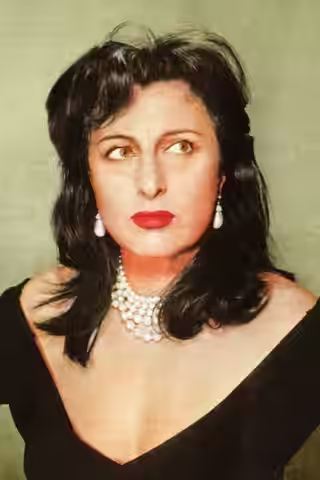
Anna Magnani lets the feeling reach her body before it reaches her mouth, and then it reaches her mouth at volume. In Rossellini's Rome and in Tennessee Williams's Gulf Coast front room it never once looks acted.
Fi1m perspective
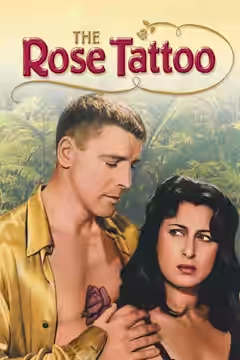
Watch what Anna Magnani does when Serafina Delle Rose hears gossip about her dead husband in The Rose Tattoo (1955). Two customers have come to collect a blouse and start talking. She goes still. Then she throws them out. Then she crosses to the urn on the shelf and speaks to it. Three things, in that order, at full pitch, and none of them looks reached for. That is the Magnani method, if it is a method: the feeling arrives in the body first, and the words come after, usually loudly.
She had been working in Roman nightclubs and repertory theatre since the 1920s and in films since 1934 before Roberto Rossellini put her in Rome, Open City (1945), and that is where the rest of the world caught up with her. Her Pina is the film's warmth and its temper. She is impatient with everyone and funny about it, and the impatience is never sanded down into something ingratiating. We laughed at her and then found we were worrying about her, which is most of the reason the film still frightens. Rossellini used her twice more, including the two-part L'Amore (1948), and through the 1950s she went from director to director: Luchino Visconti for Bellissima (1951), Jean Renoir for The Golden Coach (1952), and then Hollywood, for a run of English-language films between 1955 and 1960.
Hollywood is where The Rose Tattoo comes from, and it is the odd case of a studio getting a foreign star right by doing almost nothing. Tennessee Williams wrote Serafina for her, Daniel Mann pointed the camera and kept out of the way, and James Wong Howe lit her hard from one side so that every change on her face registered. We went in braced for a display and came out moved, because Serafina is not grieving a saint; she is grieving a marriage she will not let anyone else describe. It is a comedy, and Magnani plays it as one, in the same stained slip, for 117 minutes.
The limit is the one she named herself. She grew tired of being cast as the loud working-class woman, and Mamma Roma (1962), for Pier Paolo Pasolini, is the example usually given. It is also generally held to be one of her best late performances, which tells you how good she was at the thing she was tired of doing. We have not reviewed it and will not judge it here. After Hollywood she went back to Italy, and her last appearance on screen was as herself, in Federico Fellini's Roma (1972).
Start with Rome, Open City, then The Rose Tattoo, and notice that the same woman is carrying a war film in one and a farce in the other without changing anything she does. She said she wanted people to know that Magnani never lied to them. Watch the scene with the urn and see if you can catch her at it.
Biography
Anna Magnani was an Italian actress. She attended Rome's Academy of Dramatic Art and began her career performing in nightclubs and with touring repertory companies. Her first credited film role was in La cieca di Sorrento (1934).
She achieved international prominence for her portrayal of Pina in Roberto Rossellini's Rome, Open City (1945). Other notable performances include the title roles in Bellissima (1952) and Mamma Roma (1962), Camilla in The Golden Coach (1952), and Serafina Delle Rose in The Rose Tattoo (1955), for which she received the Academy Award for Best Actress. Her final screen appearance was in Federico Fellini's Roma (1972).
Magnani was married to director Goffredo Alessandrini from 1935 until their divorce in 1950.