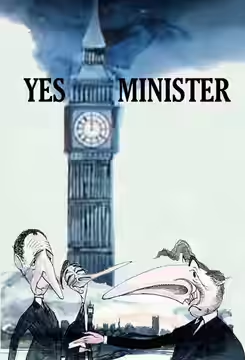
Antony Jay, with Jonathan Lynn, wrote the sharpest comedy British television has made about government, and he did it by finding the jokes in the dull things: the figures, the factory visit, the hospital with no patients. It has barely dated.
Fi1m perspective
Sir Humphrey Appleby begins a sentence and does not stop. Each clause qualifies the one before, the minister waits for the point, and when the point arrives it is that nothing will happen. Antony Jay and Jonathan Lynn wrote those speeches and Nigel Hawthorne said them without a breath, and they carry Jay's whole idea about government. The minister wants to do something; the civil servant explains why it cannot be done; the civil servant wins. We laughed at the first of these speeches, and the third, and somewhere around the tenth we felt a chill, because it was plain he was right, and the minister would be gone in two years and the department would not.
Jay had watched the machine at close quarters. He joined BBC Television in 1955, edited the current affairs programme Tonight and ran Television Talk Features before leaving to freelance as a writer and producer. He wrote the 1969 documentary Royal Family, published Management and Machiavelli in 1967 and set up Video Arts with John Cleese to make training films for managers. None of that is comedy. All of it is about how institutions behave, which turned out to be the only subject he needed.
Yes Minister (1980) is where it paid off. Jay and Lynn wrote all 21 episodes across three series, each built the same way: Jim Hacker has an idea, Sir Humphrey explains at length why it cannot be done, and by the credits Hacker has been persuaded the burial was his own. The plots are about a hospital with no patients, a set of figures the minister has not read, a visit to a factory. Jay researched it with people who had been in the rooms, and the scripts were written months ahead of transmission, so there are no jokes about that week's headlines. "Our jokes were about permanent things rather than temporary things and they stayed relevant," he said. They have. Yes, Prime Minister (1986) moved the same characters into Downing Street and kept the machine running for two more series.
The flaw is the one we named in our review: every episode has the same shape, and four in a row show the joins. Jay's method was to find the mechanism and demonstrate it, and a demonstration repeated too often becomes a lecture. He was fortunate in Lynn, who wrote every episode with him, and in Hawthorne, who made the lectures sound like a man helping a slow child across a road. Watch two episodes, not four, and then watch the news. The joke will still be running.
Biography
Antony Jay was an English writer and broadcaster. He joined BBC Television in 1955 after National Service and worked in current affairs, becoming editor of the programme Tonight from 1962 to 1963 and later head of Television Talk Features before leaving in 1964 to work freelance.
With Jonathan Lynn he co-created and wrote the BBC political comedies Yes Minister (1980–1984) and Yes, Prime Minister (1986–1988). He also wrote the 1969 documentary Royal Family and the 1992 book Elizabeth R. Jay was knighted in 1988 and appointed a Commander of the Royal Victorian Order in 1993.