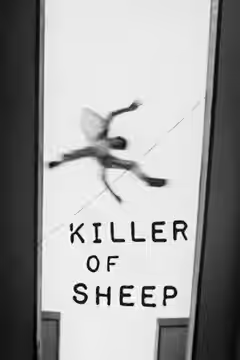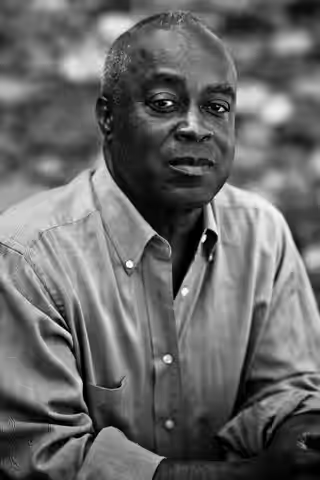
Charles Burnett films Black working-class Los Angeles as it is lived rather than as a lesson, and Killer of Sheep is one of the few American films we would tell a stranger to see. His later work has been far harder to find than it deserves.
Fi1m perspective
Children leap between rooftops. A man kneels under a sink he cannot quite fix. Sheep hang in a row at the slaughterhouse where he works. Nothing in Killer of Sheep (1978) would make a headline, and that is Charles Burnett's method: Stan goes to work, comes home too tired to be reached by his wife or his children, and the camera watches without telling us what to conclude. Burnett shot it himself, in black and white, and cut it himself, and he gives the children's games the same patience he gives the adults' labour. He said he wanted to make a film about the people he knew, and it looks exactly like that.
He knew them because his family moved from Vicksburg to Watts in 1947, and the film was his UCLA thesis, finished in 1977 and shown the following year. He was one of the L.A. Rebellion, the group of Black independent filmmakers at UCLA who worked on each other's pictures; he traded crew duties with Haile Gerima and Julie Dash, and shot Billy Woodberry's Bless Their Little Hearts. His second feature, My Brother's Wedding (1983), he again wrote, shot and produced. To Sleep with Anger (1990), with Danny Glover, was the first with a professional cast, and The Glass Shield (1994) and The Annihilation of Fish (1999) followed, along with a great deal of television and documentary work. Many projects stalled for want of money or a distributor, and his films have kept arriving in restorations well into the 2020s, which tells you how they were treated the first time.
What works is the refusal to arrange life into a crisis. Killer of Sheep moves among work, domestic unease and play without building towards anything, and some early critics took that for arty detachment. We think they mistook the method for a flaw, though our own review admitted the loose episodes need patience and that a few passages outstay their point. The non-professional actors are sometimes hesitant, too. But the structure is what makes Stan's exhaustion understandable, because we are tired with him by the end. We were more upset than we expected by the slow dance to Dinah Washington's 'This Bitter Earth', where the couple stand close and he still cannot reach her; Burnett lets the record carry the longing and asks nobody on screen to explain it.
He is listed here as a producer, and he produced his early films the way he shot and edited them, because that was how they got made. The trouble with Burnett's career has never been in the films. It is that so few people were allowed to see them when they were new. Start with Killer of Sheep, and let it be as slow as it wants to be.
Biography
Charles Burnett is an American film director, writer, producer, editor and cinematographer. Born on 13 April 1944 in Vicksburg, Mississippi, he grew up in the Watts district of Los Angeles and studied creative writing and filmmaking at the University of California, Los Angeles.
His debut feature Killer of Sheep (1978), made as his UCLA thesis film, was shot, written, directed, edited and produced by Burnett. He is also known for My Brother’s Wedding (1983), To Sleep with Anger (1990) and The Glass Shield (1994). Both Killer of Sheep and To Sleep with Anger were selected for the National Film Registry. Burnett received a MacArthur Fellowship in 1988 and an honorary Academy Award in 2017.