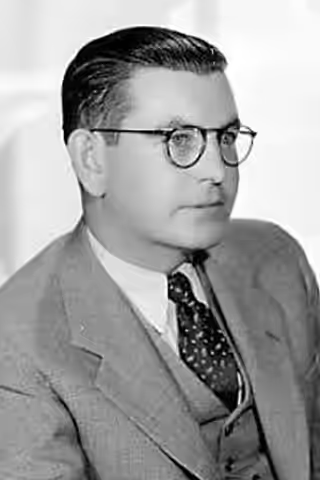
Clyde Bruckman built the long, escalating chase that Buster Keaton's best films ride on, then spent two decades lending the same trick to other comedians. The peak is The General; the decline is a matter of reusing what had already worked.
Fi1m perspective
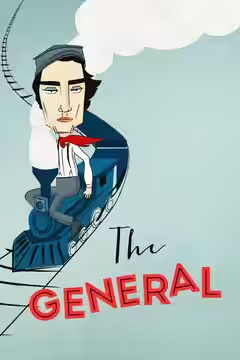
A man on a locomotive has a problem, and the track ahead keeps handing him a new one. That is The General (1926), and it is the clearest statement of what Clyde Bruckman did well. He and Buster Keaton, who share the direction and the screenplay, understood the pleasure of watching somebody do a difficult job while circumstances make it harder, and they built the film so that Johnnie Gray never gets a moment to stand back. We spent the middle stretch worrying more about the engine than about anyone aboard, and we had not expected a machine to get that out of us.
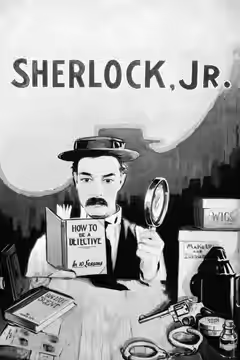
Bruckman came to comedy by an odd route. He was a sportswriter before he wrote titles for films around 1919 and 1920, and from 1921 he was a gag man in Keaton's unit, working with Jean Havez and Joseph A. Mitchell in a room he later described warmly: "In such a situation, gags are never a problem. You feel good. Your mind's at ease, and working." His name is on the screenplay of Sherlock Jr. (1924), on the story of The Cameraman (1928), and on six Keaton films in all. Which gag belongs to whom is not knowable now. What can be said is that the films he is attached to are the ones with the most sustained action built on a single premise, and that this is the thing he was known for.
After Keaton he directed shorts for Laurel and Hardy in 1927 and 1928, among them The Battle of the Century (1927) and its pie fight, and moved on to Harold Lloyd and W. C. Fields, directing The Fatal Glass of Beer (1933). The skill here was fitting the method to the man: Keaton's deadpan precision, Laurel and Hardy's escalating mess and Fields's burlesque each get a different kind of build. From the mid-1930s he worked mostly as a writer at Columbia's short-subject unit, and a good deal of what he wrote there was old material given new faces. He finished on television, for Keaton and for Abbott and Costello, in the late 1940s and early 1950s.
The flaws were there at the height. The joins in the Sherlock Jr. screenplay show; the detective plot and the play with the cinema screen sit side by side rather than together. In both Keaton features the woman is written as an obstacle, and Marion Mack and Kathryn McGuire have to supply the sincerity the script did not. Bruckman's gift was for the mechanism rather than for people, and the romances in his films are there because a chase needs someone waiting at the end of it.
See The General first, and with a crowd if you can find one. Then try Sherlock Jr., where the seams are visible and the laughs come anyway. Bruckman was at his best when the comedian was Keaton and the prop was large; the rest of the career is a man carrying the same toolbox from one set to the next and finding, more often than not, that the tools still fitted.
Biography
Clyde Bruckman (also credited as Clyde A. Bruckman) was an American comedy writer and director active from the silent era into the 1950s. He collaborated extensively with Buster Keaton, contributing screenplays to Our Hospitality (1923), Sherlock Jr. (1924), The Navigator (1924), Seven Chances (1925) and The Cameraman (1928). He co-directed and co-wrote The General (1926).
Bruckman also directed and wrote for Laurel and Hardy, Harold Lloyd, W. C. Fields and others. His credits include directing The Battle of the Century (1927) and The Fatal Glass of Beer (1933). He later worked in television on The Buster Keaton Show and The Abbott and Costello Show.