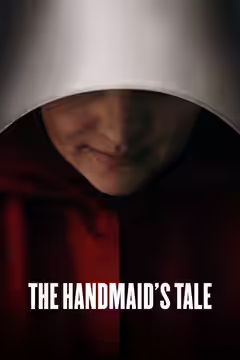
Colin Watkinson is a cinematographer who occasionally directs, and what he does best is make a room look like a painting and feel like a trap. The Handmaid's Tale is the whole case for him; the rest of the career is glimpses.
Fi1m perspective
A woman in red sits by a window with the light coming from one side, and the camera puts her dead centre and stays there long after you would like it to move. That is Colin Watkinson's frame, and The Handmaid's Tale (2017) is built out of it. He shot all ten episodes of the first series and came back for two more, with Zoë White alongside him, and he directed three episodes himself. The window light is borrowed from Vermeer, by his own account, and the bedroom it falls into is Julie Berghoff and Elisabeth Williams's, with nothing in it June could hang, cut or throw. Whenever the Handmaids gather he goes overhead, and they become a block of red on green grass.
He took a long road to that window. He started in the late 1980s as a runner and motion-control operator at Peerless Camera Company in London, after a spell as a quantity surveyor, then pulled focus and shot second unit before anyone let him light a set. The first job that mattered was The Fall (2006) for Tarsem Singh, and he went back to Singh for the ten episodes of Emerald City (2017). In between were commercials, music videos and Entourage; since Gilead there has been Luckiest Girl Alive (2022) and Alien: Earth (2025). We have not reviewed those, so we will not pretend to know them.
What we do know is the method, because he has been open about it. Two modes: a composed, still frame for the controlled world, and a handheld camera for anyone remembering or running. Haze in every room, so the light has something to sit in, and old Canon K35 lenses to take the digital edge off. "We use haze all the time," he told an interviewer, and you can see it in every Waterford interior. The first time the camera went overhead and the women became a pattern, we felt something close to nausea, because the shot was lovely and we had just been told what those women were for. That is the trick, and it is a good one.
The trouble is what happens to a trick over six seasons. Our review said the look was settled early and never changed, and the same composure that made the first ten episodes frightening becomes, in time, a house style, and a house style stops frightening anyone. That is not entirely his fault; he had left the camera by then. It is fair to say that a career spent partly in advertising shows: every image is finished, and a finished image can be admired without being felt. His own line is that it all comes down to the emotional sense, and on the pilot he was right.
He has since gone to space with Alien: Earth. We would like to know whether the haze made the trip.
Biography
Colin Watkinson is an English cinematographer. He began his career as a focus puller and motion control artist before working as a director of photography on feature films and television series.
Watkinson served as director of photography on all ten episodes of the 2017 series Emerald City and on nineteen episodes of The Handmaid's Tale (2017–2019), for which he also directed three episodes. He shot the pilot episode of Alien: Earth (2025). His other credits include the 2006 feature The Fall and the 2022 film Luckiest Girl Alive.
He won the Primetime Emmy Award for Outstanding Cinematography for a Single-Camera Series (One Hour) for the pilot episode of The Handmaid's Tale and received further nominations in the category.