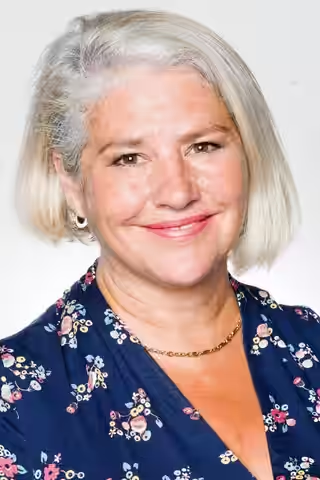
Denise Black delivers a line as if she has something better to be doing, which is why Hazel Tyler in Queer as Folk still lands. Television has kept her in forthright, maternal parts; the stage has given her more room, and she has used it.
Fi1m perspective
Hazel Tyler has the best lines in Queer as Folk (1999) and she delivers them from the kitchen with a fag on, and Denise Black makes them sound like nothing. That is the trick. Russell T Davies wrote Hazel as the mother every gay son in Manchester wished he had, a woman who takes in her son's friends and talks about their sex lives the way other mothers talk about the shopping, and Black never once plays her as a saint. She plays her as busy. The warmth arrives in passing, between a drag on the cigarette and a remark about who was in whose bed.
Then, late in the first series, there is the scene with Kelly's Vince. We will not describe it. We had been laughing thirty seconds earlier and we were not laughing then, and it was Black who turned it, saying one true thing to one son while the camera stayed put. It moved us more than a programme that quick had any right to, and it is the moment that explains why the part has stayed with her. She came back as Hazel in Davies's Cucumber (2015), and most people who know her face know it from that kitchen.
The rest is a working actor's career, and she has worked. Five years as Denise Osbourne in Coronation Street (1992–1997), with returns in 2007 and 2017; Joanie Dingle in Emmerdale (2013, 2015–2017); guest parts in Midsomer Murders, Father Brown and Casualty, where she made her television debut in 1990. The roles are nearly always the same shape: forthright, maternal, resilient, the woman at the table who has seen it all and has a view. Casting directors found a thing she does and kept asking for it. She has not refused.
That is the fair reservation. There has been no leading film role, and the film work she has done, such as Carol in Last Orders (2001), has been supporting. The theatre is where she has been given more to do. She toured Shakespeare early on and has kept at Chekhov and new writing in the regions since, including Rainey in Gary Owen's version of The Cherry Orchard at the Sherman in 2017. Television has rarely asked her for that much.
She told an interviewer in 2015, "I'm Denise, I'm not Hazel, I'm not like Hazel." We believe her, and it is a measure of the performance that we had to be told. She is in Rivals (2024) as Joyce Madden. Somebody should write her a lead.
Biography
Denise Black is an English actress born on 16 March 1958 in Emsworth, Hampshire. After studying psychology at the University of London and working in a psychiatric care home, she travelled abroad before pursuing acting. Her first professional stage role was in Miniatures at Sheffield's Crucible Theatre. She gained her Equity card in 1980 and performed with the Actors' Touring Company in productions including Shakespeare tours to South America and elsewhere.
Black is known for her television roles as Denise Osbourne in Coronation Street (1992–1997, with returns in 2007 and 2017), Hazel Tyler in Queer as Folk (1999–2000) and its follow-up Cucumber (2015), and Joanie Dingle in Emmerdale (2013, 2015–2017). She has appeared in other series including Midsomer Murders, Sherlock Holmes, Father Brown, Robin Hood, Casualty and Rivals (2024). In theatre she received the UK Theatre Award for Best Performance in a Play in 2018 for The Cherry Orchard.