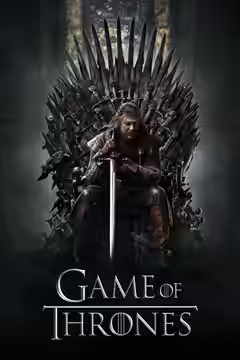
Clarke's gift is a stillness that looks like thinking: she holds a level gaze across a long scene and makes you believe a decision is being made behind it. Television gave her eight years to use it; film has mostly given her secrets to keep.
Fi1m perspective
Emilia Clarke watches. Put her in a scene with other actors and she will be the one whose face is doing the least, and after a minute you find you are looking at her to see what she makes of it all. It is a still, level, slightly upturned gaze, and the brow above it works harder than she may know; reviewers have noticed the forehead, and on a cinema screen it can read as nerves. On television, at a distance and over years, the same face reads as someone thinking, and that is where she has done her best work.
The work is Game of Thrones (2011–2019), eight seasons under David Benioff and D.B. Weiss, and Daenerys Targaryen is the part she will be asked about for the rest of her life. We rated the series highly and said the cast had no weak link, and she is a large part of why we could. The early seasons gave her one note to play and some critics said so. What she did across the long arc afterwards, from vulnerability to something much harder, is the slow kind of acting that television allows and film almost never does, each step taken plainly and without announcement. We noticed, some years in, that we had stopped watching anyone else in her scenes.
Film has been less kind, mostly because it has cast her for the stillness and forgotten to put anything behind it. Terminator Genisys (2015) and Solo: A Star Wars Story (2018) both wanted the presence without the years. We said of her Qi'ra in Solo that she "is poised and watchful and has nothing to play except a secret, and a secret is not a character", and we wanted to like her in it, and spent the back half watching Clarke wait for a scene that never arrived. The romantic leads fit her better. Me Before You (2016) uses the warmth and a quick, unguarded joy; Last Christmas (2019), for Paul Feig, from an Emma Thompson script, uses her comic timing, though the forehead did a good deal of the work there too.
She has gone back to the stage twice, in Breakfast at Tiffany's on Broadway in 2013 and The Seagull in the West End in 2022, and Jamie Lloyd, who directed her on stage, said of her: "Whatever she does is so honest and thoughtful and true, and there's this amazing warmth which felt appropriate for Nina." Honest, thoughtful, true and warm is a fair list. It is also a list of things that take time to show. Give Clarke a character with nothing to hide and eight years to change, and she is as good as anyone working in television. Give her a secret and a franchise, and she will hold the gaze and wait for the writers.
Biography
Emilia Clarke is an English actress. She was born on 23 October 1986 in London.
Clarke trained at Drama Centre London, graduating in 2009. Her first professional television role was a guest appearance in the BBC One series Doctors in 2009. She rose to international prominence playing Daenerys Targaryen in the HBO series Game of Thrones (2011–2019), for which she received four Primetime Emmy Award nominations.
Her film roles include Sarah Connor in Terminator Genisys (2015), Qi'ra in Solo: A Star Wars Story (2018), Louisa Clark in Me Before You (2016) and Kate Andrich in Last Christmas (2019). In 2024 she was appointed Member of the Order of the British Empire (MBE) for charity work.