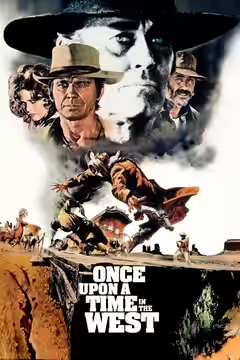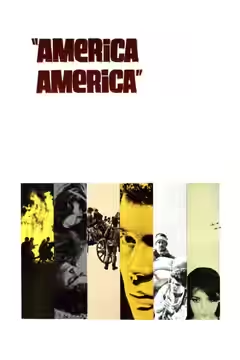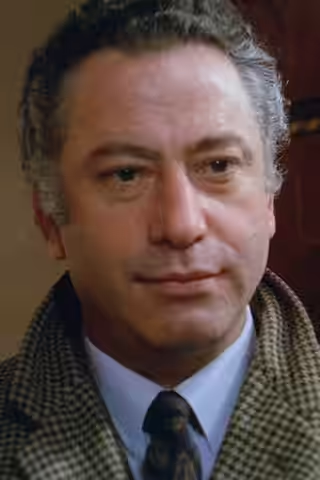
An American who spent his best years in Italian genre films, Frank Wolff made small parts feel lived in. In America America and Once Upon a Time in the West he is on screen briefly and missed for the rest of the film.
Fi1m perspective
Frank Wolff has a face that looks as though it has already been through something before the film found it. In America America (1963) Haskell Wexler shoots the Anatolian town in hard black and white, all dust and whitewash and shadow, and Wolff's Vartan fits into it as if he had been standing there when the crew arrived. He has perhaps a quarter of an hour on screen. Then he is gone, and the rest of the film keeps stepping round the hole he leaves.
He started in America, in five low-budget Roger Corman pictures between 1958 and 1961, in bit parts and supporting parts. It was Corman who advised him to try Europe, and by 1961 he had settled in Italy. The move paid off quickly. Francesco Rosi cast him as Gaspare Pisciotta in Salvatore Giuliano (1962), and Elia Kazan gave him Vartan the following year. After that he became one of those American faces Italian directors kept on hand through the 1960s, in spaghetti westerns, gialli and crime films, and he worked steadily until his death in Rome in 1971.
His two best-known westerns, both from 1968, show the two things he could do. For Sergio Leone, in Once Upon a Time in the West, he is Brett McBain, the optimistic farmer whose fate sets the whole revenge story going; the part is short, the film runs 166 minutes and tangles its plotting more than it needs to, and yet it never stops being about what happened at his farm. For Sergio Corbucci, in The Great Silence, he is Sheriff Gideon Corbett, a sympathetic figure of authority and the nearest thing to light relief in a bleak film. He worked twice with Fernando Di Leo, and his police commissioner in Caliber 9 (1972) reached cinemas after he had died.
We came out of America America thinking mostly about Stavros, as Kazan intends, and then realised we had spent the last hour half-waiting for Vartan to walk back in. That is the measure of the performance. We knew the man for fifteen minutes and kept looking for him, and nothing in Wolff's playing asks for it: no big speech, no single showcased moment, just a man who plainly has a life the camera has interrupted.
The complaint against him is really a complaint about the trade. After Corman he stayed in Italy, and a career spent in European genre pictures meant that outside that country few people learned his name, even when they knew the face. There is no lost lead performance to point to; the record is a long line of farmers, sheriffs and commissioners, done properly. If you want to see what he could do with time, start with America America. If you want to see what he could do without it, Leone gave him almost none and he used all of it.
Biography
Frank Wolff was an American actor. Born Walter Frank Hermann Wolff in San Francisco, he studied acting at the University of California, Los Angeles, and appeared in several early films directed by Roger Corman.
He moved to Europe in the early 1960s and became a familiar face in Italian cinema, with roles in films including Salvatore Giuliano (1962), America America (1963), The Great Silence (1968) as Sheriff Gideon Corbett and Once Upon a Time in the West (1968) as Brett McBain. He also appeared in television series such as The Twilight Zone and The Saint.
Wolff died in Rome in December 1971.