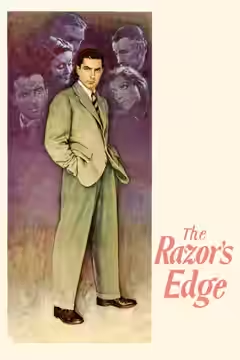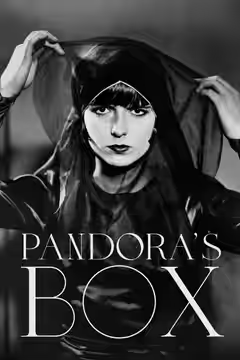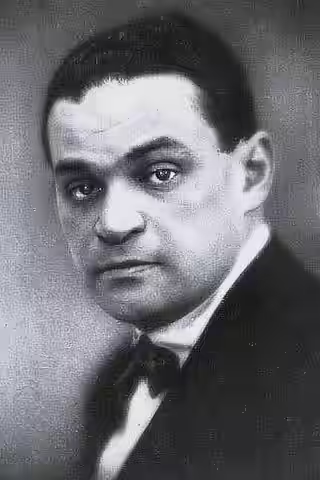
Fritz Kortner makes authority look difficult to maintain. We respond to the locked jaw and working hands, while recognising how old-fashioned those gestures look beside Louise Brooks in Pandora's Box.
Fi1m perspective
In Pandora's Box (1929), Fritz Kortner's Dr Ludwig Schön holds his jaw rigid while his hands keep working. He comes into Lulu's dressing room to order her onto the stage, and the strain in his body makes the demand unpleasant before it needs explaining. G.W. Pabst gets useful force from that heavy manner, but the contrast with Louise Brooks is unforgiving: she changes expression without preparing us for it. We felt caught by her face in that scene, and Kortner's visible effort made her ease more striking. The performance works, though there is nothing delicate about it.
That manner belongs to an actor whose work with the stage director Leopold Jessner helped establish him in Expressionist drama. The Count in Warning Shadows (1923) and Nera in The Hands of Orlac (1924) sit within an early film career frequently given over to menacing characters. His gruff appearance also suited milder character parts, and it would be a mistake to judge him only by his villains.
Edmund Goulding's The Razor's Edge (1946) gives him a different use as Kosti, a drunken, learned man whom Tyrone Power's Larry Darrell encounters down a coal mine. Kortner briefly gives the film a rhythm that its solemn account of Larry's spiritual search otherwise struggles to find. He is welcome in a film whose leading man is too often left to look thoughtful while others explain him. His presence cannot make the rest of the quest convincing. We would not recommend the whole film on Kortner's appearance alone.
After returning to Germany in 1949, he concentrated on directing stage classics, with close attention to gesture and unconventional readings of the text. That attention to gesture is recognisable in the actor: the hands are worth watching even when the face has already told us enough. We would start with Pandora's Box, where Pabst makes that insistence useful. Just do not expect Kortner to look as modern as Brooks.
Biography
Fritz Kortner was an Austrian actor and theatre director. Born Fritz Nathan Kohn in Vienna on 12 May 1892, he studied at the Vienna Academy of Music and Dramatic Art before joining Max Reinhardt’s company in Berlin in 1911 and later working with Leopold Jessner from 1916. He appeared in silent films from 1916 and became known for character roles, often sinister or threatening figures, in German Expressionist theatre and cinema.
With the rise of the Nazis, Kortner, who was Jewish, left Germany in 1933 and worked as a character actor in the United States before returning in 1949. He directed innovative productions of classics, including a 1964 staging of Richard III. His film roles include Dr Ludwig Schön in Pandora’s Box (1929), Nera in The Hands of Orlac (1924) and Kosti in The Razor’s Edge (1946). Kortner died in Munich on 22 July 1970.