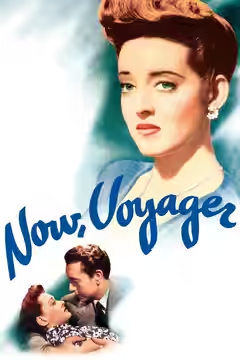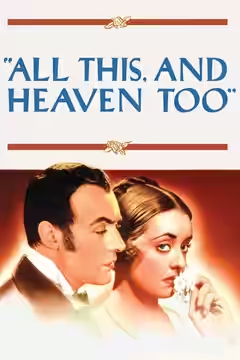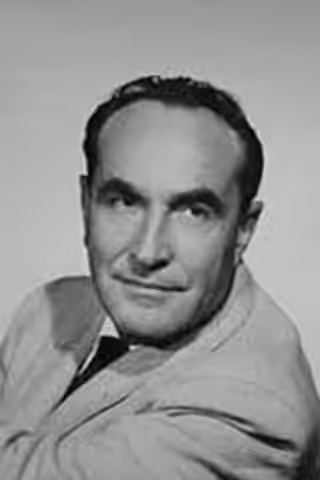
Irving Rapper takes extravagant feelings seriously and trusts actors to make them convincing. We value his patience with people, though Now, Voyager also shows how readily he lets a story wander.
Fi1m perspective
Charlotte Vale remains prickly even when Now, Voyager (1942) seems ready to turn her into a romantic heroine. Bette Davis makes confidence difficult to acquire, and Irving Rapper has the sense to let her. We were moved by Charlotte's uncertainty, which Davis allows to complicate the pleasures of the romance. Rapper's direction can be untidy, but it takes her wishes seriously. Casey Robinson's screenplay, adapted from Olive Higgins Prouty's novel, keeps those wishes in view when the love story threatens to crowd them out.
That attention to the person having the feelings also serves One Foot in Heaven (1941), his first popular and critical success as a director. Fredric March's Methodist minister has a roof, a salary and a congregation's good opinion to worry about, and Rapper accepts these as sufficient business for a film. We largely agree, although the episodic telling takes too long to gather pace. March holds it together without asking us to admire him. Its later stretches justify much of the early patience.
Rapper made his name at Warner Bros. with literary adaptations and melodramas in the 1940s, and directed Davis in four films. The Corn Is Green (1945), adapted from Emlyn Williams's play about education in a Welsh mining community, and Deception (1946) belong to that stretch. His frequent collaborator Max Steiner wrote sweeping scores that made emotional scenes larger still. We welcome Rapper's willingness to encourage strong feelings: Now, Voyager needs to make Charlotte's choices feel as important as they are to her.
After leaving Warner Bros. in 1947, he worked freelance, with a less consistent body of work and fewer films after the 1950s. The Glass Menagerie (1950), the first screen adaptation of a Tennessee Williams play, continued his interest in theatre, but the later work did not establish an equally firm reputation. Our reservations begin earlier: Now, Voyager wanders, and One Foot in Heaven makes a slow start. Both depend on actors who can hold our attention when the storytelling falters. Start with Now, Voyager, and allow Davis more patience than the plotting deserves.
Biography
Irving Rapper was a British-born American film director. Born in London in 1898, he emigrated to the United States and studied at New York University while working as an actor and stage director on Broadway. He joined Warner Bros. in Hollywood in 1936 as an assistant director and dialogue coach.
Rapper made his feature directorial debut with Shining Victory (1941). He directed and produced One Foot in Heaven (1941), which received an Academy Award nomination for Best Picture. Among his other films were several starring Bette Davis: Now, Voyager (1942), The Corn Is Green (1945), Deception (1946) and Another Man's Poison (1951). He also directed The Brave One (1956).