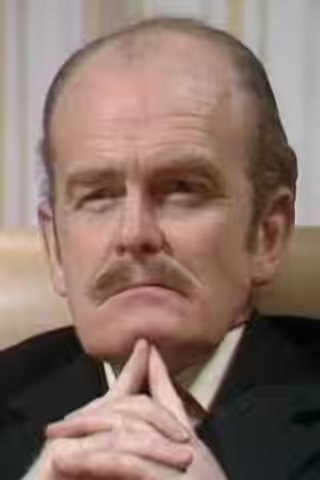
John Barron spent a career playing the man at the head of the table, judge, chief constable, boss, and played him straight. As C.J. in The Fall and Rise of Reginald Perrin he was allowed to play him as a joke, and that is the one that lasted.
Fi1m perspective
C.J. sits behind his desk at Sunshine Desserts and tells Reggie Perrin that he did not get where he is today by doing whatever Reggie has just suggested. The sentence never ends the same way twice, and what ends it is usually one cliché that has collided with another on the way out. John Barron says it every time as though it were a considered opinion. That is the performance, and it is harder than it looks: C.J. believes he is being wise, and Barron never once lets us catch him knowing better.
He had been playing that man for twenty years before David Nobbs wrote him the lines. From the mid-1950s Barron was British television's dependable figure of authority: the assistant chief constable in Softly, Softly (1966), the judge in Crown Court (1973), and between them a long run of bosses, deans, ministers and vicars. He played them straight, because the dramas needed a man whose word would be taken, and he had the voice and the bearing for it. On film he was a sub-editor in The Day the Earth Caught Fire (1961) and a doctor in the bunker of Hitler: The Last Ten Days (1973). It was steady, useful work, and none of it would have earned him a page of his own.
The Fall and Rise of Reginald Perrin (1976) took the same man and put him in a sitcom, and the authority became the joke. Barron had directed Leonard Rossiter in repertory years before, and the two of them know exactly how far apart to stand: Rossiter's Reggie is quietly coming apart, and C.J. has never noticed because C.J. has never noticed anything. We laughed hardest, and still do, at the meetings where he produces a mangled proverb and Tony says 'Great' and David says 'Super' and the meeting moves on as if something has been decided. The joke is not the lines but that nobody in the meeting has ever listened to them, and it works because Barron plays a man who stopped listening to himself long ago. By the third series the phrases are doing most of the work, and even Barron cannot hide it; the first series is where the stuffiness is still fresh.
He called C.J. 'the perfect gift for an actor because he was so appalling', and the gift came with a bill. What followed was more of the same man, not always with Nobbs's writing. Potter (1979) was a show built around its actors rather than its script. The Legacy of Reginald Perrin (1996) brought C.J. back without Rossiter, and a boss with nobody to fail to understand is only a man with a desk. Start with the first series of the original, and watch Barron's face while the office agrees with him.
Biography
John Barron (24 December 1920 – 3 July 2004) was an English actor. Born in Marylebone, London, he trained at the Royal Academy of Dramatic Art after his godfather paid his fees in 1938. He served in the Royal Navy during the Second World War and began his professional career in repertory theatre before moving into direction in the 1950s, where he worked with Leonard Rossiter.
Barron became a familiar face on British television from the 1950s, appearing in series including The Avengers (1961), The Saint (1962), Doomwatch (1970–1971) and The Fall and Rise of Reginald Perrin (1976–1979), in which he played the memorable C.J. He also featured in films such as The Day the Earth Caught Fire (1961), Hitler: The Last Ten Days (1973) and Thirteen at Dinner (1985). He served as president of the actors' union Equity from 1978 to 1982.
His later television credits included roles in To the Manor Born (1981), Whoops Apocalypse (1982) and Yes Minister (1980–1984), where he played Sir Ian Whitchurch.