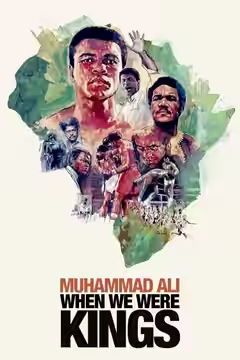
Leon Gast filmed musicians and boxers and, at his best, let them talk. When We Were Kings is the one that matters: a film about Muhammad Ali that took twenty-two years to finish and needed none of the help it was given at the end.
Fi1m perspective
Muhammad Ali on a road outside Kinshasa at dawn, talking to whoever is holding the camera. The man holding it was Leon Gast, who had gone to Zaire in the autumn of 1974 to film a music festival and whatever happened around it, and found a heavyweight fight, postponed, sitting next door. He pointed his crew at the man who would not stop talking and, for most of the running time, kept quiet himself. When We Were Kings (1996) is 89 minutes long and Ali talks for most of them, at press conferences, at his training camp, to anyone with a lens. The talk is the film, and Gast's virtue is having known it.
Gast had begun as a still photographer, for Vogue and Esquire among others, and moved into documentaries with Our Latin Thing (1972), on New York's salsa scene. Music was his first subject and he stayed near it, co-directing The Grateful Dead Movie (1977) with Jerry Garcia and making Hells Angels Forever (1983). The Kinshasa footage sat in cans through all of it. Legal and financial trouble kept it there for more than twenty years, and the wait did the film a favour. The festival had gone ahead, with James Brown, B.B. King and Miriam Makeba on the stadium stage, and by 1996 the songs were history as well as music. The editors, Keith Robinson, Taylor Hackford, Jeffrey Kusama-Hinte and Gast himself, cut them against Ali's training so that the whole film moves at the speed of a set list.
We have watched a good deal of Ali and none of it is better than this. We were laughing at him within minutes, and by the time he walked out to meet George Foreman we were frightened for him, which is the order Gast intends. Brown, drenched and shouting, is worth the evening on his own. The weakness is the one this kind of film always courts: not trusting the material. Norman Mailer and George Plimpton, filmed two decades on, describe what we are already watching, and Spike Lee is brought in to say the fight mattered when the crowd has said it louder. Each time Gast cuts from Kinshasa to a man in a chair the film cools, and we started counting the seconds until he went back. Mobutu's dictatorship and Don King's business are shown, named and set aside, which is too little for either.
The later films kept to the pattern, a charismatic subject, archive, interviews added afterwards. Smash His Camera (2010) is about the paparazzo Ron Galella; Manny (2014), co-directed with Ryan Moore and his last, is about Manny Pacquiao and has the highlight-reel shape the Ali film mostly escaped. We have not reviewed either. Gast died in 2021. The one to see is the one that took him twenty-two years. Start with Ali, and when Mailer appears, go and make the tea.
Biography
Leon Gast (1936–2021) was an American documentary filmmaker who worked as a director, producer, cinematographer and editor. A native of Jersey City, New Jersey, he studied dramatic arts at Columbia University.
Gast is best known for When We Were Kings (1996), which he directed, produced, wrote and edited. The film documents the 1974 Rumble in the Jungle heavyweight boxing match between Muhammad Ali and George Foreman in Zaire and won the Academy Award for Best Documentary Feature. He also co-directed The Grateful Dead Movie (1977) with Jerry Garcia and Hells Angels Forever (1983). His later films include Smash His Camera (2010), which won the directing award at Sundance, and Manny (2014).