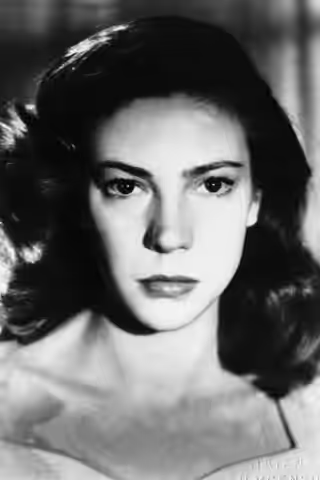
Maria Michi makes troubled women seem human without asking us to approve of them. We value the directness of her early work for Roberto Rossellini, though the parts she played could push her towards melodrama.
Fi1m perspective
In Rome, Open City (1945), Maria Michi plays Marina Mari with a directness that leaves the character’s weaknesses visible. Her delivery is unpolished, suited to a woman who is troubled and difficult company. She conveys inner turmoil without making Marina easy to approve of, and that is a good reason to seek her out. Roberto Rossellini gives her room to be fragile and morally uncertain. We value this early work most, although its emotional force can sit close to melodrama.
Anna Magnani supplies much of the warmth and temper that make the film’s people such good company. We were frightened by Rome, Open City because that warmth makes the suffering harder to bear. The villains and the music sometimes insist too much, so this is hardly a film of uniform restraint. Michi’s naturalistic delivery belongs within that sometimes emphatic drama. Her performance can be emotionally direct without being quiet, and its roughness is part of what makes her worth watching.
Paisan (1946) brought her back to Rossellini as Francesca in the Rome episode, a woman whose life is shaped by postwar hardship. Here too, her strength is making the woman’s distress feel immediate. After a long absence from films, Michi resumed screen work in the 1960s and 1970s, now in supporting parts. She appeared in Claude Chabrol’s The Breach (1970) and played Rosa’s mother in Bertolucci’s Last Tango in Paris (1972). Tinto Brass’s Salon Kitty (1976) was her final film.
The recurring difficulty is that fragile or desperate women can become a narrow set of parts, with distress doing too much of the actor’s work. Michi’s unpolished manner cannot always prevent that, especially when a role encourages melodrama. Yet a small later part need not count as a failure to fulfil an early promise. For a first encounter, choose Rome, Open City, with the caveat that neither the film nor Michi is consistently restrained.
Biography
Maria Michi was an Italian actress. She played Marina Mari in Roberto Rossellini's Rome, Open City (1945) and Francesca in Paisà (1946).
She began working as a typist and then as an usherette at the Teatro Quattro Fontane in Rome, where she was given small stage roles in the early 1940s. After appearing in a few further films in the late 1940s, she married Duke Augusto Torlonia in 1949 and largely left cinema for the theatre, working with directors including Guido Salvini. The marriage was annulled in 1956.
Michi returned to film in the 1960s and 1970s, appearing in supporting roles in titles such as The Breach (1970), Last Tango in Paris (1972), What Have You Done to Solange? (1972) and Salon Kitty (1976).