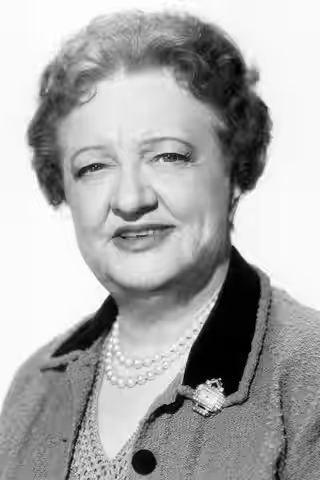
Marion Lorne played one woman for the whole of her screen career: fluttery, plummy, half a sentence behind everyone around her. It is a narrow instrument, and she knew precisely what it was for, from Hitchcock's smothering mother to a witch whose spells never quite land.
Fi1m perspective
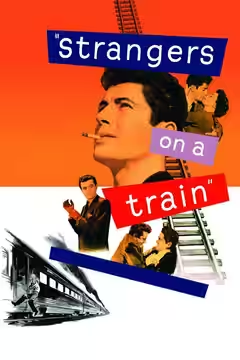
The mumble comes first. A sentence sets off in a plummy, well-bred voice, loses its way, stops, and Marion Lorne's eyes drift away towards the furniture before the double take arrives, a beat late. She did this for fifty years, mostly on stage, and the screen only found her at the end. Her feature debut, at 67, was as Mrs. Antony in Strangers on a Train (1951), the clueless, smothering mother of Robert Walker's Bruno, and it is the version of the act we know best because it sits inside a great film.
What she does there is small and it stays with you. We laughed at her fluttering, and then the laugh stuck in the throat, because Walker's Bruno is dangerous and the woman nearest to him has arranged, quite comfortably, not to notice. Our review of the film does not single her out, and that is fair; it is Walker's picture. But the mother is the joke that explains him, and Lorne plays it without a wink, as if bafflement were simply the weather she lives in.
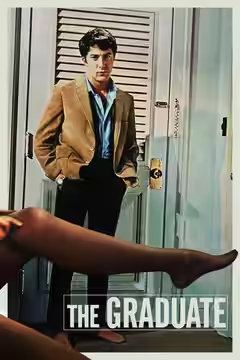
The career before that was theatre. She made her Broadway debut in 1905 and worked in New York and London for decades, running the Whitehall Theatre with her husband, the playwright Walter Hackett, through the 1920s and 1930s. Cinema barely used her after Hitchcock; a cameo as Miss DeWitte in The Graduate (1967) is about the extent of it. Television took her in instead. She was Mrs. Gurney, a perpetually confused English teacher, in Mister Peepers from 1952, and a regular sketch performer on The Garry Moore Show from 1958.
Then Bewitched (1964–1968), and Aunt Clara, the bumbling witch whose spells misfire, forever arriving in the wrong place and collecting doorknobs, which Lorne also collected in life. She said the character was "built on one lovely absurdity after another", which is also a fair description of the performance style. It is one note, and nobody ever asked her for another; Hollywood in particular used her sparingly and never gave her a part with a second gear. Whether she had one, the record does not tell us.
So the recommendation is modest. Put on Strangers on a Train for Walker, as everyone should, and watch what happens to the scene when his mother is in it. She has a few minutes. You will remember the mumble longer than you remember some of the plot.
Biography
Marion Lorne was an American actress of stage, film and television. Born Marion Lorne MacDougal or MacDougall on 12 August 1883 in West Pittston, Pennsylvania, she trained at the American Academy of Dramatic Arts in New York and made her Broadway debut in 1905. She maintained a long career in theatre in New York and London, including productions at the Whitehall Theatre, which she co-founded with her husband, playwright Walter Hackett.
Lorne made her feature film debut in Strangers on a Train (1951) as Mrs. Antony. She later appeared in The Graduate (1967) as Miss DeWitte. On television she played Mrs. Gurney in Mister Peepers (1952–1955), Myrtle Banford in Sally (1957–1958) and Aunt Clara in Bewitched (1964–1968). She received an Emmy Award posthumously for Outstanding Supporting Actress in a Comedy Series for her work on Bewitched. Lorne died on 9 May 1968.