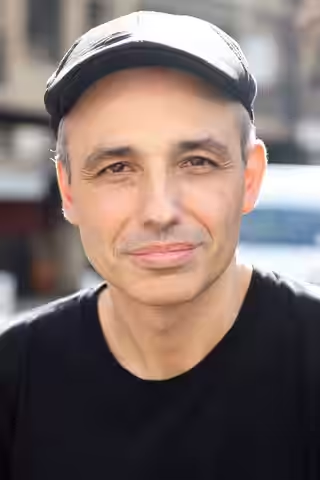
Pablo Berger makes films that hardly speak, and every one is a different bet: a silent Snow White in a bullring, a hand-drawn dog in 1980s New York. The bets mostly pay off; his middles are where he loses us.
Fi1m perspective
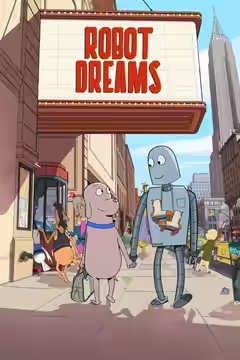
Robot lies on a beach, rusting, and dreams he can walk. He gets up, crosses the sand and goes home; then the sand comes back. Nobody says a word, because nobody in Robot Dreams (2023) says a word, and nobody in Blancanieves (2012) does either. Two of Pablo Berger's four features have no dialogue at all. He has decided that a film is pictures, cutting, music and noise, and he holds to that more stubbornly than almost any director we know.
The career is four films in twenty years, each a different dare. Torremolinos 73 (2003), his debut, is a period comedy about an encyclopaedia salesman who turns to amateur pornography in the last years of Franco. Blancanieves took years to finance and arrived as a silent, black-and-white Snow White set among the matadors of 1920s Andalusia; it is the best version of that story we have seen, and its father-and-daughter scenes moved us. Abracadabra (2017) is a black comedy about a housewife and the paranormal, and the one critics found hardest to hold together; we have not reviewed it. Then Robot Dreams, a hand-drawn adaptation of Sara Varon's graphic novel, set in a New York Berger lived in for a decade and drawn down to the graffiti on the subway cars.
What works is the trust in the frame. In Blancanieves Berger uses the close-up, the iris and the sparing intertitle as ways of telling a story, and in Robot Dreams he lets flat colours and clean black lines carry a friendship. He keeps the same people around him. Alfonso de Vilallonga's scores have done the talking on three of his films, Kiko de la Rica has shot two, and Fernando Franco has cut two, including Robot Dreams, where the seasons pass in small repeated days rather than in montage. The sound is the most exact thing in it: the city has a noise for everything and the robot has one for trying to stand up.
What does not work is the middle. Blancanieves hurries once Carmen leaves the house, as if Berger could not wait to reach the ring, and Maribel Verdú's stepmother is a run of set pieces rather than a woman. Robot Dreams stretches a slim book across 102 minutes, and for twenty of them you can see the stretching. And yet its last ten minutes hurt us more than we expected, because Berger had let each of Robot's dreams run just long enough for us to believe it before the sand came back, and by the end we had stopped bracing.
He works slowly and he has never made the same film twice. We would not guess what comes next. Start with Robot Dreams, with someone old enough for a sadness that does not get fixed; go on to Blancanieves, and do not let the word silent put you off.
Biography
Pablo Berger Uranga is a Spanish film director and screenwriter. Born in 1963 in Bilbao, he directed his first short film, Mamá, in 1988. He studied for a master’s in film at New York University and later taught at the New York Film Academy.
His feature films are the comedy Torremolinos 73 (2003), the silent drama Blancanieves (2012), the black comedy Abracadabra (2017), and the animated film Robot Dreams (2023), which he also wrote and produced. Robot Dreams was nominated for the Academy Award for Best Animated Feature.