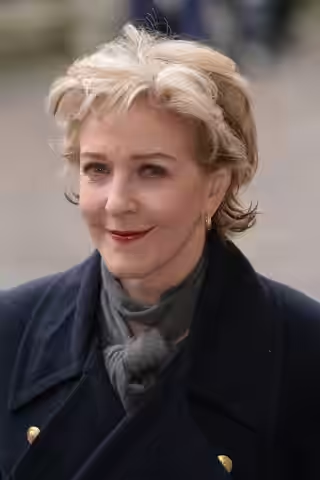
Patricia Hodge speaks as though every word has been checked by a solicitor, and lets us see what the checking costs. Fifty years of poised, patrician women on stage and screen, and the best of them are never quite as calm as they sound.
Fi1m perspective
Listen to the consonants first. Patricia Hodge speaks on screen as if every word had been checked before she said it, and the parts have been built on that for fifty years: barristers, novelists, mothers who are not pleased. The precision is what gets her cast. It is never the whole performance. The interest is in what she is holding back behind it, and in how much of it she decides to show.
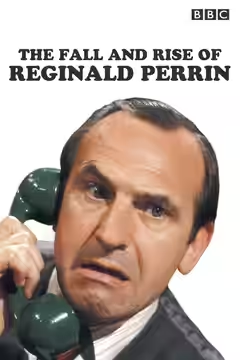
She came from the stage, with a professional debut at the Traverse in Edinburgh in 1971 and the West End a year later, and the screen was slow to work out what to do with her. She is Geraldine Hackstraw in The Fall and Rise of Reginald Perrin (1976), a series we rate highly, though it belongs to Leonard Rossiter and our review has nothing to say about her. The turn came with Phyllida Erskine-Brown in Rumpole of the Bailey (1978–1992), John Mortimer's series and the part that made her a television face. The 1980s then handed her leads: Jemima Shore Investigates (1983), Emma in the film of Harold Pinter's Betrayal (1983), and Mary Fisher, the glamorous novelist in the BBC's The Life and Loves of a She-Devil (1986).
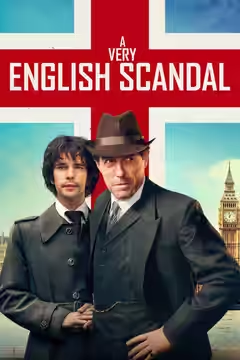
The later career turns comic. Penny in Miranda (2009–2015) found her a new audience, and we laughed at her more than we expected to, then felt slightly ashamed, because the joke is a mother who has stopped pretending to be pleased and Hodge plays it without softening it. Every withering line comes out with the same care she once gave Pinter. Since then there has been Ursula Thorpe in A Very English Scandal (2018) and Mrs Pumphrey in All Creatures Great and Small (2021 onwards), a part she took over from Diana Rigg, which tells you what sort of Englishwoman the industry now reaches for her to play.
The reservation, and it is the only one anybody has really made, is that the parts resemble one another: upper-class, poised, lately eccentric. Early on she was filed as a theatre actress, then as a television one, and the filing has not stopped. Our answer is that it matters less than it sounds, because the control is where she does her work. Give her a Pinter and the poise has something to hide. Give her a sitcom and it becomes the joke. Either way she is doing the same thing, and doing it on purpose.
She has worked three times with the director Christopher Luscombe, and she keeps going back to the theatre into her late seventies. "The process is really why I do theatre," she has said, which is a tidy way of telling us that the screen only ever gets the finished article. If you want to see what the control is for, start with Pinter.
Biography
Patricia Hodge (born 29 September 1946) is an English actress. She trained at the London Academy of Music and Dramatic Art and made her West End debut in 1972, appearing the following year in the original London production of Pippin directed by Bob Fosse.
She is known for her stage work, receiving two Olivier Award nominations for Best Actress in a Musical and winning the Olivier Award for Best Supporting Actress in 2000 for Money. On screen, her credits include Phyllida Erskine-Brown in Rumpole of the Bailey (1978–1992), Mary Fisher in the 1986 adaptation of The Life and Loves of a She-Devil, Penny in Miranda (2009–2015), Ursula Thorpe in A Very English Scandal (2018) and Mrs Pumphrey in All Creatures Great and Small (2021–present). She was nominated for a BAFTA TV Award for Best Actress for Hotel du Lac (1986).