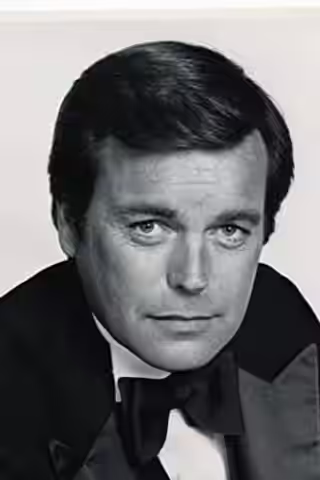
Robert Wagner's trade was ease: the polish, the low warm voice, the millionaire who never seems to have worked for it. It made him a television fixture for two decades and left him stranded whenever a film forgot to give him a job.
Fi1m perspective
What Wagner does is make money look comfortable. Put him in a good suit on a terrace and he does not need to say anything; when the voice comes it is low and unhurried and sounds as though it has never had to raise itself. Casting directors noticed early and spent the next sixty years asking for the same thing: millionaires, playboys, well-tailored rogues, the man at the party who turns out to be either the hero or the thief. It is a real skill and a narrow one, and his career is the story of how far it stretched.
He began at Twentieth Century Fox around 1950 as, in his own words, "the boy next door", and the studio kept him there longer than he wanted: romantic leads through the 1950s, Prince Valiant (1954), and one sidestep into something colder as the murderer in A Kiss Before Dying (1956), the part critics still point to when they want to argue he could have done more. After The Pink Panther (1963) the film work thinned, he spent a short spell in Europe, and then he did what the shrewder actors of his generation did: he went to television and stayed. It Takes a Thief (1968–1970), Switch (1975–1978) and above all Hart to Hart (1979–1984) are where most people's idea of Robert Wagner comes from, and that idea is of a man solving crimes with Stefanie Powers beside him and no visible strain.
The trouble with ease is that it looks like absence when a film has nothing for it to do, and that is what we saw in Curse of the Pink Panther (1983). Blake Edwards brings George Lytton back for the villa scenes, sits him near David Niven and Capucine, and asks nothing of him. Our review called it attendance rather than performance, and we stand by that. Watching it we felt something close to embarrassment on his behalf, because the manner is all intact, the posture, the voice, the readiness to be charming, and there is no scene for it to be charming in. The first time he played the part, in The Pink Panther (1963), there was a comedy going on around him. By 1983 there was a terrace.
What rescued the later decades was that someone noticed the manner could be turned into a joke. Number Two in the Austin Powers films (1997–2002), eye-patch and all, is Jonathan Hart's composure put to work for a cartoon villain, and the joke only lands because Wagner declines to wink at it. He has said the part was written for him, and it shows. NCIS (2010–2019) then gave him the charming father for the better part of a decade, which is the same man again, older and forgiven for it.
If you want to see what he does, start with Hart to Hart, where the whole programme was built around it. Do not start with the villa.
Biography
Robert Wagner is an American actor. Born in Detroit, Michigan, he was signed by 20th Century Fox after being discovered by a talent scout and made his screen debut in the early 1950s.
He gained prominence through television series including It Takes a Thief (1968–1970), Switch (1975–1978) and Hart to Hart (1979–1984). In film, he appeared as Dan Bigelow in The Towering Inferno (1974) and as Number Two in the Austin Powers trilogy (1997–2002). He has also had recurring roles in Two and a Half Men and NCIS.