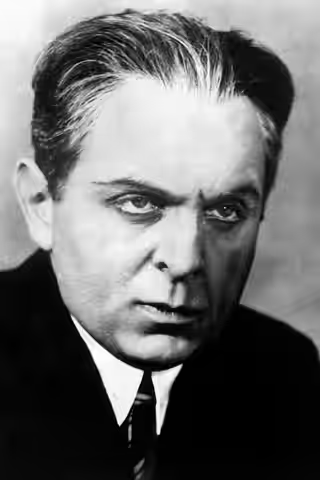
Rudolf Klein-Rogge makes obsession visible through an intense stare and a willingness to look excessive. His acting finds a good home in Fritz Lang's Metropolis, where we welcome its force without wishing everyone would follow suit.
Fi1m perspective
Rudolf Klein-Rogge's intense stare is well suited to men who expect obedience. His obsessive inventor Rotwang in Metropolis (1927) belongs in a film that expects people to express their convictions with their whole bodies. We rate the performance for its willingness to meet that demand. There is no attempt to make him unobtrusive among the scenery, and little reason why there should be.
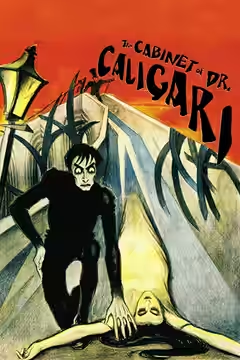
His uncredited criminal in The Cabinet of Dr. Caligari (1920) offers an early link to expressionist villainy. Our affection for that film rests chiefly on Conrad Veidt and the crooked sets, so it would be misleading to make Klein-Rogge central to its achievement. The more substantial landmark is Dr. Mabuse, the Gambler (1922), his breakthrough as the criminal mastermind. Lang repeatedly cast him as villains, establishing the partnership that gives this work its clearest shape.
Lang's Metropolis also shows why such acting needs other performers to work differently. Alfred Abel gives Joh Fredersen control, while Brigitte Helm's Maria holds our attention through stillness; Rotwang has permission to be less restrained. We enjoyed his excess because it suits a film so willing to exaggerate. Yet Helm's restraint is welcome precisely because so much else is insisting that we look at it. Klein-Rogge contributes to the excitement, but we would not want everyone in the cast performing at his pitch.
The parts continued to favour men who wanted control: the criminal mastermind and spy chief Haghi in Spies (1928), then Mabuse again in the sound film The Testament of Dr. Mabuse (1933). The latter was his final collaboration with Lang. His later career included supporting roles into the 1930s. The concentration of criminals and tyrants among his principal parts gives us plenty of evidence of his force, though less reason to claim he could do anything.
Our reservation about Metropolis is its easy proposed cure for class conflict. Klein-Rogge's emphatic acting is much easier to accept when the film around him is working on that scale. Start with Rotwang, but keep an eye on what Abel and Helm are doing beside him.
Biography
Rudolf Klein-Rogge (born Friedrich Rudolf Klein) was a German film and stage actor. He was born in Cologne on 24 November 1885 and died in Wetzelsdorf, Austria, on 29 May 1955. After studying art history in Berlin and Bonn and taking acting lessons, he made his stage debut in 1909 and appeared in his first film in 1912. He worked regularly in cinema from 1919.
Klein-Rogge became known for playing sinister or villainous characters in 1920s and 1930s German films. He appeared in several works directed by Fritz Lang, including Destiny (1921), Dr. Mabuse, the Gambler (1922), Die Nibelungen (1924), Metropolis (1927) as the inventor C.A. Rotwang, Spies (1928) and The Testament of Dr. Mabuse (1933) as Dr. Mabuse. He had earlier been married to screenwriter Thea von Harbou, who collaborated with Lang.