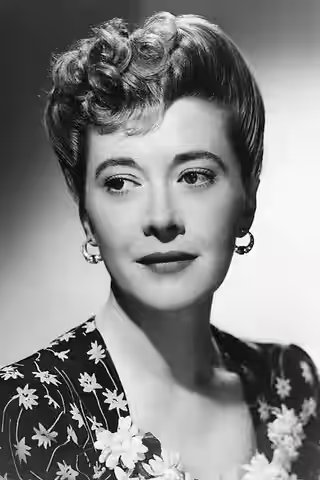
Ruth Nelson played mothers and wives who behave as if nobody is watching, a Group Theatre habit she kept for six decades. She never dominates a scene; given a room and a small task, she is often the truest thing in it.
Fi1m perspective
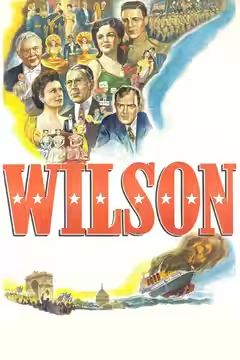
In Wilson (1944) there is a scene at the piano. Ruth Nelson's Ellen Wilson sits with her three daughters, the president joins in and cannot hold a tune, and for a minute a 154-minute monument to a man who was never wrong becomes a family making a noise in the parlour. It is the only stretch of the film in which anyone behaves as if they do not know they are in history, and it moved us more than a film we otherwise could not care about had any right to. Nelson is doing almost nothing: sitting, listening, not correcting him. That is the whole method.
She came to films late and by way of the stage. She made her New York debut in 1928 and was a charter member of the Group Theatre from 1931 to 1941, and the naturalism that company insisted on is what she carried to Hollywood in the early 1940s. Fox used it for Ellen Wilson; Elia Kazan, a Group colleague, used it for Miss McDonough in A Tree Grows in Brooklyn (1945); Warner Bros. put her beside Joan Crawford as Esther Boray in Humoresque (1946). In all of these she is the plain figure at the edge of the frame, the one the stars talk to.
Then she largely stopped. After 1951 she was away from the screen for the better part of three decades, and when she came back it was in three Robert Altman projects, for a director who liked actors who could sit in a crowded room and not ask for the light. 3 Women (1977), The Late Show (1977) and A Wedding (1978), the last of them alongside her husband, the director John Cromwell, gave her a short late run of ensemble parts. Awakenings (1990) was her final film, as Mrs Lowe, mother to Robert De Niro's patient.
The virtue and the limit are the same thing. Our own review of Awakenings does not single her out, and we doubt that would have troubled her: she is cast as the mother at the edge of the ward and she plays exactly that, without once asking the film to turn round. The restraint is all there. What is not there, in that film or in Wilson, is any stretch the script trusts her to carry alone, and so the screen record is thinner than the reputation. Her stage work in O'Neill and Wilder, which we cannot show you, is where the name for matriarchs without sentiment was made.
Start with the piano. It is a minute out of two and a half hours, and it tells you more about what she could do than the crowds and speeches around it. If you then find yourself watching Awakenings for the woman at the side of the ward rather than the two men at the centre of it, you have understood her.
Biography
Ruth Nelson was an American stage and film actress. Born Ruth Gloria Nelson in Saginaw, Michigan, she trained at the American Laboratory Theatre in New York and was a founding member of the Group Theatre from 1931 to 1941.
She appeared in numerous films during the 1940s, including A Tree Grows in Brooklyn (1945) as Miss McDonough, Humoresque (1946) as Esther Boray, Arch of Triumph (1948) as Madame Fessier and The Keys of the Kingdom (1944) as Mrs. Chisholm. Her career was interrupted in the 1950s when she was blacklisted owing to her marriage to director John Cromwell; she returned to film in the 1970s with roles in Robert Altman’s 3 Women (1977) as Mrs. Rose and A Wedding (1978) as Aunt Beatrice Sloan Cory, as well as The Late Show (1977) as Mrs. Schmidt. Her final screen role was as Mrs. Lowe in Awakenings (1990). Nelson died in New York City in 1992.