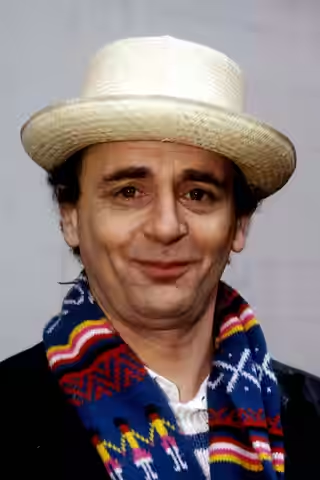
Sylvester McCoy is a physical comedian first, a stunt performer's timing in an actor's body, and he is at his best when a part gives that room to grow. In the one film of his we have reviewed, it was let loose in a single scene, and we winced.
Fi1m perspective
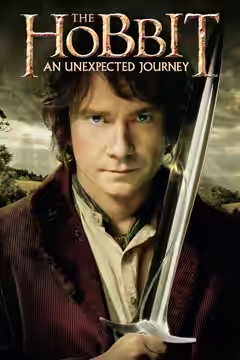
Radagast the Brown arrives in The Hobbit: An Unexpected Journey (2012) on a sled pulled by rabbits, with birds nesting under his hat, and we winced. We own that wince, and we should also be fair about it. The scene was built for noise before Sylvester McCoy got anywhere near it, and what he does inside it is what he has always done: play from the body outwards, arms and knees and eyebrows all going at once, so that the character is a shape before he is a person. In a quieter film that might have been charming. In Peter Jackson's, where nothing has weight, it is one more thing falling off a ledge.
He came to acting sideways, through the Ken Campbell Roadshow in the 1970s, as a stunt performer and physical comedian, and everything since carries that stamp. Children's television followed, and then the part that fixed him in the public mind: the Seventh Doctor in Doctor Who from 1987 to 1989, the last of the original run. We have not reviewed it, but the received view of it is consistent and we see no reason to argue. He began as a clown, in Time and the Rani (1987), and by the end had become something more watchful and calculating, a Doctor who manipulated the people around him rather than simply rescuing them. The criticism that has stuck is that when the scripts asked for anger, he could not always supply it.
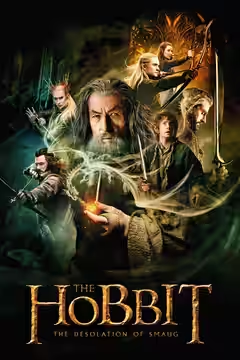
His own account of the difference between stage and screen is the most useful thing anyone has said about him: "film is like painting with one of those little, pointy brushes, a stroke here and a stroke there." He knows it. He does not always do it. Jackson cast him as Radagast in all three Hobbit films and let him use the broad brush every time. There is an early film part too, Walter in Dracula (1979), which we have not reviewed and will not pretend to judge.
The kindest and truest thing to say is that McCoy is an entertainer of an older kind, closer to vaudeville than to naturalism, and that film has rarely known what to do with him. On television, given three years and a character to grow into, he found a way to make the clowning carry something darker underneath. Given one scene and a sled, he did not. If you want to know what he can do, start with the Doctor and not with the wizard.
Biography
Sylvester McCoy, born Percy James Patrick Kent-Smith on 20 August 1943 in Dunoon, Scotland, is a Scottish actor and physical comedian. He studied for the priesthood at Blairs College in Aberdeen before pursuing a career in entertainment. He gained early experience as a performer with the Ken Campbell Roadshow, adopting his stage name during that time.
McCoy is best known for portraying the Seventh Doctor in the BBC series Doctor Who from 1987 to 1989, the final Doctor of the original run. He reprised the role in the 1996 television film Doctor Who and made further appearances in the revived series, including "The Power of the Doctor" (2022).
He played Radagast the Brown in The Hobbit: An Unexpected Journey (2012), The Hobbit: The Desolation of Smaug (2013) and The Hobbit: The Battle of the Five Armies (2014). His other credits include the 1979 film Dracula.