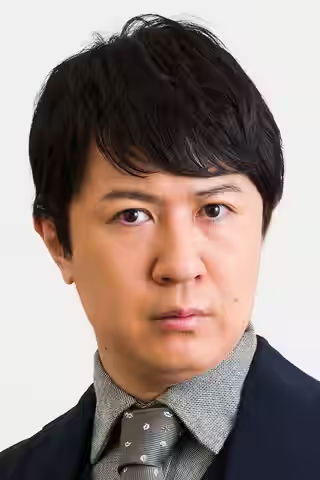
A bass voice that never hurries, put into young men who sound like they have already seen the ending. The jokes made him famous; the two Godzilla films we have reviewed show the stubbornness underneath, and it holds up better than the films around it.
Fi1m perspective
Sugita has a deep bass and has spent most of his career lending it to young men, so the slacker or the schoolboy sounds like someone who has already read the last page. What he does with it is refuse to hurry. A joke arrives at the pace of a train announcement; a threat arrives at the pace of the joke. His two breakthrough parts, Kyon in The Melancholy of Haruhi Suzumiya and Gintoki Sakata in Gintama, both 2006, are built on that: a man commenting on the nonsense around him as if it were a nuisance, until the moment it is not, and he does not change gear to tell us which moment that was.
He had been working for eight years by then. He began at 17, narrating Kamen Rider promotions in 1998, took his first lead as Hideki Motosuwa in Chobits in 2002, and after 2006 became one of the busiest voices in Japanese animation, in games and dubs as well as series. Joseph Joestar in JoJo's Bizarre Adventure (2012) is the same man turned up, a showman who improvises and knows it. Gyomei Himejima in Demon Slayer (2019) is a stoic who says little and carries a great deal. He is known for ad-libbing in comedy, and the one complaint anyone makes is that a voice this recognisable can sit heavily on light material.
The parts we have reviewed ask for none of the jokes. In the animated Godzilla trilogy that began with Godzilla: Planet of the Monsters (2017) he is Martin Lazzari, a scientist, and in Godzilla: City on the Edge of Battle (2018) his job is to explain the Houtua in a film where everybody's job is to explain something. He does it clearly and it is not enough, because nothing in that hour of committee is enough. Godzilla: The Planet Eater (2018) gives him something better: a patient argument with Takahiro Sakurai's Metphies, who preaches that the universe is empty, while Lazzari would rather keep taking measurements. We did not expect to be moved by a man insisting on data in a film we otherwise found inert, but we were, because Sugita plays the stubbornness plainly, without the hoarse grief the rest of the cast is shouting, and against Sakurai's whisper the flatness reads as courage. They are the only two in the film given scenes to act, and the film knows it.
That pairing is the clue. Sugita has said he tries not to complete a performance on his own, that a joke only works if there is someone to react to it, and the Godzilla films bear him out. Give him a control room and he is a voice explaining the Houtua; give him Sakurai and he is a character. We would start with Gintama for the jokes, and with The Planet Eater to hear what the same voice does when there is nothing left to be funny about; he is one of the two reasons to sit through it.
Biography
Tomokazu Sugita is a Japanese voice actor. He was born on 11 October 1980 in Ranzan, Saitama. He began his career in the late 1990s after winning a voice acting award while still in high school, and has been active since 1998.
Sugita is best known for voicing Gintoki Sakata in Gintama and Kyon in The Melancholy of Haruhi Suzumiya. He has voiced Gyomei Himejima in the Demon Slayer: Kimetsu no Yaiba series and films, including Demon Slayer: Kimetsu no Yaiba Infinity Castle (2025). Other notable roles include Joseph Joestar in JoJo's Bizarre Adventure and characters in Bleach, Attack on Titan and Jujutsu Kaisen.
He was previously affiliated with Atomic Monkey from 2001 until 2020, when he left to establish his own agency, AGRS. In 2009 he won the Best Supporting Actor award at the 3rd Seiyu Awards.