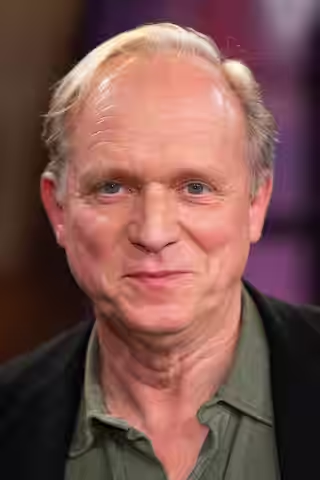
Ulrich Tukur is persuasive as men whose authority makes them difficult to read. We value the precision of his supporting work, especially when a few scenes leave a stronger impression than their size would suggest.
Fi1m perspective
In Solaris (2002), Ulrich Tukur's Gibarian has a handful of scenes and a recorded message. We found that message unsettling; his restrained presence makes a brief appearance difficult to shake off. Steven Soderbergh has Jeremy Davies mumbling and fluttering his hands as Snow, and Viola Davis refusing to soften as Gordon. Tukur's economy holds its own in that company. This is supporting work we rate for what it contributes, without wishing the film would give him more to do.
His international film work took hold in the early 2000s, after a stage breakthrough with Peter Zadek in Ghetto (1984). The parts were not uniformly small: Costa-Gavras's Amen. (2002) cast him in the lead as Kurt Gerstein. We would still begin with the supporting performances, where his precision has to count quickly. They also make clear why he is so useful as an authority figure: he can suggest a man accustomed to being heard without making a display of it.
In Florian Henckel von Donnersmarck's The Lives of Others (2006), that authority belongs to Anton Grubitz, a Stasi officer. Tukur is persuasive as a bureaucratic figure whose moral position requires watching, and his understatement serves the part. Ulrich Mühe's patient performance carries the film, so there is no need to overstate Tukur's share of its success. We recommend it warmly, while finding that its faith in personal goodness sometimes makes a brutal system look too easily understood.
The risk for Tukur himself is familiar casting becoming too comfortable. Michael Haneke's The White Ribbon (2009) gives him the Baron, another figure defined by rank; John Rabe (2009) gives him the title role. We would want each new official to offer more than the reassurance that the actor knows how authority behaves. Try Solaris for him, provided a cold, patient film about grief suits the evening.
Biography
Ulrich Tukur (born Ulrich Gerhard Scheurlen) is a German actor and musician. He was born on 29 July 1957 in Viernheim. He studied German, English and history at the University of Tübingen before training as an actor at the Staatliche Hochschule für Musik und Darstellende Kunst in Stuttgart from 1980 to 1983.
Tukur began his career in theatre, becoming a member of the ensemble at the Deutsches Schauspielhaus in Hamburg under Peter Zadek and later co-directing the Hamburg Kammerspiele. His film roles include Willi Graf in Die weiße Rose (1982), Gibarian in Steven Soderbergh's Solaris (2002), Kurt Gerstein in Amen. (2002), Anton Grubitz in The Lives of Others (2006) and the Baron in Michael Haneke's The White Ribbon (2009). He has also performed and recorded as a musician with his band Ulrich Tukur & The Rhythm Boys since 1995.