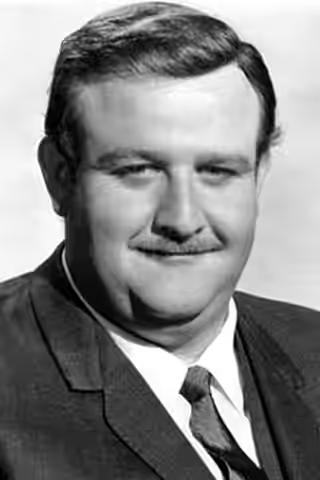
A large man with a sonorous voice, Victor Buono played men far older than himself and was best when the joke and the threat came out of the same mouth. Robert Aldrich cast him three times; television let him overact, which he enjoyed.
Fi1m perspective
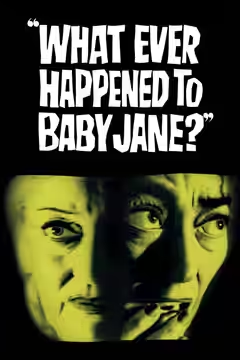
Edwin Flagg comes to the house in What Ever Happened to Baby Jane? (1962) because he has answered an advertisement and needs the money. Victor Buono plays him large and damp, all wounded dignity and one eye on the chequebook, and he was twenty-four when he did it. Nothing on screen tells you that. The bulk, the careful vowels, the manners of a man already disappointed by life: he arrived looking like a middle-aged character actor and was hired as one.
He had been playing old men for years. In San Diego he joined the Globe Theater Players at eighteen and did Shakespeare, including Falstaff, which is where a Warner Bros. scout found him in 1959. Television took him first, and then Robert Aldrich, who used him three times, in Baby Jane and again with Bette Davis in Hush...Hush, Sweet Charlotte (1964). The same year he carried The Strangler as a mother-obsessed killer, the closest he came to a lead. The Greatest Story Ever Told (1965) put him in robes as the high priest Sorak. After that the work was mostly heavies, on television and in genre films, through the 1970s.
The television villainy is the part of his career people remember and the part critics hold against him. King Tut on Batman (1966 to 1968, ten episodes) and Count Manzeppi on The Wild Wild West were broad by design, and he knew it: "Being on Batman allowed me to do something we actors are taught never to do: overact." We do not hold it against him. A man built like that, with that voice, was always going to be offered eccentrics and heavies, and he took them with more relish than most.
What he did well is harder to name than what he was cast as. The joke and the threat come out of the same mouth. In Beneath the Planet of the Apes (1970), a film we cannot recommend as a whole, he and Paul Richards preside over a congregation underground with evident enjoyment, and that stretch is the best thing in the picture; we were unnerved, and it was the straight faces that did it, a hymn sung by men who believe every word. In Baby Jane we laughed at Edwin and then, without meaning to, felt for him. It is the dignity: he keeps picking it up after every humiliation and dusting it off. The scenes with his mother across town stop that film dead, but that is a fault of the script rather than of the man in them.
The criticism that sticks is that the heavies crowded out anything subtler, and it is fair. Aldrich saw that the wit and the menace belonged together; most of the people who hired him afterwards wanted one or the other. Start with Baby Jane. Then, if the taste is yours, King Tut.
Biography
Victor Buono was an American actor. Born in San Diego, California, on 3 February 1938, he began performing in high-school productions and studied at the Globe Theater in San Diego. A Warner Bros. talent scout saw him there in 1959 and arranged a screen test.
Buono made his film debut as Edwin Flagg in What Ever Happened to Baby Jane? (1962), for which he received an Academy Award nomination for Best Supporting Actor. He appeared in Hush... Hush, Sweet Charlotte (1964), The Greatest Story Ever Told (1965) and Beneath the Planet of the Apes (1970) as the Fat Man. On television he played King Tut in the series Batman (1966–1968) and guest-starred in series including Get Smart and Hawaii Five-O. He also worked as a comic and recording artist. Buono died on 1 January 1982.