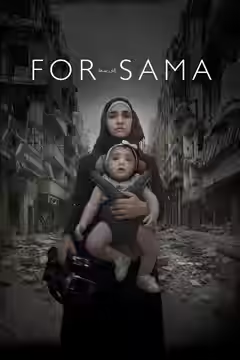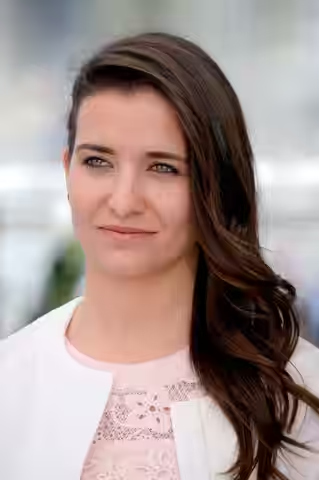
Waad al-Kateab filmed in Aleppo for five years with a small camera and did not know she was making a film. For Sama is the most direct account of that war we have seen, because nothing in it was arranged.
Fi1m perspective
Somewhere in For Sama (2019) the camera is put down on a hospital counter in the middle of a crisis and left running while people rush past it. Nobody decided that shot. That is how Waad al-Kateab works, or worked: she was in the corridor because she lived there, and the camera came along. The result is the most direct account of the Syrian war we have seen, and we rate it highly. It is also, so far, one film.
The footage came first and the film came years later. She was a student in Aleppo when the demonstrations began, and she started filming protests and daily life as a citizen journalist. She stayed through the siege of the eastern half of the city, where her husband Hamza Al-Khateab ran a hospital and where their daughter Sama was born while the bombs fell, until the evacuation in December 2016. Only afterwards, with the British filmmaker Edward Watts as co-director, was the material shaped into a 100-minute letter to the child. "When I was first filming there was no plan at all, except to survive. I just shot daily life." The film is honest about that, and it is better for it.
What she has, and what a crew could not have got, is a picture that does not know what is about to happen. The framing is offhand, the focus hunts, and when a strike lands nearby the image jerks to the ceiling and comes back without a word of explanation. We found it as hard to sit through as anything we have reviewed, and the reason is that there is no angle: the camera sits at the height of someone trying to keep out of the way, so the dead and the injured arrive in the frame the way they came through the hospital door. The voiceover matches. She asks Sama whether she will understand, whether she will forgive them, and does not pretend to know.
The film's one lapse is shared. Nainita Desai's score keeps a low pulse under most of it, which is right, and then swells two or three times under footage that needed nothing, which is not. It is the sound of the finished film worrying that the raw one was not enough. It was.
The harder question is what happens next. Her method depended on being there, and it cannot be repeated by choice. We Dare to Dream (2023), about the Refugee Olympic Team at Tokyo 2020 and framed by her own story, is her first film about lives she did not share. Start with For Sama, when you are ready for it. Then watch what she does with a camera she is holding on purpose.
Biography
Waad al-Kateab is a Syrian journalist, filmmaker and activist. She moved to Aleppo in 2009 to study marketing at the University of Aleppo. When the Syrian Civil War began in 2011 she began filming as a citizen journalist, with her reports broadcast on Channel 4 News.
Her documentary For Sama (2019), co-directed with Edward Watts, draws on five years of footage from Aleppo documenting her life, marriage to doctor Hamza al-Kateab and the birth of their daughter Sama. The film won the BAFTA for Best Documentary and received an Academy Award nomination for Best Documentary Feature. Her coverage of the Siege of Aleppo earned an International Emmy Award.