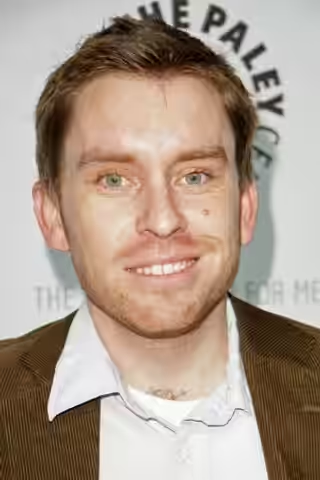
Zack Whedon's name sits on some of the best-written television of the last two decades, usually alongside several others. He is a room writer, good at people who cannot say what they mean, and the one time he worked alone the reviews were not kind.
Fi1m perspective
In Dr. Horrible's Sing-Along Blog (2008), Billy tells his webcam how the day went, and then we watch the day. The two rarely match, and the gap between what he says and what happened is where the writing lives. Zack Whedon wrote it with Joss Whedon, Jed Whedon and Maurissa Tancharoen during the American writers' strike of 2007 and 2008, in three acts of about fourteen minutes, and it went online in July 2008. We had settled in for a comedy about a freeze ray and were not given one; the third act caught us off guard, and then it seemed the only honest place the story could have gone.
That is the one thing he has created. The rest of the career is other people's shows. He started as a production assistant on Angel, then as assistant to David Milch on Deadwood (2004), and his first credit is a co-writing one on Amateur Night, in the final season of 2006. From there he became the sort of writer whose name appears in the middle of a list: three episodes of Fringe (2008), episodes of Rubicon (2010), Southland (2013) and The Red Road, then Halt and Catch Fire (2014), where he wrote and produced across its run to 2017. He writes comics too, including Serenity: Leaves on the Wind (2014), and has said of that ambition, "I will wear a tuxedo on that day and introduce myself as, 'Zack Whedon. Comic Writer.'"
The difficulty with a room writer is knowing which sentence is his. On Deadwood he is one hand among Milch's; on Fringe one of many. Halt and Catch Fire is the clearest case. Its first season is a nervous imitation of Mad Men with keyboards, and somewhere in the second the writers, Whedon among them, notice that Cameron Howe and Donna Clark are the series, and that Joe is a character in it rather than the reason for it. What follows is a patient drama about work and failure, and Mackenzie Davis and Kerry Bishé carry it. The habit that runs through his credits is the same one as the launderette: people saying one thing and meaning another, and a script that trusts us to see the difference.
The exception is Come and Find Me (2016), a thriller with Aaron Paul that he wrote and directed himself. We have not reviewed it, so we will not judge it at length, but the reviews found the pacing slow, the flashbacks a burden and the twists hard to believe, and the plot familiar. It is the one credit that stands alone, and it is the one nobody brings up.
A writers' room can be a place to hide or a place to be useful, and Whedon has been useful on programmes that are far better than most. Watch Halt and Catch Fire from its second season and Dr. Horrible in one sitting. Whatever is his in them is good, and it may be sensible to stop trying to work out which bit.
Biography
Zack Whedon is an American screenwriter, film director and comic book writer. Born on 14 August 1979, he is the son of screenwriter Tom Whedon and grandson of screenwriter John Whedon. His brothers are screenwriter and musician Jed Whedon and producer, director and writer Joss Whedon.
He graduated in 2002 with a film degree from Wesleyan University, where he served as president of the Eclectic Society. His first professional television work was as a production assistant on his brother Joss's series Angel. He joined the crew of the HBO series Deadwood (2004) as an assistant to executive producer David Milch for the first two seasons and became a writer for the third season, co-writing the episode 'Amateur Night'.
Whedon has written episodes for series including Fringe (2008), Dr. Horrible's Sing-Along Blog (2008), Rubicon (2010), Halt and Catch Fire (2014) and In Treatment (2008). He has also written and directed the feature film Come and Find Me (2016) and contributed to comic books such as the Serenity series.