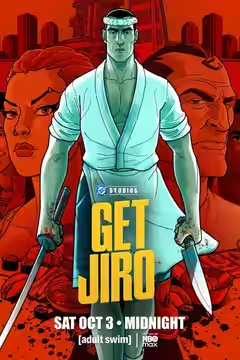
Brian Gatewood and Alessandro Tanaka have turned Anthony Bourdain and Joel Rose’s graphic novel into five short, bloody, often funny episodes about a sushi chef in a city ruled by cooks. Sharp on food, softer elsewhere, and over before it decides what it is.
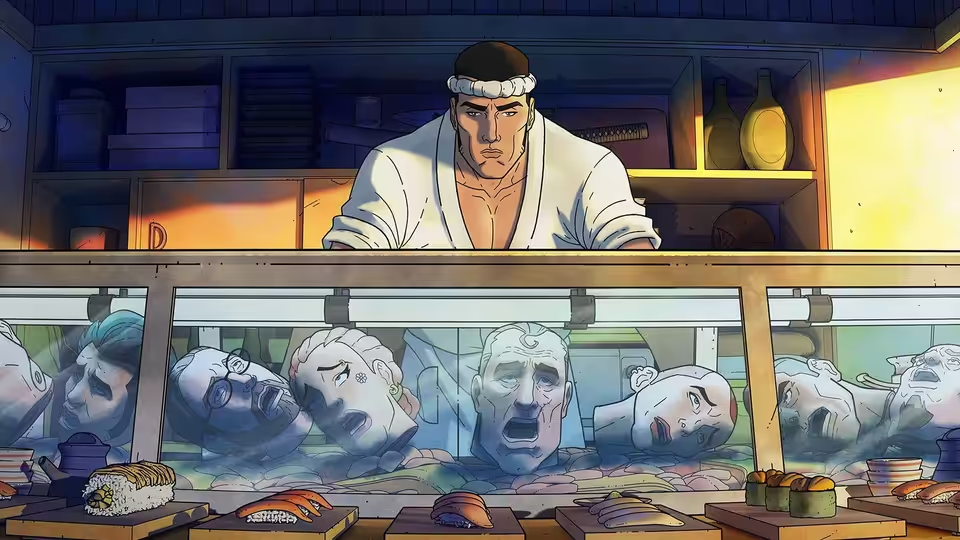
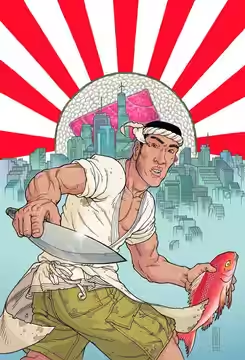
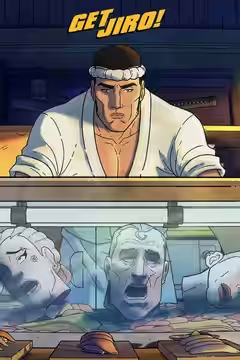
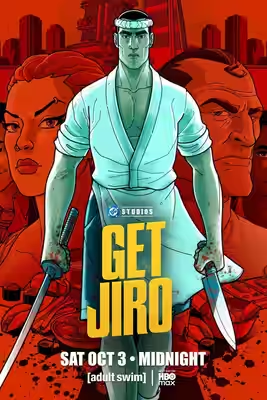
The idea is Anthony Bourdain’s, and it is a good one. In the graphic novel he wrote with Joel Rose, Los Angeles has become a place where food is the only thing anyone cares about, the chefs have the power that gangsters used to have, and a quiet sushi master called Jiro refuses to join either of the kitchens that run the town. Brian Gatewood and Alessandro Tanaka, who created the series, have kept the bones of that and added a great deal of blood. It is funny, it is fast, and at five episodes it is over before the joke wears out, which is both its chief virtue and its chief problem.
Brian Tee voices Jiro, and he is the reason the thing holds together. He says very little. When the rest of the cast are shouting about terroir and provenance, Tee drops his lines flat and low, a man who has already judged you and is only deciding whether to bother saying so. It is a hard trick in animation, where the temptation is to overplay because the face is doing less, and he resists it in every scene. The character is a cartoon, in the literal sense, but the voice is not.
We should own up to the first killing. A customer insults the fish, Jiro reaches for the cleaver, and we laughed out loud, then felt slightly ashamed, then laughed again when the series cut straight to him wiping down the counter. That is the tone for the whole run: violence as a punchline, delivered without a pause and without an apology. The animators stage the fights with real clarity, bright arterial red against pale wood and steel, and you can always tell whose hand is holding what. We have sat through live-action kitchen dramas that were harder to follow.
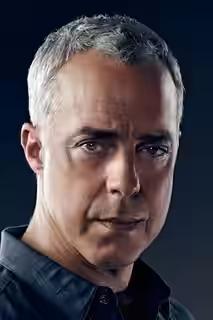
The satire is at its best when it stays in the kitchen. The series has a sharp eye for the fetishes of modern eating: the single tomato presented like a relic, the tasting menu that takes four hours and leaves you hungry, the restaurant that will not give you a fork. Titus Welliver, Alison Pill and Justin Kirk fill out the warring factions around Jiro, Welliver doing his familiar gravel, Pill brittle and bright, Kirk oozing. None of them is given much to be beyond a position on how food should be grown and served, but the voices are strong enough that you do not mind until later.
Later is where it slackens. Somewhere around the third episode the series remembers that a story about who gets to eat where is also a story about who gets to live where, and the gentrification material comes in heavy. The jokes thin, the speeches lengthen, and characters begin explaining the point to each other in case we missed it. Bourdain could be angry about this kind of thing and still be a pleasure to listen to; the dialogue here, when it goes serious, strains for his rhythm and lands a beat behind it. Then, with the war between the kitchens only just coming to the boil, the series is done.
The one review we have read so far is warmer than we are, and we can see why. Bourdain has been dead for several years and there is a hunger for anything that carries his appetite and his contempt for fuss, and this does carry both. But a tribute is not the same as a finished story, and five episodes is not enough room for the city the series keeps gesturing at. It wants to be a satire, a gang picture and an elegy at once, and only the first of those is properly cooked.
Watch it in one sitting, with something good to eat within reach, because you will want it. All five episodes arrive on 4 October 2026, and the whole run takes about as long as a tasting menu, with considerably more blood.