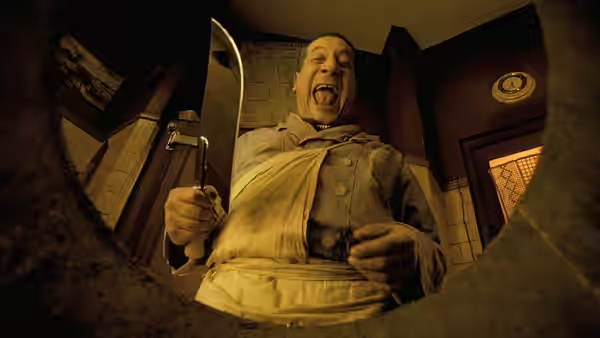
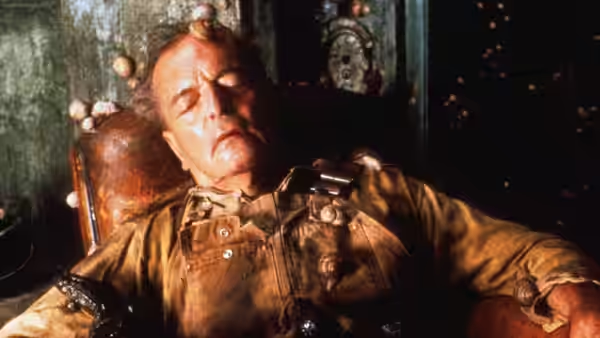
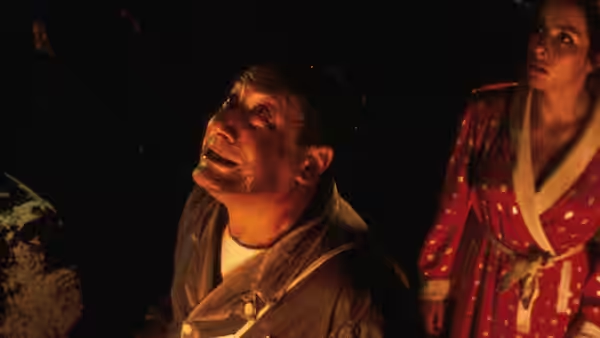
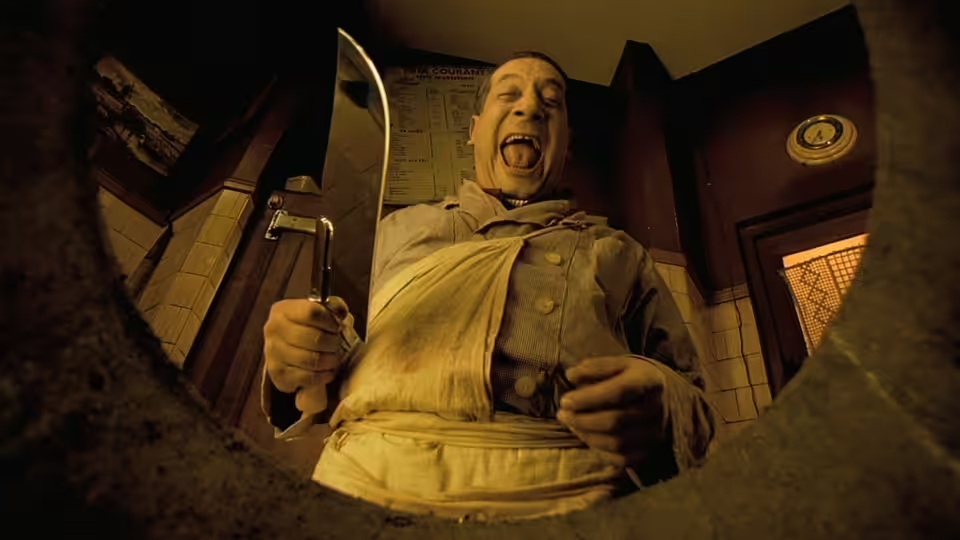
butcher gripping a cleaver and shouting upwards from below a hatch
Film review

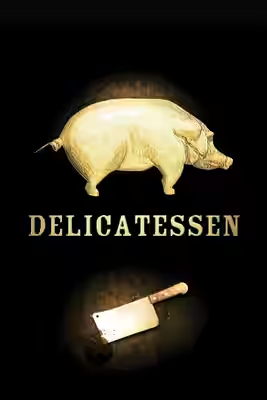
Delicatessen

1991 · Directed by Jean-Pierre Jeunet, Marc Caro · 1h 39m · MPA R

In a sentenceAn unemployed clown should be suspicious when a butcher takes such an interest in his future

In a post-apocalyptic future, former clown Louison (Dominique Pinon) takes a job above a butcher’s shop. Clapet (Jean-Claude Dreyfus) is the butcher, and Louison falls for his daughter, Julie (Marie-Laure Dougnac), while entering a community whose inhabitants have found a cannibalistic means of getting by. Around them, eccentric neighbours make daily life difficult to predict, and the prospect of romance comes with reasons to be afraid. Directed by Jean-Pierre Jeunet and Marc Caro, Delicatessen follows Louison into a place where work, food and courtship are difficult to keep separate.

Plays from YouTube when you press play; nothing loads from them until then.

Fi1m review

Jean-Pierre Jeunet and Marc Caro make cannibalism surprisingly cheerful in this nimble, crowded black comedy. The supporting eccentrics can become tiresome, but the precise slapstick and Dominique Pinon’s sweetness keep the nastiness funny.

Delicatessen is a funny, carefully made black comedy that occasionally fusses too much over its own oddness. Jean-Pierre Jeunet and Marc Caro put an ex-clown to work above a butcher’s shop in a post-apocalyptic future, then let him fall for the butcher’s daughter. Cannibalism is part of everyday life here, which gives even the prospect of settling down an unpleasant implication. The directors want us to enjoy the absurdity without forgetting what makes the place dangerous.

Dominique Pinon gives Louison the innocence the film needs if its cruelty is to remain bearable. A former clown could easily become an excuse for a performance full of appealing little tricks; Pinon’s physical comedy feels like a way this man gets through the day. Marie-Laure Dougnac’s Julie gives the romance enough tenderness to matter amid the grotesque behaviour. Jean-Claude Dreyfus, as Clapet, supplies a threat sufficiently blunt that the film can afford all those peculiar people around him.

Production designers Miljen ‘Kreka’ Kljaković and Caro make the butcher’s shop and its surroundings feel suited to the people who inhabit them. The crowded sets give the eye things to investigate while the actors get on with being peculiar. Darius Khondji’s photography gives these spaces an oppressive, unreal presence. His images keep the suggestion of horror alive even when the performances are broad, so the grotesque faces never become entirely cosy.

The most persuasive display of control comes in the rhythmic montage. Editor Hervé Schneid links the images with such exact timing that the cutting becomes the joke, and each new addition has somewhere to land. We laughed because the sequence keeps making its pattern more ridiculous without losing the beat. Carlos D’Alessio’s music keeps the comedy light enough for the ugliness not to become wearying.

The screenplay, by Jeunet, Caro and Gilles Adrien, is less dependable when it asks us to enjoy another eccentric simply for being eccentric. Some of the supporting figures seem to have been given a peculiarity in place of a personality. The humour becomes laboured when a character has nothing to offer beyond the odd thing they do, and the romance has to compete for attention. There is enough invention to carry these passages, though we would gladly exchange a few flourishes for more time with Louison and Julie.

Black comedy can grow monotonous when every human weakness receives the same punishment. Jeunet and Caro avoid that trap often enough because they keep Louison sympathetic, helped considerably by Pinon’s performance. The cannibalism is ghastly, but the film takes pleasure in the clown’s physical humour as well as the surrounding depravity. That makes its blend of farce and horror more inviting than the premise suggests, without requiring us to find every resident endearing.

At 99 minutes, the film does not ask for more patience than its inventions can repay. We would happily spend another evening with Pinon’s Louison, even if several of his neighbours could use less encouragement. Choose it for the slapstick, provided cannibalism is something everyone present can agree to laugh about.

Critical consensus AI synthesised

70
Positive
7
Mixed
1
Negative
2

Most critics like Delicatessen, and seven of the ten reviews are positive. The praise clusters on the look of the thing: the sets, the effects and the rhythmically edited set pieces get named again and again, along with the crowd of grotesque tenants above the butcher’s shop. Reviewers keep reaching for Gilliam and Lynch as points of comparison, and most mean it kindly. The balance of farce and horror, with a childlike centre under the cannibalism, is what wins them over.

The reservations cluster on originality and warmth. Several critics note how much the film owes to Brazil and find the whimsy sometimes overdone. The spread is wide: two reviews are negative. The AV Club calls it a stylistically sloppy early effort from Jeunet and Caro, while Slant finds it unfunny and short of compassion for its characters, who become props in a chase. The New York Times sits in the middle, finding it clever but not radically new.

Empire
1 January 2000 · Jack Yeovil
90*

The film is a delightfully original picture poised perfectly between farce and horror, with sinister undertones of much recent French cinema.

Read the full review →
Time Out
5 December 2014 · GA
90*

The near-future story of an ex-clown who takes a job above a butcher's shop and falls for the butcher's daughter is layered with inventive comic detail and grotesque characters. Visually evocative of Gilliam, Lynch and others, the film's sets, effects, pace and performances deliver brash, nightmarish humour that entertains from start to finish.

Read the full review →
Variety
31 December 1990 · festival review · Variety Staff
90*

The zany little film is a startling and clever debut, beautifully textured, cleverly scripted and eerily shot, with a rich array of eccentrics and an outrageous montage of rhythmically edited visuals in a darkly bizarre futuristic world.

Read the full review →
Los Angeles Times
10 April 1992 · Michael Wilmington
70*

The film is a nightmare comedy with a childlike center, mixing horrific images and macabre jolts with playful, weird unpredictability in a post-apocalyptic world of cannibalism. It is seen as an original with satisfying density, a true cult movie that outshocks American horror comedies.

Read the full review →
The New York Times
3 May 1992
50*

The critic finds the film clever but not radically new, noting its debts to Brazil and its whimsical elements that sometimes go too far, while praising its graceful slapstick humor and inventive blend of black comedy with sight gags.

Read the full review →
Slant Magazine
21 May 2006
30*

The critic finds the film unfunny and unappetizing, criticizing its lack of compassion for characters, preening preciousness, and repetitive cartoonish oppression that echoes Brazil without meaning. It faults the aggressive stylization for reducing characters to quirky props in a cat-and-mouse game.

Read the full review →

Straight answers AI written, from our review

Is Delicatessen worth watching?
Delicatessen is worth watching for anyone who can laugh at cannibalism, and we scored it 83. Jean-Pierre Jeunet and Marc Caro time the slapstick so precisely that the cutting becomes the joke, and Dominique Pinon keeps the ex-clown Louison sympathetic. Some of the supporting eccentrics wear thin, and the romance has to compete with them.
How long is Delicatessen, and what is it rated?
Delicatessen runs 1h 39m and is rated R by the MPA in the US. It is a comedy and science fiction film.
Where can I watch Delicatessen in the US?
Delicatessen is streaming on Tubi in the US, and it is also available to rent from Amazon Prime Video and Apple TV from $3.99. It leaves Tubi on 1 October. Availability is checked daily; the links above go straight to each service.
How violent or frightening is Delicatessen, and is it suitable for children?
Delicatessen is a 15 in the UK and R in the US, and its comedy turns on a community that eats people, so it is not for children. The cannibalism is ghastly rather than graphic, played for black laughs, and Darius Khondji's oppressive photography keeps a suggestion of horror under the farce. Older teenagers with a taste for the grotesque should manage.
How does Delicatessen compare to Brazil?
Delicatessen is the lighter and tighter of the two, a 99-minute black comedy about a clown above a butcher's shop, where Brazil is a longer, more exhausting nightmare about bureaucracy. Both crowd the frame with grotesque detail, but Jeunet and Caro keep a firmer grip on shape and rhythm. Choose Gilliam's film for something more frightening and more sprawling.
What should I watch after Delicatessen?
After Delicatessen, try The Ladykillers (1955, Fi1m 86): A confined address, murderous intentions and comic performances precise enough to disguise the cruelty. Then Brazil (1985, Fi1m 83): More oppressive bureaucracy and grotesque humour, with a similarly crowded visual imagination.

Cast

Awards

European Film Award for Best Production Designer, 1991

Won
European Film Award for Best Production Designer

Sitges Film Festival Best Actor award, 1991

Won
Sitges Film Festival Best Actor award

Sitges Film Festival Best Director award, 1991

Won
Sitges Film Festival Best Director award

Young European Film of the Year, 1991

Nominated
Young European Film of the Year

If you liked this, try…

  1. The Ladykillers (1955, Fi1m 86)A confined address, murderous intentions and comic performances precise enough to disguise the cruelty.

  2. Brazil (1985, Fi1m 83)More oppressive bureaucracy and grotesque humour, with a similarly crowded visual imagination.

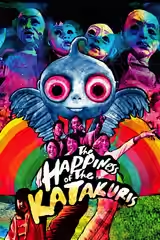
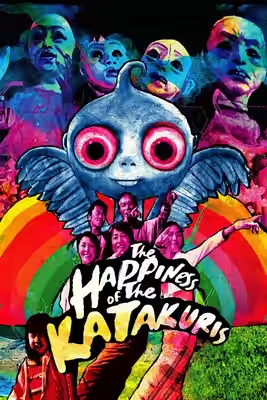
  3. The Happiness of the Katakuris (2001) · not reviewed yetFamily enterprise turns macabre, with musical interruptions making the bad behaviour stranger still.

  4. The Bothersome Man (2006) · not reviewed yetAn orderly city makes everyday comfort feel sinister, with considerably drier humour.

  5. The Phantom of Liberty (1974) · not reviewed yetSocial rituals become absurd through precise comic timing and a cheerful disregard for plot.

Free account

Know what to watch tonight

Two lists that know where things are streaming, collections you can share, your own score beside ours, and Discover that remembers what you have seen.

  • Want to see, sorted by what is streaming now
  • Seen, with your score out of ten
  • No adverts, ever