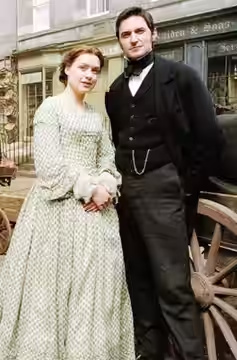
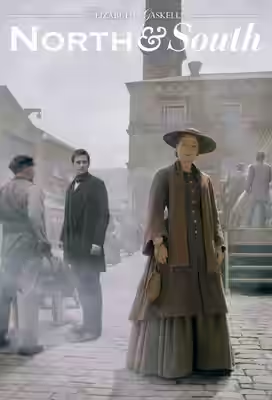
John Thornton (Richard Armitage) stands with Margaret Hale (Daniela Denby-Ashe) in an industrial yard
Series review

North & South

2004 · Created by Elizabeth Gaskell, Sandy Welch · Series · 1h 00m

In a sentenceWe came for the courtship and left grateful we don’t work in the scenery

Margaret Hale (Daniela Denby-Ashe) and John Thornton (Richard Armitage) face a social divide that complicates the prospect of love. Their story unfolds amid industrial surroundings, where questions of class enter personal relationships. Hannah Thornton (Sinéad Cusack) and Richard Hale (Tim Pigott-Smith) form part of the circle around them, alongside Nicholas Higgins (Brendan Coyle) and Bessy Higgins (Anna Maxwell Martin). Margaret and John must contend with differences that attraction alone cannot settle, while the people around them bring their own concerns to a relationship shaped by more than the feelings of the couple.

Fi1m review

Brian Percival’s adaptation of Elizabeth Gaskell makes its romance worth the wait, with forceful performances and class divisions that matter. The pacing occasionally drags, but the sharp dialogue gives the patient viewer plenty to enjoy.

North & South takes love across a social divide seriously enough to make the disagreements worth hearing. Director Brian Percival has four episodes in which to persuade us that Margaret Hale and John Thornton deserve our attention, and largely uses them well. We recommend this Elizabeth Gaskell adaptation warmly, with a caveat about the stretches where patience begins to feel compulsory. Sandy Welch’s screenplay gives people distinct opinions and lets their conversations become awkward without immediately providing a charming way out.

Daniela Denby-Ashe, as Margaret Hale, makes firmness an asset, even when it limits how readily we warm to her. Richard Armitage’s John Thornton is reserved enough that small changes in his manner become interesting, without requiring us to find every silence profound. We were moved by the way they listen to one another: both make taking another person’s words seriously look difficult. Their exchanges can be prickly, and the attraction gains from the sense that agreement will take some work.

Period romances can be impatient with anyone who gets between the leads, but the supporting performances here prevent the central relationship from claiming all our sympathy. Sinéad Cusack’s Hannah Thornton has an authority that demands attention even when it is unwelcome, while Brendan Coyle’s Nicholas Higgins feels like someone with concerns beyond the needs of the romance. Anna Maxwell Martin brings a welcome directness to Bessy Higgins. There is pleasure in watching actors allowed to insist upon a character’s point of view without having to make that character immediately agreeable.

Peter Greenhalgh’s cinematography gives the industrial setting a prominence that matters: the surroundings keep claiming our attention even while we are watching the people. There is a risk of making hardship too attractive, but the sharpness of the performances mostly prevents that. Simon Elliott’s production design makes these spaces convincing as places of work, rather than somewhere cleared out for a romantic scene. We believe that people have to spend their days here, and that helps the conversations about social differences feel less like a discussion arranged for our benefit.

Kristina Hetherington’s editing is generous to the actors, allowing an uncomfortable exchange to remain uncomfortable instead of cutting away for reassurance. That patience helps the courtship, although it also produces passages where the pace slackens and little is gained. Martin Phipps’s score supplies emotional emphasis that the leads do not always need. When the music presses a feeling already evident in their performances, we would prefer a little less help; there is enough happening between the actors to hold our attention without it.

Give it time, and resist the temptation to treat every conversation without the leads as an interruption. The supporting characters are worth attending to, particularly when their concerns complicate the pleasure of following a courtship. Choose it for an evening when two stubborn people trying to understand one another sounds more promising than a quick declaration.


Critical consensus AI synthesised

2 of 6
Positive
2
Mixed
0
Negative
0
The Times
15 November 2004 · Paul Hoggart
80*

The adaptation succeeds in delivering gritty realism over clichés through a sharp script and strong performances, resulting in an intelligent, moving and visually striking series that represents traditional TV drama at its best.

Read the full review →
The Guardian
21 November 2004
75*

The critic views the gritty BBC adaptation as a welcome change from typical period drama, highlighting its well-acted performances, beautiful visuals in industrial settings, and sharp dialogue that captures the era's contrasts.

Read the full review →

Straight answers AI written, from our review

Is North & South worth watching?
North & South is worth watching for anyone who wants a period romance where the disagreements matter as much as the attraction, and we scored it 83. Daniela Denby-Ashe and Richard Armitage make listening to one another look like hard work, which is the point. Expect some stretches across the four episodes where the pace slackens and patience feels compulsory.
How long is North & South, and what is it rated?
North & South has episodes of about 1h 00m. It is a drama series.
Where can I watch North & South in the US?
North & South is streaming on Amazon Prime Video, BritBox, Peacock, The Roku Channel and Apple TV in the US, and it is also available to buy from Apple TV and Amazon Prime Video. Availability is checked daily; the links above go straight to each service.
How does North & South compare to The Age of Innocence?
North & South and The Age of Innocence both make a romance out of social rules, but the series sets its courtship among mills and working people, while Scorsese's film stays inside New York finery. The film is the more painful and the more polished; the series is warmer and gives its supporting characters more room. Choose the film for suppressed desire and the series for two stubborn people arguing their way towards one another.
Is North & South based on a true story or a book?
North & South is based on the novel by Elizabeth Gaskell, not on a true story. Sandy Welch's screenplay keeps the class divisions central and gives the characters distinct opinions, so the industrial setting is more than a backdrop for the courtship. You do not need to have read the book to follow it, though the argument about class will land harder if you have.
What should I watch after North & South?
After North & South, try The Age of Innocence (1993, Fi1m 86): Social rules make even the smallest romantic concession feel like a public offence. Then The Lunchbox (2013, Fi1m 75): A tentative connection develops through small exchanges that reward close attention; and The Shop Around the Corner (1940, Fi1m 88): Two stubborn colleagues make disagreement an unexpectedly persuasive route towards affection.

Cast

If you liked this, try…

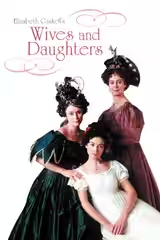
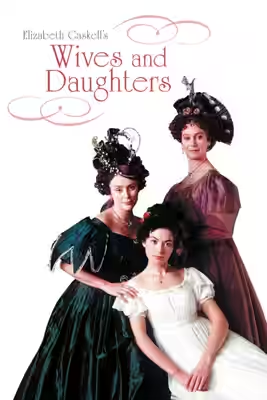
  1. Wives and Daughters (1999) · not reviewed yetPatient character work and family interference give another Gaskell courtship its complications.

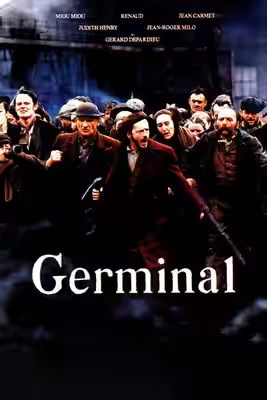
  2. Germinal (1993) · not reviewed yetFor the industrial hardship, with considerably less comfort from the romance.

  3. The Age of Innocence (1993, Fi1m 86)Social rules make even the smallest romantic concession feel like a public offence.

  4. The Lunchbox (2013, Fi1m 75)A tentative connection develops through small exchanges that reward close attention.

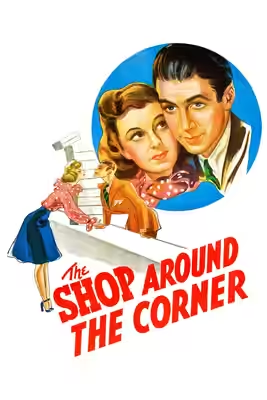
  5. The Shop Around the Corner (1940, Fi1m 88)Two stubborn colleagues make disagreement an unexpectedly persuasive route towards affection.

Free account

Know what to watch tonight

Two lists that know where things are streaming, collections you can share, your own score beside ours, and Discover that remembers what you have seen.

  • Want to see, sorted by what is streaming now
  • Seen, with your score out of ten
  • No adverts, ever