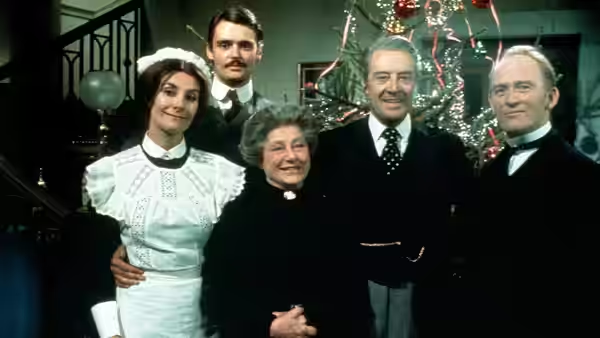
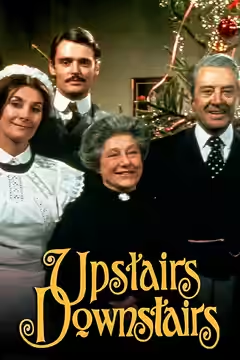
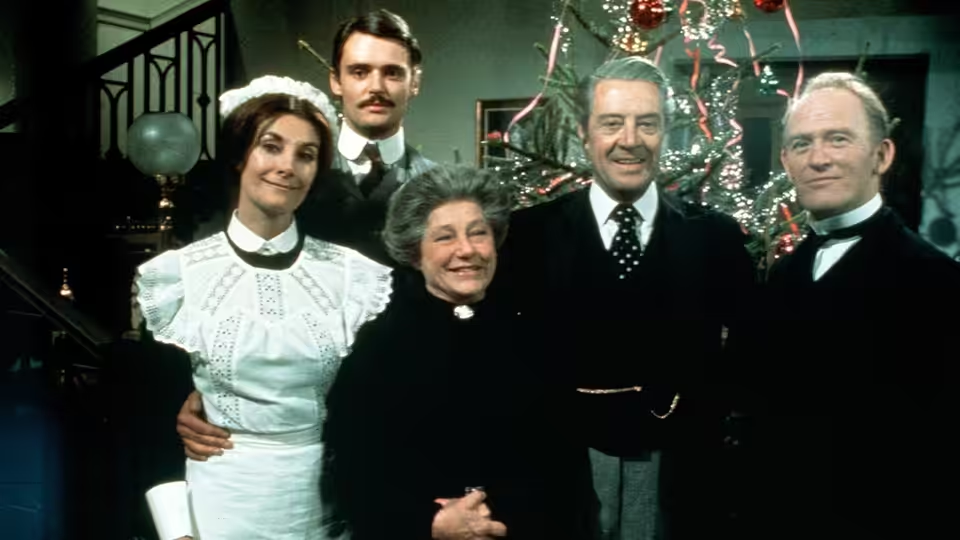
A maid and four others gathered together indoors near a Christmas tree
Series review

Upstairs, Downstairs

1971 · Created by John Hawkesworth, Eileen Atkins, Jean Marsh · Series · 50m · MPA TV-PG

In a sentenceEveryone has a place, and the people downstairs have rather more to do

In an Edwardian household, the lives of Richard Bellamy (David Langton) and James Bellamy (Simon Williams) run alongside those of Angus Hudson (Gordon Jackson), Rose Buck (Jean Marsh) and Mrs. Bridges (Angela Baddeley). Upstairs and downstairs, people have private concerns, but their freedom to attend to them depends on money and position. Those in service need to earn a living while meeting the demands of the household. The story moves between employers and staff, following the everyday work and personal difficulties that bring them into contact across a division neither side can simply ignore.

Fi1m review

Upstairs, Downstairs earns our affection by taking the servants’ lives seriously and letting characters develop over time. The staging can be stiff, but the class tensions keep this household drama from becoming too comfortable.

Upstairs, Downstairs is absorbing television with a harder view of household life than its period setting might suggest. We recommend it, with a caveat about the stiffness of some of the staging. Creators John Hawkesworth, Eileen Atkins and Jean Marsh make room for the people who do the work, giving their concerns enough time to become important to us. The series asks for an investment in a large company of characters, then rewards it through the steady accumulation of detail.

Jean Marsh also plays Rose Buck, and she is central to the appeal of an ensemble that makes sustained attention worthwhile. Gordon Jackson as Angus Hudson and Angela Baddeley as Mrs. Bridges give the downstairs company considerable authority. Their characters hold our interest without needing the household’s social rank to tell us whose troubles matter most. David Langton’s Richard Bellamy and Simon Williams’s James Bellamy belong to the same broad account of domestic life, though the people below stairs are often the stronger reason to return.

The theatrical presentation is the main qualification. Directors including Joan Kemp-Welch and Bill Bain sometimes leave us too aware of the drama being arranged, and the dated passages require a little patience. Geoff Beames’s editing helps the stories keep moving, with enough pace to prevent all that character detail from becoming a burden. Even so, anyone looking for a period drama to supply a succession of handsome images will find that the pleasure here depends much more heavily on the writing and performances.

We were angrier than we expected at the ordinary unfairness of this household. The attention to daily work does it: somebody’s ease depends on somebody else remaining available, and the programme keeps the working people in view. Class is present in the practical business of employment, not confined to declarations about how society ought to behave. That makes the domestic detail more involving, because earning a living affects how much room these people have for a private life.

The writing credits include Fay Weldon, Elizabeth Jane Howard and Alfred Shaughnessy, and the material has interests beyond maintaining order in a household. Its treatment of sexuality helps to disturb the impression that this is merely reassuring period entertainment. Affection for familiar characters can make some of those household arrangements seem easier to accept. We sometimes wanted the programme to press harder, though its attention to work and differences in income keeps the discomfort alive.

Within period drama, its strength is the time it gives to lives that might otherwise be reduced to household duties. Across five series, the cumulative storytelling allows concerns to grow instead of requiring each episode to manufacture a fresh crisis. It can be dated, and we would not pretend that patience cures every stiff passage. But there is ample reward in a programme prepared to make working life a substantial part of its entertainment. Give it several episodes; this is a household worth getting to know.

Critical consensus AI synthesised

3 of 6
Positive
3
Mixed
0
Negative
0
The AV Club
6 April 2011 · A- · Emily St. James
90

The critic praises the 1971 series as an important link between early anthology TV and modern serialized dramas like The Sopranos and Mad Men, noting its cumulative storytelling and focus on both upstairs and downstairs characters. The review singles out the show's novelistic sweep and political commentary on class and income disparity for praise while noting some staginess and dated elements as minor complaints.

Read the full review →
The Guardian
· Peter Fiddick
70*

The series avoids many potential traps and builds strong characters with pace and detail among the lower orders. It delivers popular but solid entertainment that plays the upstairs-downstairs dynamic for real.

Read the full review →
The Times
24 September 2005
70*

The series was more hard-hitting than remembered, tackling suicide, homosexuality and working life in its Edwardian setting. It established an audience for period TV despite not matching the production values of later shows like Brideshead Revisited.

Read the full review →

Straight answers AI written, from our review

Is Upstairs, Downstairs worth watching?
Upstairs, Downstairs is worth watching for anyone with the patience for a large cast and a slow build, and we scored it 83. The staging can be stiff and some passages are dated, but the servants' lives are taken seriously enough that the household becomes worth returning to. Give it several episodes before deciding.
How long is Upstairs, Downstairs, and what is it rated?
Upstairs, Downstairs has episodes of about 50m and is rated TV-PG by the MPA in the US. It is a drama series.
Where can I watch Upstairs, Downstairs in the US?
Upstairs, Downstairs is streaming on BritBox, The Roku Channel, Tubi and Apple TV in the US. Availability is checked daily; the links above go straight to each service.
How violent or frightening is Upstairs, Downstairs, and is it suitable for children?
Upstairs, Downstairs carries a UK 12 certificate and contains little that is violent or frightening. Its discomfort is social, in the ordinary unfairness of who works and who rests, and its treatment of sexuality is more adult than the period setting suggests. Older children may follow it; younger ones will find it slow.
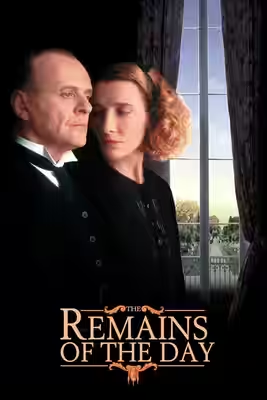
How does Upstairs, Downstairs compare to The Remains of the Day?
Upstairs, Downstairs spreads a life in service across a whole household and five series, while The Remains of the Day concentrates it in one man over one evening's viewing. The film is the more finished piece of craft and the more painful; the series is stiffer to look at but gives its working people far more time. Choose by how long you want to stay.
What should I watch after Upstairs, Downstairs?
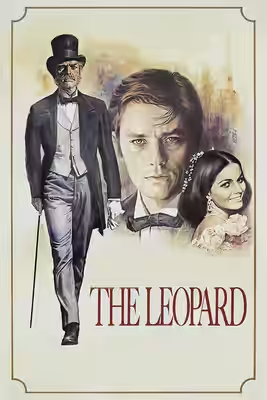
After Upstairs, Downstairs, try The Remains of the Day (1993, Fi1m 88): Another life in service, with the private cost brought painfully close. Then Gosford Park (2001, Fi1m 85): A country house offers plenty of opportunities to mistake employment for loyalty; and The Leopard (1963, Fi1m 88): An aristocratic household confronts change while taking considerable care over its appearance.

Cast

Awards

Primetime Emmy Awards, 2011

Nominated
Outstanding Supporting Actress in a Miniseries or a Movie

Peabody Awards, 1977

Won
Peabody Awards

Primetime Emmy Awards, 1976

Nominated
Outstanding Writing for a Drama Series

BAFTA Television Awards, 1975

Nominated
Best Actor

Primetime Emmy Awards, 1975

Nominated
Outstanding Supporting Actress in a Drama Series
Won
Outstanding Lead Actress in a Drama Series

BAFTA Television Awards, 1974

Won
Best Drama Series

Golden Globes, 1974

Nominated
Best Actress – Television Series Drama
Won
Best Television Series – Drama

Primetime Emmy Awards, 1974

Won
Outstanding Drama Series

BAFTA Television Awards, 1973

Nominated
Best Actress

If you liked this, try…

  1. The Remains of the Day (1993, Fi1m 88)Another life in service, with the private cost brought painfully close.

  2. Gosford Park (2001, Fi1m 85)A country house offers plenty of opportunities to mistake employment for loyalty.

  3. The Leopard (1963, Fi1m 88)An aristocratic household confronts change while taking considerable care over its appearance.

  4. Fanny and Alexander (1982, Fi1m 92)Family life gathers force through rooms, routines and the adults children watch.

  5. Shtisel (2013) · not reviewed yetPatient household storytelling gives private hopes room to challenge firmly inherited rules.

Free account

Know what to watch tonight

Two lists that know where things are streaming, collections you can share, your own score beside ours, and Discover that remembers what you have seen.

  • Want to see, sorted by what is streaming now
  • Seen, with your score out of ten
  • No adverts, ever