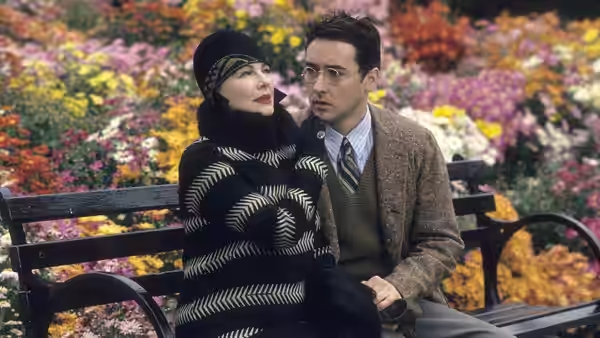
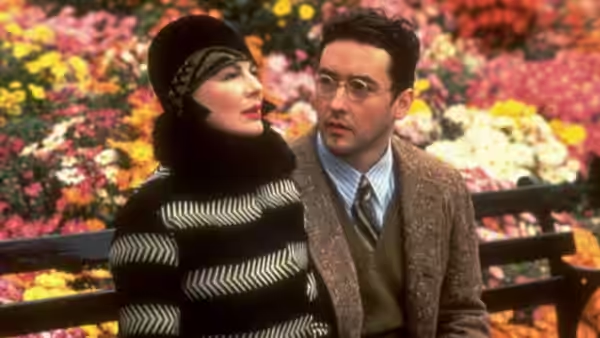
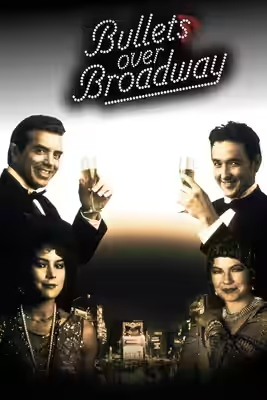
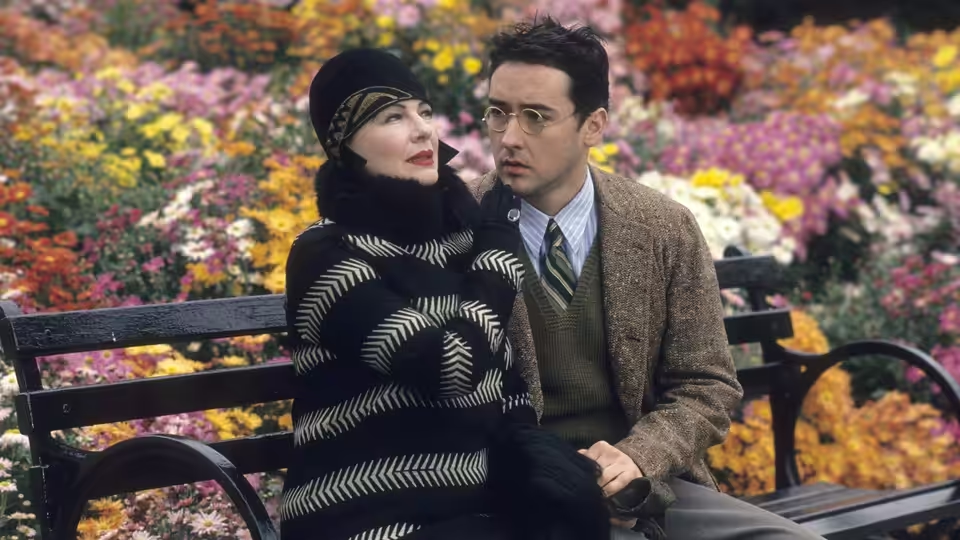
David Shayne (John Cusack) sits with Helen Sinclair (Dianne Wiest) on a bench amid colorful flowers
Film review

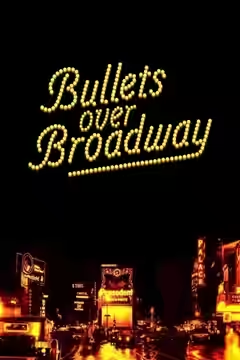
Bullets Over Broadway

1994 · Directed by Woody Allen · 1h 38m · MPA R

In a sentenceThe actors make such a fuss about their work that a gangster’s bodyguard starts to seem like sensible company

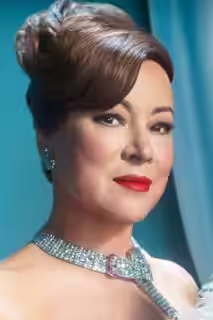
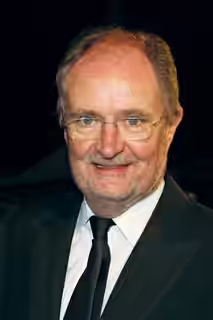
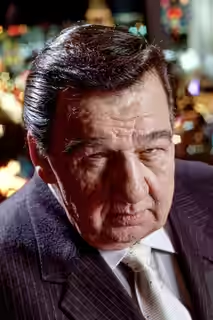
The theatre and the gangster world meet in the 1920s, with a play at the centre of their dealings. John Cusack plays David Shayne, alongside Dianne Wiest as leading lady Helen Sinclair and Jennifer Tilly as Olive Neal. Around the production, artistic ambition has to contend with people used to getting their way, onstage and elsewhere. Chazz Palminteri plays Cheech, a gangster’s bodyguard whose presence brings the two worlds together. Woody Allen directs this backstage crime comedy, with an ensemble that also includes Jim Broadbent, Tracey Ullman and Mary-Louise Parker.

Fi1m review

Woody Allen’s backstage crime comedy is brisk, funny and satisfyingly unkind to artistic vanity. Dianne Wiest and Chazz Palminteri give it bite, though the theatrical clichés and occasional stiff staging keep it from feeling quite as fresh as its best jokes.

Woody Allen’s Bullets Over Broadway is a sharp, funny backstage comedy with a useful shortage of respect for people who announce their own talent. Written by Allen and Douglas McGrath, it puts the theatre beside the gangster business and finds plenty of bullying in both. The actors’ vanity supplies plenty of jokes, though that alone would barely sustain a sketch. Allen and McGrath get further by questioning how much these people understand about the art they claim to serve.

Dianne Wiest’s Helen Sinclair is the main pleasure, a leading lady whose grand manner makes even vanity seem like demanding work. We laughed at the sheer insistence of her performance: Helen expects her importance to be accepted before anyone gets on with anything else. Jennifer Tilly’s Olive Neal supplies a competing, less polished kind of self-regard, and Tilly keeps the caricature forceful without apologising for it. Both performances are broad, but neither actress lets the exaggeration obscure how determined her character is to command attention.

Chazz Palminteri’s Cheech gives the comedy its less comfortable edge. A gangster’s bodyguard among theatre people is an easy excuse for jokes about manners, but Allen and McGrath give him enough importance to challenge the actors’ assumptions about talent. Palminteri is funny without making Cheech seem harmless, which matters whenever criminal behaviour enters the jokes about art. His performance keeps the gangster side of the story from becoming merely a convenient supply of interruptions.

Carlo Di Palma’s cinematography and Santo Loquasto’s production design make the 1920s setting a pleasure to spend time in. The period atmosphere helps the theatre and gangster scenes belong to the same comedy, even when the performances threaten to pull it in several directions. The staging is less reliable, and Allen sometimes leaves an exchange looking awkwardly arranged rather than spontaneous. That stiffness is noticeable in a film whose dialogue moves so quickly.

Susan E. Morse’s editing helps maintain that pace, and the 98-minute running time is a sensible fit for the material. There is little opportunity for the comedy to sag, although speed cannot disguise every familiar type. Allen and McGrath sometimes rely on recognisable theatrical foolishness when a more particular observation would have been funnier. Once a character’s vanity has been established, repeating it gives the actor something to do but does not always give us another joke.

As a backstage comedy, it benefits from letting criminal behaviour intrude on the usual rivalries and wounded pride. Farce needs characters who regard their own wishes as urgent, and the actors and gangsters are equally well suited to that requirement. Allen and McGrath find something uncomfortable in the ease with which talk of artistic achievement can push ordinary decency out of consideration. The film gives that question enough weight to sharpen the laughter without stopping for a lengthy discussion of it.

There is no need to bring much reverence for the theatre to this one. A tolerance for actors being extravagant will help, particularly when the writing falls back on familiar types. Choose it for Wiest and Palminteri, and watch it with someone who has endured a long explanation of another person’s creative process.
Critical consensus AI synthesised

78
Positive
9
Mixed
0
Negative
0

The reviews are unanimous in their approval. Most critics call this one of Woody Allen’s funniest and most energetic comedies in years, a screwball farce set among 1920s theatre folk that satirises their pretensions without slackening the pace. The praise clusters on the cast: Dianne Wiest’s haughty leading lady Helen Sinclair is singled out again and again, with Jennifer Tilly’s Olive and Chazz Palminteri’s gangster Cheech close behind. Several critics credit the Cheech twist, a hit man who turns out to have more talent than the playwright, with lifting the film above routine backstage comedy.

The spread is narrow, running from warm to very warm, and the reservations are mild. Empire finds it a charming diversion that lacks the depth of Allen’s best work, Film Comment wishes he had chased the comic possibilities of the milieu harder, and Time Out notes some clichés and clumsy staging. Nobody argues against seeing it.

The Guardian
6 April 2014
90*

The film is one of Woody Allen's finest, a screwball comedy thriller that is elegant, effervescent, superbly constructed and very funny. The critic singles out the performances, particularly Dianne Wiest's Oscar-winning turn as the haughty leading lady Helen Sinclair.

Read the full review →
The New York Times
30 September 1994 · festival review · Janet Maslin
90*

The critic calls the film a bright, energetic, side-splitting comedy with vital matters on its mind, exactly the kind of sharp-edged farce Allen does best. She singles out the wild card of the gangster Cheech for making the story more than a routine comedy.

Read the full review →
Time Out
25 February 2015 · TCh
85*

The critic calls it Allen's fizziest piece in years and a merciless satire on the pretensions of theatre folk. They single out the fiercely competitive caricatures from Tilly and Wiest for praise while noting some clichés and clumsy staging but ultimately recommend seeing it.

Read the full review →
The Independent
13 May 1995
80*

The critic praises the rapid-fire gags and the interplay between the gangster and theater worlds in this 1920s-set comedy, highlighting strong ensemble performances especially from Dianne Wiest as the vampish leading lady.

Read the full review →
Empire
1 January 2000 · Colin Kennedy
75*

The review calls it a delightful diversion with a remarkable ensemble and brilliant gags, noting the vivid period atmosphere and witty dialogue as a charming addition to Allen's canon, though it lacks the depth of his best work.

Read the full review →
Film Comment
1 November 1994 · festival review · Robert Horton
70*

The critic calls it Woody Allen’s funniest movie in years, praising its lovingly realized 1920s Broadway backdrop and the way a gruff gangster character is willing to die for his art. They note some untapped comic possibilities in the milieu and wish Allen paid more attention to pure comedy.

Read the full review →

Straight answers AI written, from our review

Is Bullets Over Broadway worth watching?
Bullets Over Broadway is worth watching for anyone who enjoys seeing actors punished for their vanity, and we scored it 80. Dianne Wiest and Chazz Palminteri give Woody Allen's backstage crime comedy its bite, and 98 minutes is the right length for it. The staging is sometimes stiff and the theatrical types familiar, so it works better as sharp fun than as a fresh one.
How long is Bullets Over Broadway, and what is it rated?
Bullets Over Broadway runs 1h 38m and is rated R by the MPA in the US. It is a comedy and crime film.
Where can I watch Bullets Over Broadway in the US?
Bullets Over Broadway is streaming on Amazon Prime Video, The Roku Channel and Tubi in the US, and it is also available to rent from Amazon Prime Video from $4.99. Availability is checked daily; the links above go straight to each service.
How violent or frightening is Bullets Over Broadway, and is it suitable for children?
Bullets Over Broadway carries a US R certificate and has no UK rating, so treat it as an adult comedy rather than a family one. The gangster side of the story brings criminal behaviour into the jokes, and Palminteri's bodyguard is funny without being harmless. It is not frightening, but the humour about actors and thugs is aimed squarely at grown-ups.
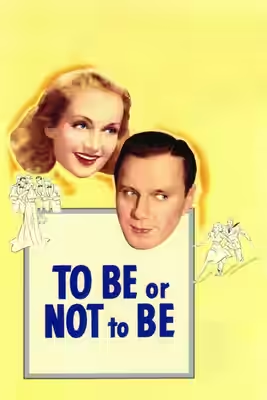
How does Bullets Over Broadway compare to To Be or Not to Be?
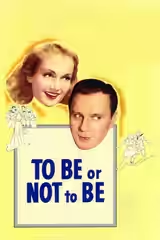
Bullets Over Broadway and To Be or Not to Be both find theatrical vanity useful in a comedy, but Lubitsch's film sets it against Nazis rather than 1920s gangsters, and is the more unnerving of the two. Allen's is brisker and gentler, with the sharper performances from Wiest and Palminteri. Choose Lubitsch for daring, Allen for an easier evening.
What should I watch after Bullets Over Broadway?
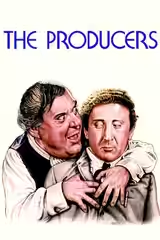
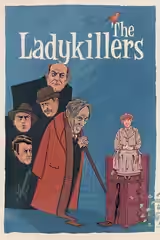
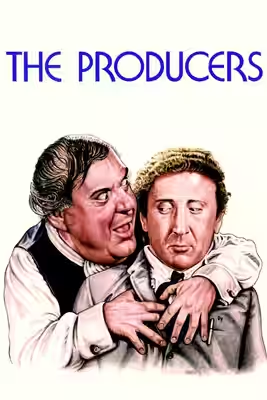
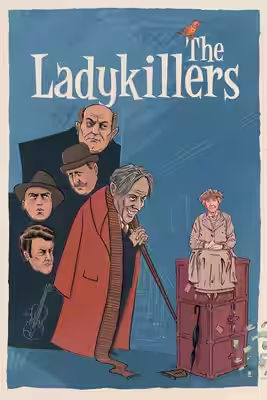
After Bullets Over Broadway, try The Producers (1967, Fi1m 82): Another backstage scheme in which bad behaviour gives the performers plenty to work with. Then The Ladykillers (1955, Fi1m 86): Criminal confidence proves no protection against foolishness in this dry British ensemble comedy; and To Be or Not to Be (1942, Fi1m 87): Theatrical vanity becomes dangerously useful in a comedy that lets actors misbehave magnificently.

Cast

Awards

BAFTA Film Awards, 1996

Nominated
Best Original Screenplay

Academy Awards, 1995

Nominated
Best Costume Design
Nominated
Best Director
Nominated
Best Production Design
Nominated
Best Supporting Actor
Nominated
Best Writing, Original Screenplay
Won
Best Supporting Actress

Independent Spirit Awards, 1995

Nominated
Best Screenplay
Won
Best Supporting Female
Won
Best Supporting Male

SAG Awards, 1995

Nominated
Outstanding Performance by a Male Actor in a Supporting Role
Won
Outstanding Performance by a Female Actor in a Supporting Role

Writers Guild of America Award for Best Original Screenplay, 1995

Nominated
Writers Guild of America Award for Best Original Screenplay

Golden Globes, 1994

Won
Best Supporting Actress – Motion Picture

National Society of Film Critics Award for Best Supporting Actress, 1994

Won
National Society of Film Critics Award for Best Supporting Actress

If you liked this, try…

  1. The Producers (1967, Fi1m 82)Another backstage scheme in which bad behaviour gives the performers plenty to work with.

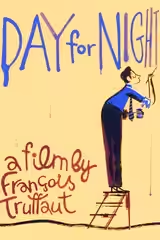
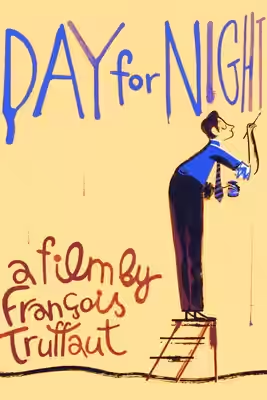
  2. Day for Night (1973) · not reviewed yetFor an ensemble comedy about making art while managing everybody’s inconvenient personal needs.

  3. The Ladykillers (1955, Fi1m 86)Criminal confidence proves no protection against foolishness in this dry British ensemble comedy.

  4. To Be or Not to Be (1942, Fi1m 87)Theatrical vanity becomes dangerously useful in a comedy that lets actors misbehave magnificently.

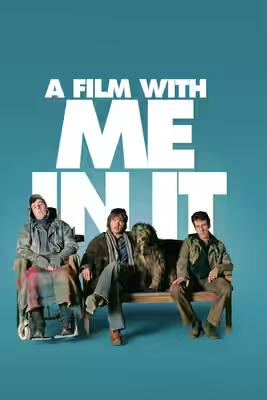
  5. A Film with Me in It (2008) · not reviewed yetMore performers, worse decisions, and criminal complications that keep interrupting the creative work.

Free account

Know what to watch tonight

Two lists that know where things are streaming, collections you can share, your own score beside ours, and Discover that remembers what you have seen.

  • Want to see, sorted by what is streaming now
  • Seen, with your score out of ten
  • No adverts, ever