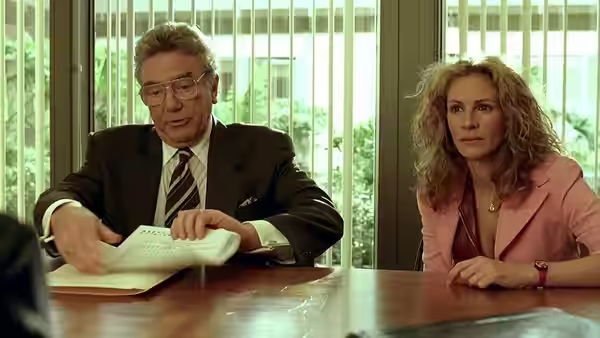
Erin Brockovich (Julia Roberts) seated at a desk reviewing documents in an office
Film review

Erin Brockovich

2000 · Directed by Steven Soderbergh · 2h 11m · MPA R

In a sentenceJulia Roberts in a push-up bra shouts down half of California, and California had it coming

Erin Brockovich (Julia Roberts) is twice divorced, has three small children, no job and a car that has just been hit by a doctor at a junction. She loses the personal injury case in the opening minutes, then talks her way into a filing job at the office of the lawyer who lost it, Ed Masry (Albert Finney). In a property file she finds medical records that have no business being there, and drives out to a desert town where a utility company is buying up houses and paying residents’ doctors’ bills. Aaron Eckhart plays the biker next door who minds the children. Marg Helgenberger is the first of the families Erin knocks on. Steven Soderbergh directs, from a script by Susannah Grant.

Fi1m review

Soderbergh’s true story of a filing clerk who took a utility company to court is shrewd about how such fights are actually won, and it is carried, scene by scene, by Julia Roberts. It is predictable to the minute. We did not much mind.

Erin Brockovich has no money, no husband and a neck brace from a car accident that was not her fault, and in the opening scene a jury declines to believe her. She responds by turning up at her lawyer’s office and refusing to leave until he gives her a job. Ed Masry (Albert Finney) does, mostly to make her stop talking. In a pro bono property file she finds blood tests and medical records, drives out to Hinkley, California, and starts asking why a power company is so keen to buy people’s houses. That is the first half hour, and Steven Soderbergh has made a good, plain film out of what follows. It is as predictable as a bus timetable. It is also funny, properly acted and honest about how a case like this gets built, which is by knocking on doors and reading everything.

Roberts plays Erin fast and loud and never once asks us to like her, which is why we do. The mouth is the weapon; she swears at receptionists, lawyers, neighbours and her own boss, and the swearing is precise. Jeffrey Kurland puts her in the shortest skirts and lowest tops in any room she walks into, and the film is clear-eyed about what that costs her and what it buys. Some critics found the wardrobe a distraction from the case. We thought it was the case: Erin is underestimated on sight, by everyone, and she uses that to get into rooms nobody else can enter.

Finney is the other reason to watch. His Masry is rumpled, tired, pleased with a small practice and appalled to find himself in a large fight, and the exasperation slowly turns into something like pride. The two of them arguing across a desk is the best material in the film. Aaron Eckhart’s George, the biker who moves in next door and ends up raising Erin’s children while she drives around the desert, is written as a saint and Eckhart plays him as one, which is not his fault and is a fault.

Soderbergh shoots it rough. Edward Lachman’s camera is often handheld and the light looks like whatever was already there when the crew arrived; the desert is bleached brown and the houses are photographed in flat afternoon sun, with no swelling music to tell us these people are victims. Philip Messina gives the law office wood panelling and a drop ceiling, and Erin’s rented house looks rented. Anne V. Coates cuts scenes before they can take a bow, coming in late and leaving early, so that a film with a dozen speeches in it never feels like it is making one. Thomas Newman’s score is guitar and hand percussion, low in the mix, and it stays out of the way until the last stretch, when it does not.

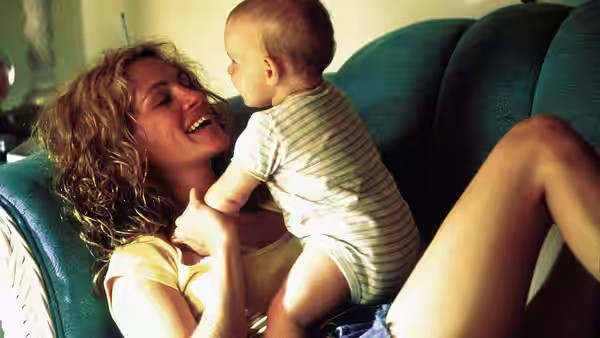
Here is what got us. Erin is in a motel in Hinkley, and George rings to tell her that their youngest has said her first word, and Erin was not there to hear it. Roberts does almost nothing with her face. We were moved more than we expected to be, because the film has spent an hour making the case matter and it now spends thirty seconds pointing out what it is costing. Marg Helgenberger, as the first Hinkley mother Erin sits down with, does similar work: a woman explaining her family’s tumours in the tone of someone giving directions.

The weaknesses are the ones the material invites. The company’s lawyers are cardboard, and Veanne Cox’s Theresa Dallavale, a lawyer from a bigger firm who is set up as a rival, is dispatched in a single exchange written to be applauded. Susannah Grant’s script is never in any doubt about who is right, and the second half repeats its own shape: Erin drives out, a family tells its story, Erin drives back and shouts at Ed. At 131 minutes we felt the length around the two-hour mark. There is also a late arrival, played by Tracey Walter, whose timing is a little too convenient, and we will say no more about him.

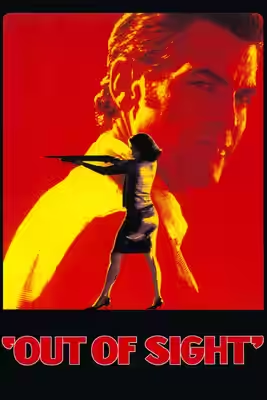
After Out of Sight (1998), this is Soderbergh’s simplest film, and that looks like a choice rather than a lapse. He has a star and a true story, and he trusts both enough not to decorate them. It carries a 15 certificate, mostly for the language, and the language is the point. Watch it with someone who still thinks Julia Roberts is only a smile; they will be quiet by the end of the first reel.


Critical consensus AI synthesised

81
Positive
18
Mixed
0
Negative
1

Most critics like it, and almost all of them like it for the same reason: Julia Roberts. The reviews describe her Erin as vivid, funny, foul-mouthed and credible, and several treat the film chiefly as a vehicle she carries without strain. Steven Soderbergh is the second point of agreement. Critics praise his restraint, his interest in character over courtroom procedure and his refusal to reach for easy sentiment. Albert Finney’s supporting turn is warmly noted more than once.

The reservations are mild and cluster around the story. Several critics call it predictable, an underdog tale that goes exactly where you expect, and The Guardian finds it triumphalist and less complex than comparable films. The spread is narrow: eighteen of nineteen reviews are favourable. The single dissent is RogerEbert.com, which argues that Roberts and her wardrobe upstage the litigation, and that the supporting characters and screenplay are thin. Nobody else agrees.

Radio Times
★★★★★ · Alan Jones
100

The critic calls it compulsive viewing thanks to Roberts' sensationally showy performance and Finney's lovable supporting turn in this emotionally rich true-story drama.

Read the full review →
Empire
1 January 2000 · Ian Nathan
90*

The critic praises Julia Roberts for delivering a superlative, Oscar-worthy performance as the trashy single mother turned crusader, bringing vulnerability, wit and determination to the role. Soderbergh is lauded for crafting an intensely funny and emotionally satisfying film that highlights individual impact against corporate power, though it remains predictable.

Read the full review →
Evening Standard
10 April 2012
90*

The critic praises Julia Roberts' monumental, exuberant performance as her best role, highlighting her chemistry with Albert Finney and the film's balance of maternal care, legal drama, and gender reversal. The screenplay is called a model for dramatizing issues while humanizing them, with Soderbergh's direction exemplary.

Read the full review →
Los Angeles Times
17 March 2000 · Kenneth Turan
90*

The critic calls the film an irresistible, hugely satisfying feminist fairy tale that turns Norma Rae into the protagonist of A Civil Action. He singles out Julia Roberts' textured, star-powered performance and Steven Soderbergh's restraint and intelligence in handling mainstream material.

Read the full review →
Sight and Sound
· Andrew O'Hehir
90*

The critic praises Julia Roberts' complex, edgy performance as the spirited but flawed heroine and Steven Soderbergh's restrained, respectful direction that avoids sentimentality and cinematic tricks.

Read the full review →
The New York Times
17 March 2000 · A.O. Scott
90*

The movie is a feel-good crowd-pleaser that embraces every cliché but delivers laughs, tears and cheers thanks to Julia Roberts' vibrant performance. Soderbergh directs with restraint, making it likely to earn her an Oscar nomination.

Read the full review →

Straight answers AI written, from our review

Is Erin Brockovich worth watching?
Erin Brockovich is worth watching for anyone who wants a true legal story told plainly and carried by a star performance, and we scored it 78. Julia Roberts and Albert Finney arguing across a desk is the best of it. The shape is predictable to the minute and the length shows around the two-hour mark, but we did not much mind.
How long is Erin Brockovich, and what is it rated?
Erin Brockovich runs 2h 11m and is rated R by the MPA in the US. It is a drama film.
Where can I watch Erin Brockovich in the US?
Erin Brockovich is available to rent from Amazon Prime Video from $3.99. Availability is checked daily; the links above go straight to each service.
How violent or frightening is Erin Brockovich, and is it suitable for children?
Erin Brockovich carries a UK 15 certificate, almost entirely for the language, which is constant, precise and the point of the character. There is no violence to speak of and nothing frightening; the darkest material is families describing their illnesses in flat, matter-of-fact tones. It is unsuitable for younger children only because of the swearing, and older teenagers will be fine.
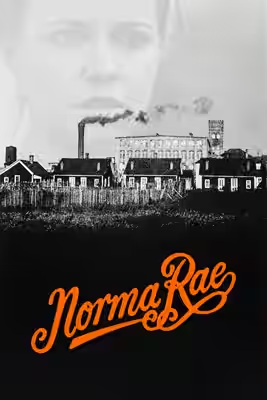
How does Erin Brockovich compare to Norma Rae?
Erin Brockovich and Norma Rae tell much the same story, a working woman taking on a company that has been quietly poisoning or exploiting a town, and both are simple-minded about their bosses. Sally Field's film is rawer and puts you on the factory floor; Soderbergh's is funnier and shrewder about how such a case is built. Take Norma Rae for grit, Erin Brockovich for the star turn.
What should I watch after Erin Brockovich?
After Erin Brockovich, try Norma Rae (1979, Fi1m 82): Sally Field organises a mill town; the same anger, twenty years earlier, no wardrobe jokes. Then Out of Sight (1998, Fi1m 86): Soderbergh two years earlier, looser and funnier, with George Clooney robbing banks.

Cast

Awards

Academy Awards, 2001

Nominated
Best Director
Nominated
Best Picture
Nominated
Best Supporting Actor
Nominated
Best Writing, Original Screenplay
Won
Best Actress

European Film Award for Best Non-European Film, 2000

Nominated
European Film Award for Best Non-European Film

If you liked this, try…

  1. Norma Rae (1979, Fi1m 82)Sally Field organises a mill town; the same anger, twenty years earlier, no wardrobe jokes.

  2. Silkwood (1983) · not reviewed yetMeryl Streep at a plutonium plant; the crusade without the comfort of a settlement.

  3. Dark Waters (2019) · not reviewed yetTodd Haynes does the corporate poisoning case grey, slow and frightening.

  4. Made in Dagenham (2010) · not reviewed yetEssex machinists take on Ford; warmer and sillier, with the same working-class spine.

  5. Out of Sight (1998, Fi1m 86)Soderbergh two years earlier, looser and funnier, with George Clooney robbing banks.

Free account

Know what to watch tonight

Two lists that know where things are streaming, collections you can share, your own score beside ours, and Discover that remembers what you have seen.

  • Want to see, sorted by what is streaming now
  • Seen, with your score out of ten
  • No adverts, ever