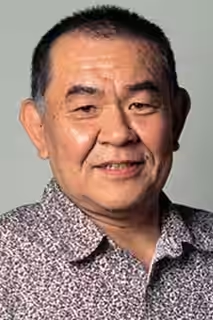
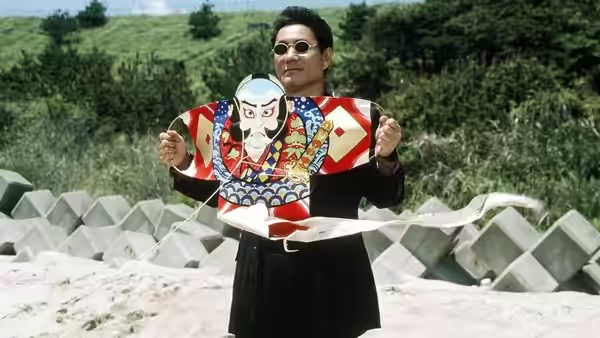
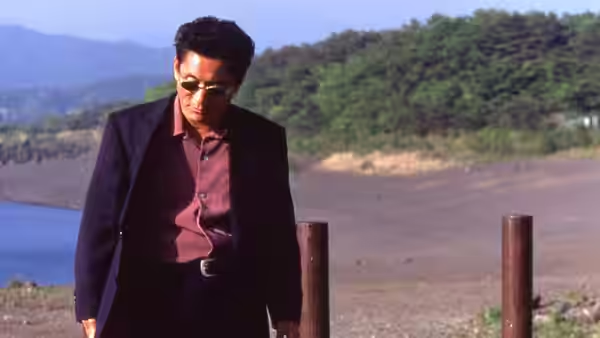
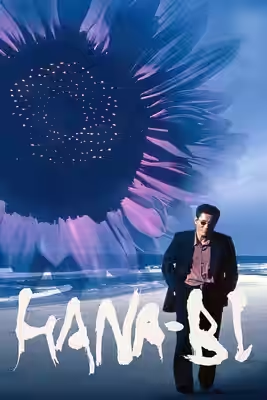
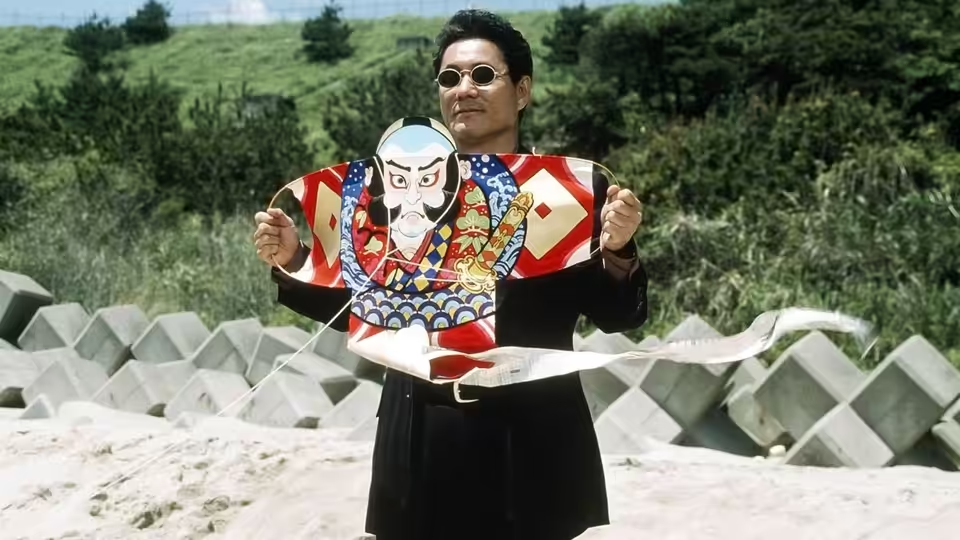
Yoshitaka Nishi (Takeshi Kitano) holding a large kite on the shore
Film review

Fireworks

1997 · Directed by Takeshi Kitano · 1h 43m · MPA R

In a sentenceTakeshi Kitano barely changes expression; we spent the film doing it for him

Yoshitaka Nishi (Takeshi Kitano) is a retired police officer whose wife (Kayoko Kishimoto) is terminally ill and whose colleague has suffered a disabling injury. Already dealing with debts to the yakuza, Nishi turns to crime to help them. His attempts to care for his wife unfold alongside encounters with violence, as the couple live with her illness and he struggles with his obligations to others. Written and directed by Kitano, Fireworks places a marriage within a crime story, with grief, loyalty and the need to provide for others shaping Nishi’s decisions.

Fi1m review

Takeshi Kitano’s crime drama is moving, funny and frightening, with abrupt violence that keeps its tenderness from becoming cosy. Its treatment of the wife is thinner than it should be, but the performances and patient visual storytelling make this an easy recommendation.

The violence in Fireworks is frightening because it comes from a man we have also watched caring for his wife. Takeshi Kitano writes, directs and plays Yoshitaka Nishi, a retired police officer who turns to crime while facing yakuza debts, his wife’s terminal illness and a colleague’s disabling injury. It is a moving, disquieting film, with enough deadpan humour to stop its grief becoming oppressive. Kitano is interested in how this man behaves when professional habits no longer solve the problems in front of him.

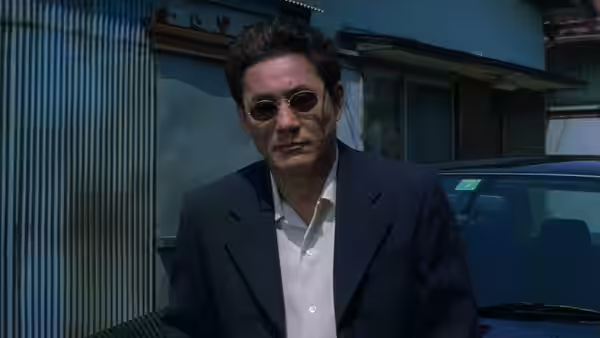
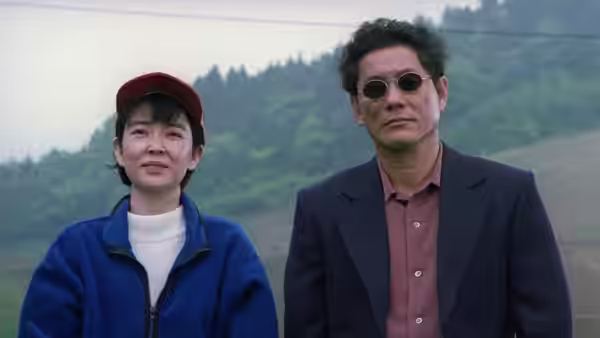
Kitano gives Nishi little outward expression, and that makes the small changes worth watching. His stillness can be funny, threatening or simply exhausted; the performance asks us to keep reassessing the same face. We were moved by Nishi’s quiet attention to his dying wife. Kitano makes us feel how helpless this man is beside her, without changing his performance into something softer. He does not need a speech explaining his distress.

Kayoko Kishimoto gives the wife a presence that the screenplay does not always match. There is tenderness in their scenes together, and she helps make the marriage seem worth caring about without much explanation. But we wanted more sense of what she wants for herself. Too often, the illness explains Nishi’s actions while her own thoughts remain difficult to reach. Kitano’s reticence serves his leading performance better than it serves hers.

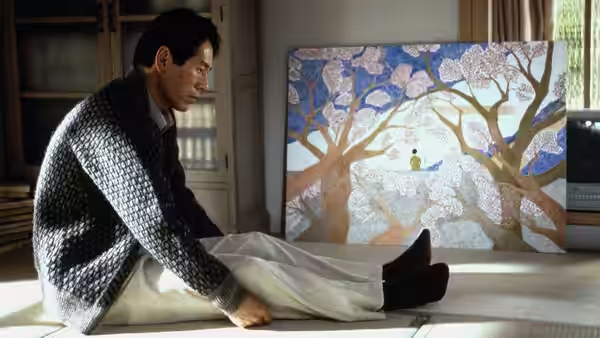
Hideo Yamamoto’s cinematography gives the figures space and allows a still composition to hold our attention. It works because we have time to study how people occupy the frame, without a restless camera supplying interest for them. Norihiro Isoda’s production design is similarly restrained, keeping the surroundings from competing with the people. The paintings, made by Kitano himself, become things we want to examine rather than decoration passed on the way to the next confrontation.

The cutting is less soothing. Editors Yoshinori Ota and Kitano break the stretches of stillness with violence so abrupt that there is little opportunity to prepare for it. The impact comes from being denied the usual warning; we have barely adjusted before someone is hurt. The gaps in the storytelling also work, asking us to make connections without turning Nishi’s troubles into a puzzle to be solved.

Joe Hisaishi’s melancholy score lets us hear some of the sadness that Nishi will not discuss. For the most part, that is welcome, particularly when Kitano’s face threatens to tell us nothing at all. Occasionally the music presses too firmly, and a face we were already watching with concern hardly needs further assistance. Those passages are the nearest the film comes to insisting on a response, and they make Kitano’s quieter choices seem wiser.

Part of the pleasure of a crime film is watching someone who seems to know exactly what to do. Here, Nishi’s ability to act decisively gives us little confidence that he knows how to help. The humour matters because it lets foolishness and awkwardness into a story that could easily become solemn about male suffering. Kitano allows us to laugh without making the next violent encounter feel harmless.

At 103 minutes, Fireworks has room for its pauses without feeling padded. It is worth watching in one sitting, with as little interruption as possible. Just do not mistake the quiet for a promise that you will be allowed to relax.
Critical consensus AI synthesised

84
Positive
9
Mixed
0
Negative
0

The reviews are unanimous in their praise and unusually consistent about why. Nearly every critic describes the same thing: long stretches of stillness broken by sudden, brutal violence, with deadpan humour running underneath. The praise clusters on Kitano himself, as director and as the taciturn lead, and on the way his own paintings are worked into the story of a former detective caring for a dying wife. Several also single out the composition, the melancholic score and the elliptical structure.

The spread is narrow and nobody dislikes it; the differences are of temperature. The most enthusiastic reviews treat it as a significant step forward for Kitano. The cooler ones, from the Los Angeles Times and the New York Times, admire the originality and the sparing use of violence but stop short of the rapture found elsewhere. Slant Magazine is alone in naming sentimentality, particularly in the scenes with the wife, though it counts this as part of the design rather than a fault.

Empire
1 January 2000 · David Parkinson
90*

The critic praises Kitano's personal meditation on love, violence, grief and loss as moving and edgy, highlighting its cinematic use of space, stillness and the director's own performance and paintings.

Read the full review →
The Guardian
24 September 1999 · ********
90*

The critic praises Kitano's reflective mode in this extraordinary film blending stillness with bursts of violence and deadpan humour, noting his mastery of style, tenderness without sentimentality, and careful composition and landscape use.

Read the full review →
The New Yorker
23 March 1998 · Anthony Lane
90*

Kitano's film mixes deadpan physical comedy and swift savagery with a tender study of marriage and loss as the protagonist cares for his dying wife and seeks redemption. Lane praises its elliptical structure, visual invention, and emotional depth as a major advance.

Read the full review →
Time Out
8 January 2016 · GA
90*

Kitano's Venice prize-winner mixes tenderness, violence and droll humour in an assured, imaginative story of a retired cop turning to crime for his terminally ill wife and a crippled colleague. The critic praises the sudden brutal violence in the editing, the resonant use of Kitano's own paintings, sharp mise-en-scène and the actor-director's taciturn yet expressive performance.

Read the full review →
Total Film
24 July 1998
90*

The review describes the film as a lyrical and elegiac piece of cinema, noting its blend of violence, absurdity and tenderness along with exquisite visuals and melancholic score.

Read the full review →
Variety
14 September 1997 · festival review
90*

Kitano delivers a poignant reflection on love, violence, grief, and loss through the story of a detective balancing yakuza debts, his partner's injury, and his wife's terminal illness. The review praises the masterful balance of tenderness and violence along with its visual storytelling and soulful conclusion.

Read the full review →

Straight answers AI written, from our review

Is Fireworks worth watching?
Fireworks is worth watching for anyone who can take a slow, quiet crime drama broken by sudden violence, and we scored it 88. Takeshi Kitano's near-expressionless performance as a retired police officer caring for his dying wife is moving and often funny. Its one real weakness is that the wife is written more thinly than she deserves.
How long is Fireworks, and what is it rated?
Fireworks runs 1h 43m and is rated R by the MPA in the US. It is a crime and drama film.
Where can I watch Fireworks in the US?
Fireworks is not on any streaming or rental service in the US at the moment. Availability is checked daily.
How violent or frightening is Fireworks, and is it suitable for children?
Fireworks carries an 18 certificate in the UK and is not suitable for children. The violence is brief but abrupt and frightening, arriving with almost no warning after long stretches of stillness, and the story rests on terminal illness and grief. Teenagers under eighteen should not be watching it, and the squeamish will find the sudden cuts to injury hard.
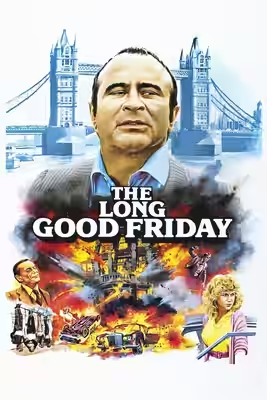
How does Fireworks compare to The Long Good Friday?
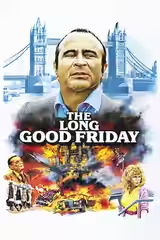
Fireworks is the quieter and sadder of the two, a study of a man whose decisiveness no longer helps anyone, where The Long Good Friday is a louder, plottier London thriller built around Bob Hoskins's bluster. Both are about criminals discovering how little force can do once certainty goes. We rate Kitano's film the higher; Mackenzie's is the easier evening.
What should I watch after Fireworks?
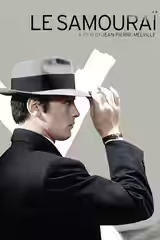
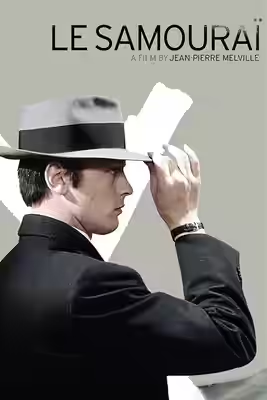
After Fireworks, try Le Samouraï (1967, Fi1m 88): Patient compositions and a watchful leading man make criminal routine feel precarious. Then The Long Good Friday (1980, Fi1m 88): A forceful criminal discovers how little authority can do when certainty disappears.

Cast

Awards

Independent Spirit Awards, 1999

Nominated
Best Foreign Film

Japan Academy Prize for Director of the Year, 1999

Nominated
Japan Academy Prize for Director of the Year

Japan Academy Prize for Outstanding Performance by an Actor in a Leading Role, 1999

Nominated
Japan Academy Prize for Outstanding Performance by an Actor in a Leading Role

Japan Academy Prize for Outstanding Performance by an Actress in a Leading Role, 1999

Nominated
Japan Academy Prize for Outstanding Performance by an Actress in a Leading Role

Japan Academy Prize for Picture of the Year, 1999

Nominated
Japan Academy Prize for Picture of the Year

Japan Academy Prize for Screenplay of the Year, 1999

Nominated
Japan Academy Prize for Screenplay of the Year

César Award for Best Foreign Film, 1998

Nominated
César Award for Best Foreign Film

National Society of Film Critics Award for Best Foreign Language Film, 1998

Nominated
National Society of Film Critics Award for Best Foreign Language Film

European Film Award for Best Non-European Film, 1997

Won
European Film Award for Best Non-European Film

Venice Film Festival, 1997

Won
Golden Lion

If you liked this, try…

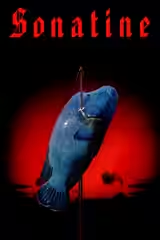
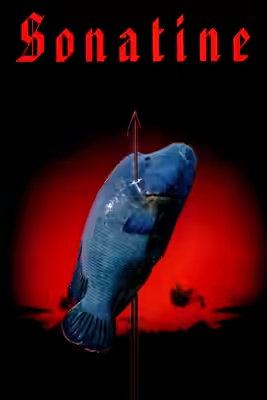
  1. Sonatine (1993) · not reviewed yetKitano lets gangsters idle long enough for their vulnerability to become troubling.

  2. Le Samouraï (1967, Fi1m 88)Patient compositions and a watchful leading man make criminal routine feel precarious.

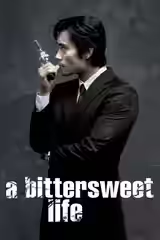
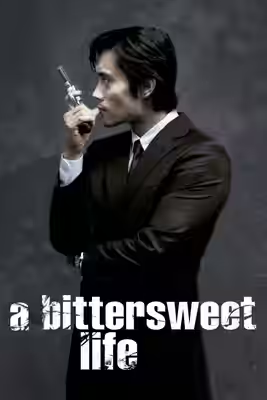
  3. A Bittersweet Life (2005) · not reviewed yetA crime drama that allows elegance and affection no protection from violence.

  4. The Man Without a Past (2002) · not reviewed yetDeadpan humour and unshowy kindness, with rather less reason to brace yourself.

  5. The Long Good Friday (1980, Fi1m 88)A forceful criminal discovers how little authority can do when certainty disappears.

Free account

Know what to watch tonight

Two lists that know where things are streaming, collections you can share, your own score beside ours, and Discover that remembers what you have seen.

  • Want to see, sorted by what is streaming now
  • Seen, with your score out of ten
  • No adverts, ever