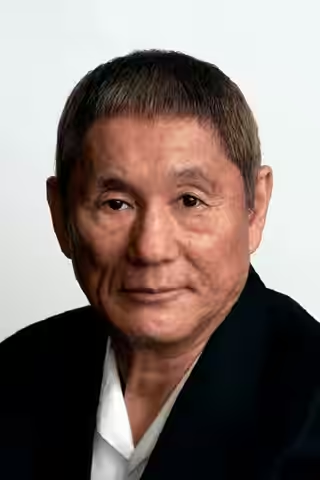
Takeshi Kitano acts with a face that barely moves and lets the film around it decide what the face means. Stillness that reads as menace in one scene and grief in the next is his whole method, and in Fireworks it is close to perfect.
Fi1m perspective
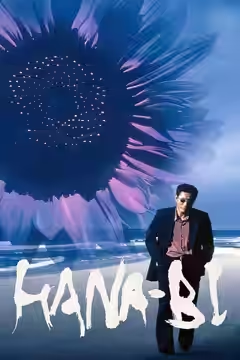
Watch Yoshitaka Nishi in Fireworks (1997) sitting beside his dying wife. His face barely moves. A few scenes later he hurts a man badly, and it is the same face. Kitano's method as an actor is to give the camera almost nothing and make us supply the rest, and he knows exactly what he is doing. He has compared it to a Noh mask: "It's unnecessary for the actor to act dramatically. What the audience can see and interpret is limitless." Plenty of actors say something like that to excuse doing nothing. Kitano's nothing is full.
He started as a stand-up comedian, Beat Takeshi on Japanese television in the 1970s, and the comedy did not go away when he took up crime films; it went quiet. His first big film part was in Merry Christmas, Mr Lawrence (1983). He directed himself for the first time in Violent Cop (1989), and the yakuza and police outsiders he played through Sonatine (1993), Fireworks, Brother (2000) and the Outrage trilogy (2010–2017) are all variations on a man who has stopped explaining himself. Japanese critics at first treated the directing as a comedian's hobby. They were wrong about the 1990s, and the films since Zatoichi (2003) have been fairly called less inventive; we have not reviewed them and will not judge them here.
What he does works best when the frame leaves him alone. In Fireworks, Hideo Yamamoto shoots Nishi in still compositions with room around him, so we have time to study the face and notice when it changes, which is rarely and always matters. His stillness reads as funny, threatening or simply exhausted depending on what is next to it, and his editing arranges what is next to it. We were moved by Nishi's quiet attention to his wife, and moved because he never softened the performance to earn it; the helplessness is in what he does not do. Joe Hisaishi's music, across six films together, supplies the warmth the face withholds.
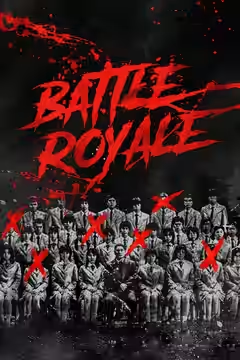
The cost of the method falls on other people. In Fireworks the wife, played by Kayoko Kishimoto, is thinner than she should be, because a man who will not explain himself does not leave much room for anyone else to. Under another director the same reticence becomes something else. In Kinji Fukasaku's Battle Royale (2000) his teacher is essential to the film's unpleasant humour, funny without making the killing seem harmless, and the menace makes the adults' cruelty feel personal. It is the best argument that the face is an instrument and not a limitation.
Start with Fireworks, then Battle Royale, to see what someone else does with the same face. Then decide whether a man who gives so little has, over three decades, been giving the same thing.
Biography
Takeshi Kitano (born 18 January 1947) is a Japanese comedian, actor and filmmaker, known in Japan as Beat Takeshi. He began his career in the 1970s as one half of the comedy duo Two Beat before pursuing solo work in television and film.
Kitano made his directorial debut with Violent Cop (1989). He gained international recognition for Sonatine (1993) and Fireworks (1997; also known as Hana-bi), the latter winning the Golden Lion at the Venice Film Festival. He frequently writes, directs, edits and stars in his films, which include Kikujiro (1999), Zatoichi (2003) and the Outrage trilogy (2010–2017).