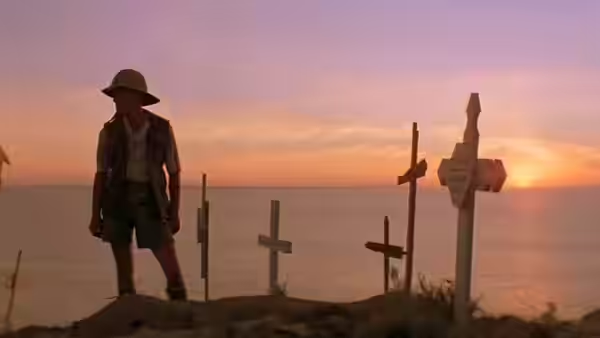
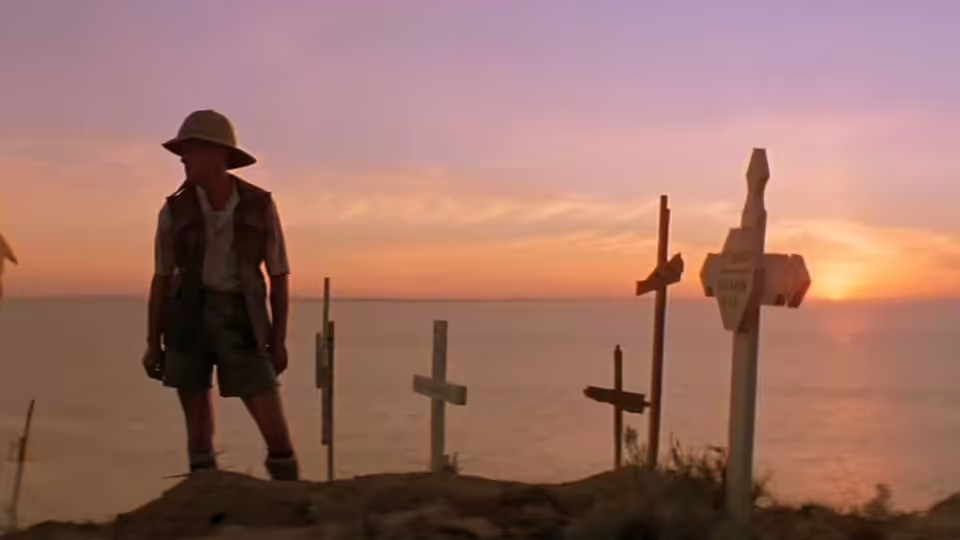
a man standing among wooden crosses overlooking the sea at sunset
Film review

Gallipoli

1981 · Directed by Peter Weir · 1h 52m · MPA PG

In a sentenceTwo runners join the army, and we spend the film wishing they had stuck to athletics

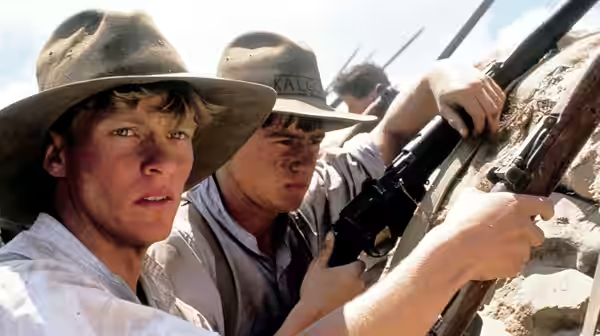
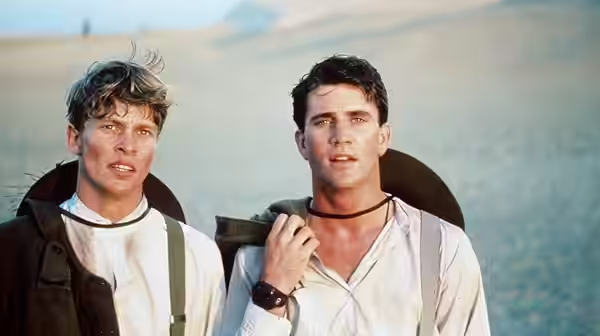
Archy Hamilton (Mark Lee) and Frank Dunne (Mel Gibson) are young Australian runners whose lives take them from sporting competition towards military service. With the First World War under way, joining up offers the prospect of travel and adventure. Their friendship develops as they leave civilian life and enter the army, carrying their competitiveness into new surroundings. Peter Weir’s drama follows the pair from the Australian Outback towards the Gallipoli campaign, keeping their companionship at the centre of a story about enlistment and the experience of becoming soldiers.

Plays from YouTube when you press play; nothing loads from them until then.

Fi1m review

Peter Weir’s war drama earns its force through the friendship between two runners. It is moving and warmly acted, though the training scenes linger and the portrayal of British command is too blunt.

Peter Weir’s Gallipoli is a moving war film that takes its time getting to the war, and mostly uses that time well. It begins with young Australian runners, giving their competitiveness and growing friendship the attention another film might reserve for military preparations. Archy Hamilton (Mark Lee) and Frank Dunne (Mel Gibson) have lives worth watching before they become soldiers. David Williamson’s screenplay gives their companionship enough space for enlistment to feel like a choice made by people we have begun to know.

Lee and Gibson are persuasive together because the friendship never feels like an obligation imposed by a war-film script. Competition gives them something to do besides announce their feelings, and the affection becomes convincing through their shared appetite for it. We felt protective of them during the early running scenes. Watching them enjoy their strength and one another’s company made us reluctant to follow them into army life, even though the title had settled the destination.

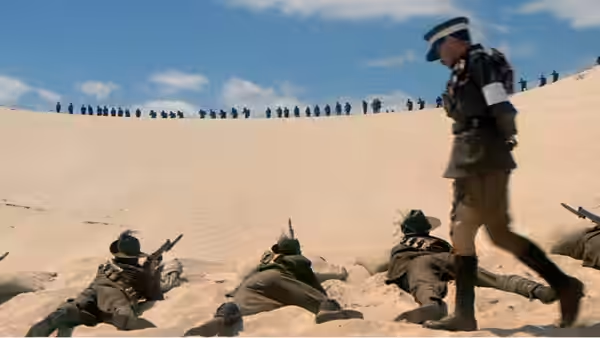
Russell Boyd’s cinematography makes good use of the contrast between the sunlit Outback and the confusion of the trenches. The opening landscapes allow the runners’ physical freedom to register; later, the battlefield leaves us searching for that ease and space. These are attractive images, but the beauty does not make the fighting look inviting. Weir keeps our attention on the young men within those settings, so the change in surroundings also changes how we look at their bodies.

The patience becomes a problem in the Egypt training section, where the comic horseplay carries on after the friendship has been established. Editor William M. Anderson gives the earlier material a comfortable pace, but here the film needs to move sooner. Some of the supporting figures are broad enough to make the humour feel cheaply obtained, especially beside the care lavished on the leads. We understand the wish to spend time with these men before battle; there is still more than one scene doing essentially the same job.

Williamson is better at writing companionship than at distributing responsibility. The portrayal of British command is blunt, and Weir does too little to complicate it; we would not mistake this for a sufficient history of the campaign. That simplification matters because the film asks us to feel so strongly about the men being commanded. Their responses remain persuasive, but the people above them are given little room to be anything beyond an explanation for what is going wrong.

The music is credited to Brian May, Jean-Michel Jarre and Tommaso Albinoni, and it sometimes supplies more solemnity than the performances need. Weir is most affecting when he trusts the companionship he has already shown us. Lee and Gibson have made that part of the film credible without needing every feeling underlined. That is a small reservation, and it never breaks our involvement.

Among war dramas, Gallipoli stands out for taking the attractions of enlistment seriously: competition, travel and companionship. Its warmth makes those motives understandable without requiring us to share them. The attention paid to the two runners earns our recommendation, despite the stretches where the comedy outlasts its welcome. Watch it for Lee and Gibson, and bring some patience for the training.

Critical consensus AI synthesised

78
Positive
11
Mixed
1
Negative
0

With only 5 reviews in so far, most critics praise Peter Weir’s moving account of young Australians going to war, particularly the friendship between its leads. The contrast between the sunlit opening and the trenches draws praise, as does the film’s treatment of comradeship and sacrifice. Reservations concern its historical perspective and pacing: The Telegraph objects to an anti-British bias in the portrayal of command decisions, while Time Out finds the Egypt training section sluggish and its humour crude. The latter is notably cooler than the other reviews, despite admiring the battle photography.

The AV Club
19 January 2006 · A · Scott Tobias
95

The film follows young Australian soldiers from enlistment through training to the trenches, where their initial sense of adventure gives way to inevitable slaughter. Weir honors the patriotic sacrifice while underscoring the futility, with the unforgettable final freeze-frame singled out as especially powerful.

Read the full review →
Empire
1 January 2000 · Ian Nathan
90*

The critic calls it a haunting and moving tribute to the Australians who sacrificed their lives at Gallipoli, presenting the tragic loss of innocence in a more affecting way than similar films. Weir is praised for portraying the strange calling of war as an intimate elegy through the comradeship and bond between the two leads, contrasted with the Outback and trenches.

Read the full review →
RogerEbert.com
18 November 2022 · Daniel Joyaux
90*

The critic calls “Gallipoli” the purest distillation of Weir’s recurring theme of people finding themselves in the wrong place. He singles out the film’s final five minutes as the most singularly devastating ending in film history.

Read the full review →
The Guardian
22 January 2009 · A–
90*

The critic praises Peter Weir's 1981 film as a magisterial portrait of the Gallipoli campaign and its historical settings. It singles out the moving climax at the Battle of the Nek for its emotional impact while noting some minor historical liberties.

Read the full review →
Radio Times
★★★★ · David Parkinson
80

This landmark Australian film focuses on the spirit of competition and camaraderie rather than overt pacifism or Anzac pride. Weir effectively contrasts the trenches' chaos with the sunlit opening scenes while centering on the responses of the two young leads.

Read the full review →
The New York Times
28 August 1981 · Janet Maslin
70*

The film follows young Australian runners into the catastrophic WWI battle at Gallipoli, approaching war obliquely through its beauty and emotional power rather than as a conventional war movie. Weir's delicate style yields uncommon warmth, immediacy and striking images, such as the underwater shot of soldiers in reddening water.

Read the full review →

Straight answers AI written, from our review

Is Gallipoli worth watching?
Gallipoli is worth watching for anyone who wants a war film that cares more about two young men than about the fighting, and we scored it 82. Mark Lee and Mel Gibson make the friendship between the runners moving and credible. The Egypt training section runs on too long, and the portrayal of British command is blunt, so bring some patience.
How long is Gallipoli, and what is it rated?
Gallipoli runs 1h 52m and is rated PG by the MPA in the US. It is a war and history film.
Where can I watch Gallipoli in the US?
Gallipoli is available to rent from Amazon Prime Video and Apple TV from $4.99. Availability is checked daily; the links above go straight to each service.
How violent or frightening is Gallipoli, and is it suitable for children?
Gallipoli carries a UK PG certificate and is a war drama rather than a graphic one. The film spends most of its length on friendship, running and training before reaching the trenches, and its force comes from feeling for the two leads rather than from gore. Older children should cope, though the ending is designed to upset.
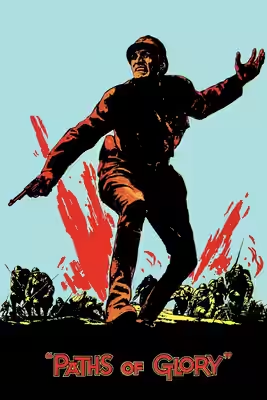
How does Gallipoli compare to Paths of Glory?
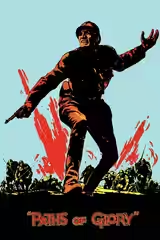
Gallipoli is the warmer film and Paths of Glory the angrier and more exact one. Weir keeps the friendship between two runners at the centre and treats British command bluntly, while Kubrick watches the officers closely and earns his fury at military cruelty. Choose Gallipoli for companionship, Paths of Glory for a sharper argument about the men in charge.
Is Gallipoli based on a true story or a book?
Gallipoli is credited as based on a novel by Ernest Raymond and is set during the real Gallipoli campaign of the First World War. The two runners at its centre are dramatic inventions rather than documented figures, and we would not treat the film as a sufficient history of the campaign. Knowing the source is not needed to follow it.
What should I watch after Gallipoli?
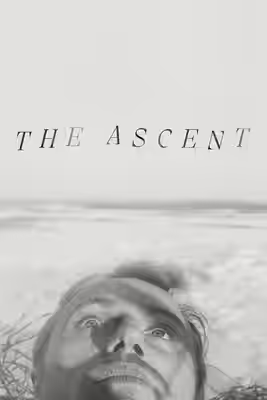
After Gallipoli, try Paths of Glory (1957, Fi1m 93): Another war film that watches officers closely and worries about the men. Then The Big Parade (1925, Fi1m 80): Soldiers’ companionship and everyday comedy make the approach of battle harder to bear; and The Ascent (1977, Fi1m 88): For a colder, harsher war drama built around two men under pressure.

Cast

Awards

AACTA Award for Best Actor in a Leading Role, 1981

Won
AACTA Award for Best Actor in a Leading Role

AACTA Award for Best Actor in a Supporting Role, 1981

Won
AACTA Award for Best Actor in a Supporting Role

AACTA Award for Best Cinematography, 1981

Won
AACTA Award for Best Cinematography

AACTA Award for Best Costume Design, 1981

Nominated
AACTA Award for Best Costume Design

AACTA Award for Best Direction, 1981

Won
AACTA Award for Best Direction

AACTA Award for Best Editing, 1981

Won
AACTA Award for Best Editing

AACTA Award for Best Film, 1981

Won
AACTA Award for Best Film

AACTA Award for Best Production Design, 1981

Won
AACTA Award for Best Production Design

AACTA Award for Best Sound, 1981

Won
AACTA Award for Best Sound

Australian Film Institute Award for Best Screenplay, 1981

Won
Australian Film Institute Award for Best Screenplay

Golden Globes, 1981

Nominated
Best Non-English Language Film

If you liked this, try…

  1. Paths of Glory (1957, Fi1m 93)Another war film that watches officers closely and worries about the men.

  2. The Big Parade (1925, Fi1m 80)Soldiers’ companionship and everyday comedy make the approach of battle harder to bear.

  3. The Ascent (1977, Fi1m 88)For a colder, harsher war drama built around two men under pressure.

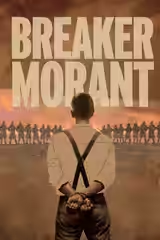
  4. Breaker Morant (1980) · not reviewed yetAustralian soldiers face military judgement in a drama with sharper political teeth.

  5. The Life and Death of Colonel Blimp (1943, Fi1m 91)Friendship and military service examined across decades, with affection and awkward questions.

Free account

Know what to watch tonight

Two lists that know where things are streaming, collections you can share, your own score beside ours, and Discover that remembers what you have seen.

  • Want to see, sorted by what is streaming now
  • Seen, with your score out of ten
  • No adverts, ever