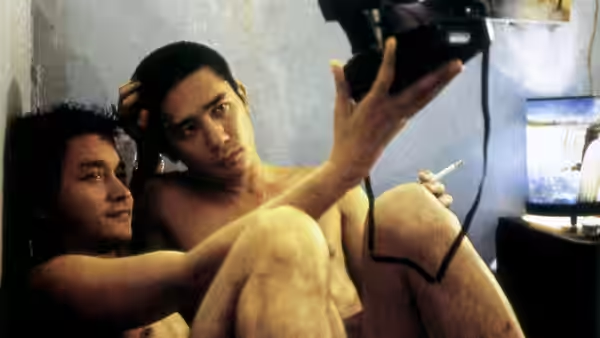
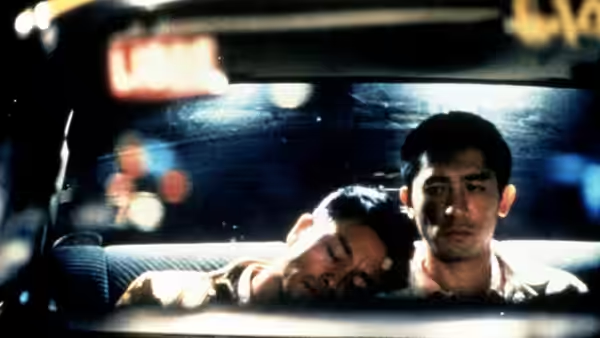
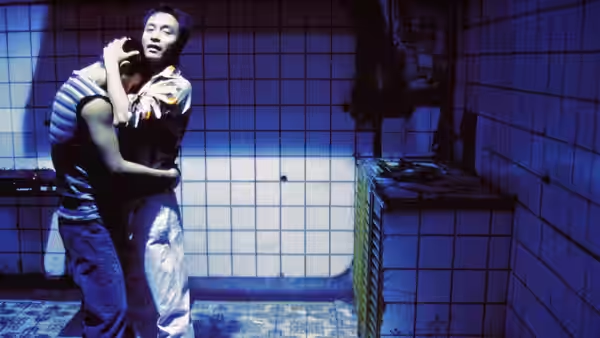
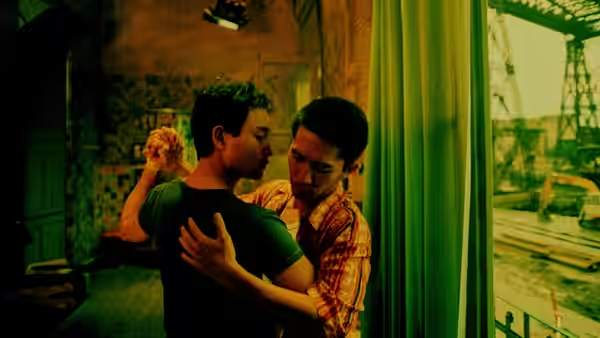
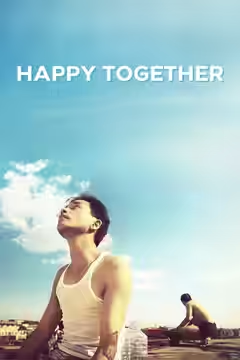
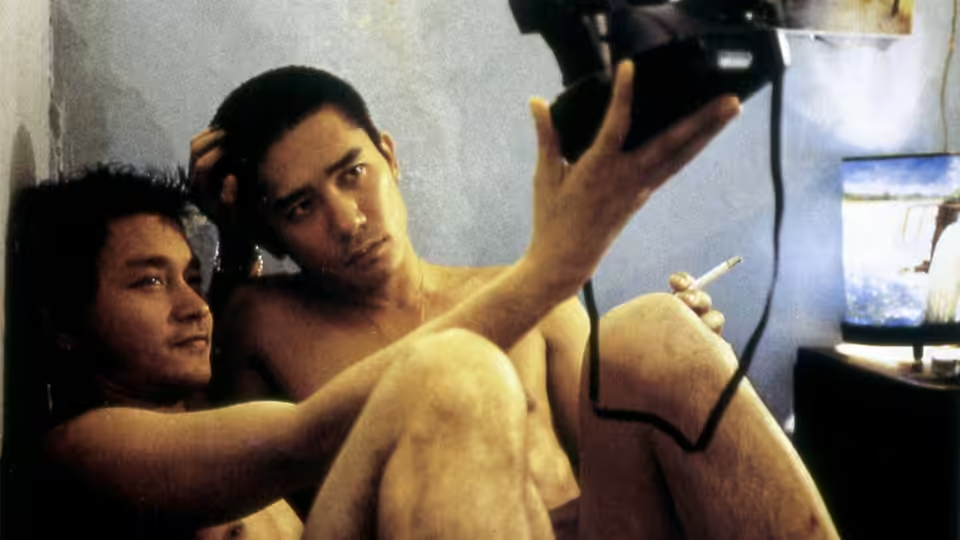
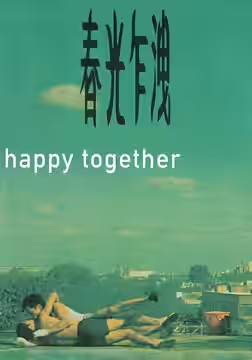
Two shirtless men sit on the floor holding a video camera
Film review

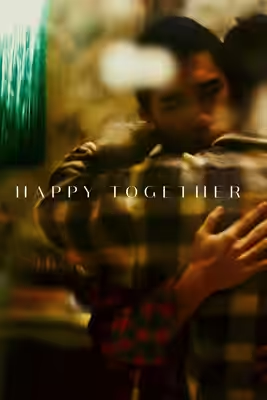
Happy Together

1997 · Directed by Wong Kar-Wai · 1h 36m · MPA NR

In a sentenceChanging continents is an expensive way to discover the problem is still your boyfriend

Ho Po-wing (Leslie Cheung) and Lai Yiu-fai (Tony Leung Chiu-wai) are lovers from Hong Kong who arrive in Argentina with their relationship already in trouble. In Buenos Aires, being far from home offers no simple way to change how they live together. Each man has to reckon with wanting the same person who also makes him unhappy. Written and directed by Wong Kar-Wai, the film follows a relationship caught between the wish to begin again and the difficulty of leaving.

Plays from YouTube when you press play; nothing loads from them until then.

Fi1m review

Wong Kar-Wai makes a painful, persuasive romance out of two men who keep trying again. Leslie Cheung and Tony Leung Chiu-wai give the relationship weight, even when the fractured storytelling begins to repeat itself.

Wong Kar-Wai’s Happy Together is a painful, persuasive romance, worth seeing for two performances that make a failing relationship difficult to dismiss. Ho Po-wing and Lai Yiu-fai leave Hong Kong for Argentina, but their troubles come with them. Wong is interested in why people try again when experience has given them ample reason to stop. His fractured storytelling sometimes repeats what we already understand, but he takes the men’s attachment seriously without making either of them easy company.

Leslie Cheung makes Ho’s appeal survive behaviour that could easily exhaust our sympathy, while Tony Leung Chiu-wai gives Lai’s unhappiness a convincing weariness. Neither performance turns the other man into a simple obstacle to happiness. We were moved by the attachment the actors convey even when the men cannot live comfortably together.

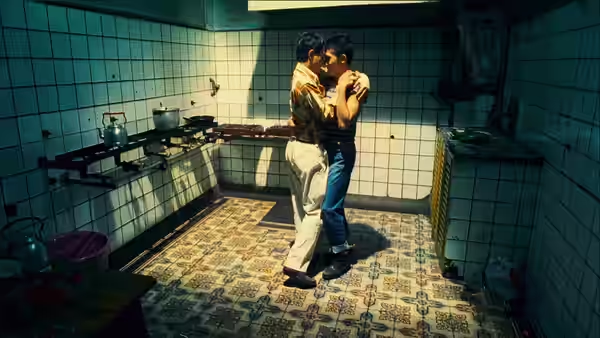
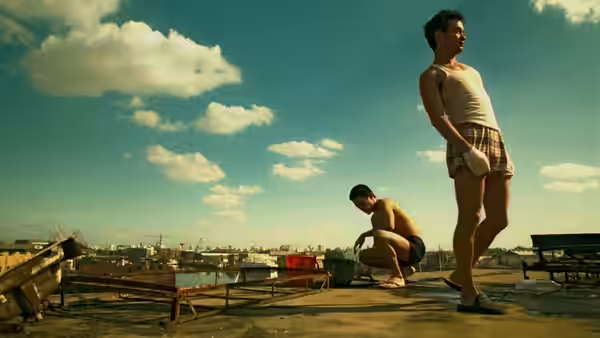
Christopher Doyle’s handheld photography gives their life in Buenos Aires a restlessness that suits them, while the rich colour keeps the film from becoming merely punishing. Doyle photographs them romantically even when their behaviour offers little encouragement. That is a risky choice: beautiful pictures can make staying miserable seem more appealing than it ought to be. Here the performances are uncomfortable enough to stop us simply admiring the view.

William Chang Suk-Ping’s production design helps Buenos Aires feel like a place to live unhappily, rather than a destination chosen to improve the pictures. He also edits with Wong Ming-Lam, and their broken-up telling suits a couple unable to settle their difficulties. The cutting asks us to reconsider a relationship we might otherwise have judged in the opening stretch. At its most effective, it makes another attempt feel plausible without pretending the previous damage has gone.

Danny Chung Ting-Yat’s music contributes to the film’s romantic feeling, though this is hardly the department in need of assistance. The more persistent problem is Wong’s writing, which sometimes brings the lovers back to familiar emotional ground without giving us enough new understanding. We begin waiting for the relationship to become clearer while the film offers another variation on its unhappiness. At 96 minutes it is not long, but several passages still feel like repetitions, and the unsettled editing cannot always disguise that.

Yet Wong avoids a more serious trap of troubled romances: treating the lovers’ suffering as proof that they must belong together. There is tenderness here, but it does not make their behaviour harmless. The men are allowed to be unreasonable, needy and particular, without being made to explain gay relationships in general. That freedom gives the performances more room than a tidier, more instructive script would have allowed.

The performances are the reason to stay when the repetitions begin to chafe. Cheung and Leung keep the men interesting without demanding that we take sides in every fresh difficulty. We would save it for an evening when we were already getting along.

Critical consensus AI synthesised

67
Positive
7
Mixed
0
Negative
2

Most critics like it, and the praise clusters on how it looks. Christopher Doyle’s photography of Buenos Aires draws admiration nearly everywhere, as does Wong Kar-wai’s loose, fragmented way of cutting, which several reviews say matches the couple’s on-again, off-again pattern. Tony Leung’s lead performance is singled out, and more than one critic finds the film wiser and more heartfelt than Wong’s earlier Hong Kong work, with the quieter, non-sexual friendship at its heart named as the emotional centre.

The spread is wide. Two of the nine reviews are plainly negative, and for related reasons: Empire calls it style over substance, with the imagery carrying viewers through erratic plotting and little emotional weight, and The Guardian finds the endless quarrels and the selfish central pair hard to sit with. Even some admirers concede the film is sour on love and claustrophobic. The argument is whether the beauty earns the misery.

The AV Club
9 June 2010 · A- · Scott Tobias
90

The film argues for the essentiality of doomed relationships through its on-again/off-again gay lovers in Buenos Aires. Wong's improvisational style and lush imagery from Christopher Doyle create a wistful, wise tone despite the co-dependency and heartache.

Read the full review →
Time Out
7 January 2015 · TR
85*

Wong Kar-Wai and cameraman Chris Doyle have crafted their most lyrical film. The romance between two gay men from Hong Kong ends soon after they arrive in Argentina, crystallising the anxieties and hopes of Hong Kong people on the eve of the return to China.

Read the full review →
Slant Magazine
4 June 2010 · Eric Henderson
80*

Wong's 1997 film is a mass of contradictions, mostly sour on love but filmed with romanticism; it is a vibrant, colorful gay classic about two men joined and repelled by intimacy and repulsion.

Read the full review →
The New York Times
10 October 1997 · festival review · Stephen Holden
75*

The critic describes the film as a more coherent and heartfelt work than Wong's earlier fantastical Hong Kong films. He singles out the poignant, nonsexual friendship that becomes the emotional center, capturing youth's restless spirit with piercing sadness.

Read the full review →
Little White Lies
16 July 2017 · David Pountain
70*

The film is a deeply affecting portrait of a failing relationship between two men whose on-again, off-again dynamic in Argentina becomes a volatile, claustrophobic addiction marked by fighting and emotional wreckage. Wong's restless, fragmented style underscores the couple's destructive patterns while hinting at personal renewal for the one who learns to let go.

Read the full review →
The Independent
23 January 2009
70*

Describes the film as Wong's most left-field offering among three masterpieces in a DVD collection, focusing on an expatriate gay couple from Hong Kong living in Buenos Aires.

Read the full review →

Straight answers AI written, from our review

Is Happy Together worth watching?
Happy Together is worth watching for anyone who can sit with a painful romance about two men who keep trying again, and we scored it 86. Leslie Cheung and Tony Leung Chiu-wai make the failing relationship hard to dismiss, though Wong Kar-Wai's fractured storytelling repeats itself in places. Save it for an evening when you are already getting along.
How long is Happy Together, and what is it rated?
Happy Together runs 1h 36m and is rated NR by the MPA in the US. It is a drama and romance film.
Where can I watch Happy Together in the US?
Happy Together is streaming on HBO Max, Hulu, The Roku Channel and Amazon Prime Video in the US, and it is also available to rent from Amazon Prime Video from $2.99. It leaves HBO Max on 30 September. Availability is checked daily; the links above go straight to each service.
How does Happy Together compare to Weekend?
Happy Together is the more restless and colourful of the two films, following a couple from Hong Kong falling apart in Buenos Aires, where Andrew Haigh's Weekend stays small and plain over a single Nottingham weekend of talk. We hold Weekend the more even piece, with fewer repetitions, while Wong Kar-Wai's film offers stronger pictures and two performances that carry it through its slack passages.
Is Happy Together based on a true story or a book?
Happy Together is based on a novel by Manuel Puig, not on a true story. Wong Kar-Wai, who wrote and directed the film, treats the material as his own, and our review found nothing that requires the book to be read first. The lovers' story stands on its own as a piece of cinema, and knowing the source is not needed to follow it.
What should I watch after Happy Together?
After Happy Together, try Weekend (2011, Fi1m 86): For another gay romance attentive to what people struggle to say. Then Ali: Fear Eats the Soul (1974, Fi1m 88): A couple’s private tenderness meets the daily pressure of other people’s judgement; and Brief Encounter (1945, Fi1m 90): Desire, restraint and the painful work of carrying on with ordinary life.

Cast

If you liked this, try…

  1. Weekend (2011, Fi1m 86)For another gay romance attentive to what people struggle to say.

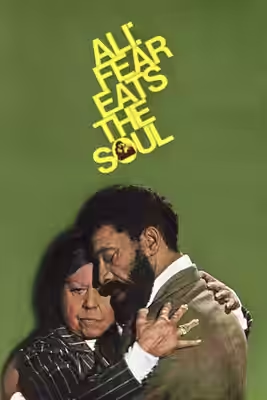
  2. Ali: Fear Eats the Soul (1974, Fi1m 88)A couple’s private tenderness meets the daily pressure of other people’s judgement.

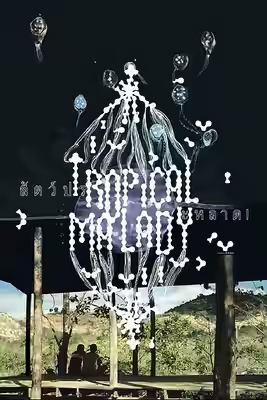
  3. Tropical Malady (2004) · not reviewed yetFor a gay romance willing to abandon familiar ways of telling stories.

  4. Brief Encounter (1945, Fi1m 90)Desire, restraint and the painful work of carrying on with ordinary life.

  5. Cold War (2018, Fi1m 85)Another restless couple discovers that changing countries cannot settle their difficulties.

Free account

Know what to watch tonight

Two lists that know where things are streaming, collections you can share, your own score beside ours, and Discover that remembers what you have seen.

  • Want to see, sorted by what is streaming now
  • Seen, with your score out of ten
  • No adverts, ever